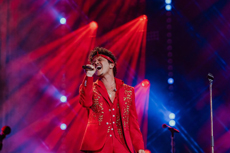
Elation Proteus Delivers Versatility and Audience Impact on Bruno Mars' The Romantic Tour For Bruno Mars' first full headlining tour in nearly a decade, lighting and co-production designer Whitney Hoversten built a new lighting design around versatility, movement, and audience engagement. Supporting the overall design are 142 Elation Proteus Hybrid Max moving heads, whose multifunctional capabilities help create the show's varied visual looks and bring the artist's dynamic show out to the fans on The Romantic Tour. The tour launched in Las Vegas in April 2026 and marks his first full-scale headlining stadium outing, with international dates scheduled well into 2027. "My position with Bruno has grown very organically over the years," Hoversten says. "Bruno is somebody who is so particular, so hands-on, and constantly changing things, so I like to stay involved in every show. I enjoy the collaboration, and I still enjoy being out on the road." "We really started from scratch," he explains about the new design. "This was an opportunity to take ideas that had been working in the past and improve upon them, develop new ideas, and give ourselves the best opportunity to create." The result is a 30-song show that moves between soulful ballads and high-energy performance numbers, balancing intimate theatrical moments with the scale and spectacle of a stadium production. The set is highly mobile, with ten rotating truss pillars, four additional rotators flanking the stage, circular pods and a video screen, and a large upstage video wall continually reshaping the performance space. With so much movement and variety, flexibility was a priority in Hoversten's fixture choices. Hoversten has relied on Elation's IP-rated Proteus fixtures since Mars began performing more outdoor stadium shows and weather protection became a critical consideration. For this show, Proteus Hybrid Max, an IP66-rated beam, spot, and wash fixture, offered the versatility he was looking for. "We've got a ton of audience lighting on delay towers and a pretty good amount of lighting in the wings," he says. "It was really about finding equipment that was as versatile as possible and could be the Swiss Army knife. I don't think there's a better description of the Hybrid Max than that." The fixture's range of effects allows Hoversten and the programming team to move between tight beams, gobo projections, animation effects, prism effects, and broader wash looks. Its continuous pan rotation adds another dimension, creating distinctive movement in selected songs. The fixture can also function as a wash, expanding its usefulness across the production. Of the 142 Proteus Hybrid Max fixtures, 80 are positioned on four audience delay towers, with 20 fixtures per tower. The remaining units are integrated into the stage wings, positioned above and below the IMAG screens that flank the performance area, extending the visual scale of the stage. The delay-tower fixtures play an important role throughout the show for what Hoversten describes as "club lighting" -- a deliberate extension of the stage experience into the stadium, where light and movement help audiences feel connected to the performance even when they are far from the artist. "One of the hardest things about performing or designing for a stadium is creating intimacy and making the person in the back feel connected with the artist," he says. "Using those fixtures on the delay towers helps bring that immersive experience out to the audience, so people can feel part of the party even though they're hundreds of feet away. There are some intentional looks happening out there. It's an important role and one that Bruno definitely cares about." Mars is intensely involved in the development of the show, working closely with Hoversten and lighting programmers Brian Jenkins and Eric Marchwinski to refine looks and ensure each moment reflects the artist's vision. During the creative process, Mars spent up to 14 hours a day with the lighting team, working through cues, testing ideas, and making adjustments until the results felt right. Hoversten notes that Mars has developed a strong lighting vocabulary over the years and can clearly articulate the colors, effects, and visual qualities he wants. The process is highly collaborative, with ideas coming from the artist, designer, and programmers alike. "Brian and Eric have really played a big role in developing looks and finding ways to use the rig's capabilities," Hoversten says. "They have done such an amazing job taking all these fixtures that I've chosen and really making them dance." Hoversten also works closely with production manager Joel Forman, who he says has been central to the show's success. "None of it works without Joel. He has a great balance of letting the art be the art and managing the practical demands of a large-scale touring production." Whitney says that the final design is very close to his initial version, something that is satisfying for him and one that reflects the strong collaboration Forman brings to the production. Lighting equipment for the tour is supplied by Fuse Technical Group, a longtime collaborator with the Bruno Mars production. Following earlier North American and European legs this year, The Romantic Tour will head to Mexico City in December before continuing to Japan, Australia, New Zealand, and other destinations across Asia in 2027. 
|