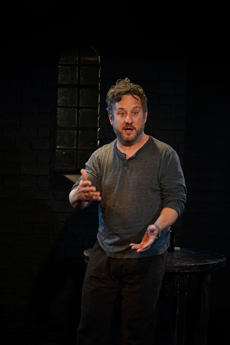
Theatre in Review: The Good Thief (Irish Repertory Theatre) Seeing The Good Thief the other day, I was oddly reminded of Fintan O'Toole's magnificent book of modern Irish history, a tumultuous account of political corruption and social progress: We Are Not Ourselves. Indeed, nobody involved in this enterprise is interested in what they've done before, preferring instead to head off to artistic parts unknown. It makes for a fascinating, if sometimes uneven, experience. Cognitive dissonance rears its head in the first few passages of Conor McPherson's solo play, narrated by a self-described "paid thug," who works for a tough guy named Joe Murray. "I scared people for him," he says. "Set fire to places. Shot people. As warnings." Well, it's a living, if an awkward one, since the narrator's girlfriend, Greta, has decamped to Murray's bed. Then again, as he admits, "Power attracts women. Also, I had been beating her up, and I knew it was wrong, but I'm not the issue here, so let's leave it. Let's not. She annoyed me." A real sweetheart, not? Anyway, he is sent off to put the fear of God in Mitchell, an associate of Murray's whose warehouses, ostensibly for food storage, are packed with "dodgy gear from some of the bigger robberies in the city. Antiques and that." (Mitchell, who pays Murray protection money, wants out of the game altogether; Murray is not amused.) But on arrival, our paid thug finds a hostage situation already in progress; gunplay follows, people are killed, and soon the narrator is on the run with Mrs. Mitchell and her daughter, wondering if he was set up or wandered into somebody else's trap. At this point, given the script's violence and black humor, I idly wondered if Martin McDonagh had submitted it under a pseudonym, or if McPherson had been hired to pen a treatment for film director Guy Ritchie. Compared to plays like Dublin Carol, Port Authority, and The Seafarer, all poignant studies of loneliness and alcoholism, The Good Thief seems to occupy a separate, bullet-sprayed universe. Even odder, this brutal, boozing, foul-mouthed character is played by Christopher Fitzgerald, best known for his gallery of musical theatre oddballs and sprites named Boq, Igor, Og, and Ogie. On the face of it, a less plausible meeting of playwright, star, and material is hard to imagine. I won't pretend that The Good Thief is a totally satisfying experience. The early passages are packed with suspense, but they also seem to set up a violent revenge comedy in which McPherson ultimately has no interest. Indeed, just as one girds for a battle royal, the playwright's sensibility exerts itself, and the play barrels toward a desolate finale, leaving plenty of plot danglers. (Among other things, Greta, the woman who got away, turns out to be both the protagonist's betrayer and his salvation.) This feeling of uncertainty extends to Fitzgerald, who sometimes seems to be feeling his way through a script inhabited by such depraved underworld types. But if you're willing to give some grace to the playwright and star, The Good Thief arrives at a powerfully melancholy conclusion. For all the narrative's gaudy appurtenances -- including plenty of smack talk, unfaithful women, bursts of violence, and oceans of booze -- consider the play's title, an allusion to one of the criminals crucified next to Christ. Instead of a gang war, we are witness to one man's personal via dolorosa, a bleaching of his soul, as McPherson would put it, which leaves him profoundly emptied and quite possibly transformed. Justin Waldman's production is alert to the script's hairpin turns, and neither her nor Fitzgerald tries to soft-peddle the character's less attractive characteristics. Quibbles aside, Fitzgerald, his face a punching bag wreathed in five o'clock shadow, is shockingly good at evoking his normally coiled fury; there's also something strangely touching about the thoughtful, hollowed-out figure he eventually becomes. The action unfolds on a tiny set, precisely designed by Wilson Chin, featuring a raised deck and an arched, grated window. (But for the drink in Fitzgerald's hand, one might swear the play takes place in a confessional.) Jen Leno's lighting adds touches of chiaroscuro. Jess Goldstein dresses Fitzgerald in appropriately seedy fashion. Drew Levy's sound design ranges from plangent piano chords to a sweeping rainstorm. The Good Thief, presented in association with Two River Theater in Red Bank, New Jersey, is in many ways an ideal piece for the Irish Rep's studio space, which gives artists space to stretch themselves a little. It's not perfect, but neither is it easy to forget. It traffics in pulp fiction for reasons of its own, exploiting them to prove that something profound can happen in even the shallowest tough guy's soul. --David Barbour 
|