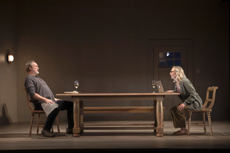
Theatre in Review: ANON (MCC Theater)In ANON, Anne Washburn turns her attention to the dueling ideologies tearing this country apart, a subject tailor-made for drama yet one that leaves her licked. It's the tale of two households in a San Antonia suburb. First up is Jeanie, a "digital warrior" who all but lives online, filling the ether with a steady stream of slop about vaccines, the Communist threat, government-controlled weather, the gay agenda, and many other imagined nefarious phenomena. Such activities have led to strained relations with her husband, Michael, and daughter Delia; the latter has issued a fatwa against being represented in any of Jeanie's posts. Apologetically, Jeanie notes that "so many people are mad at me" that she "can't always keep track of it all." No alarm bells there... A pleasant-seeming housewife in person, Jeanie's unhinged TikTok rants conjure a dark vision world trampled by corporations and Jewish-controlled media, who, she swears, have "shadowlined" her, driving away her one-hundred-thousand followers because she won't stop telling the truth. (The script implies, without quite saying so, that those eyeballs departed once she started spinning fevered conspiracy theories.) Her followers currently number about three hundred, but she is determined to soldier on. Indeed, she insists, a great day is coming: "I've been seeing a lot of comments and posts from folks who are really starting to freak out about the timeline: Why is Fauci still free, when will Hillary Clinton face judgment, where are the arrests, are there medbeds, and The Storm, The Storm, when is The Storm already?? And I just want to say, folks: Trust the Plan." Across the street are newcomers Adam and Will, recently residents of Philadelphia, and a little rattled to find themselves in a deep-red state. Adam hangs a Pride flag on the porch, unaware it is tantamount to waving a red rag at Jeanie, who is soon fulminating about it online: "I lived in Commiefornia a long time, and I had gay friends; they can be good people; folks, they can; but this is a family-oriented neighborhood in Texas; this is not the place for this level of indoctrination." You can practically feel the coming clash, but Washburn has little interest in pursuing such dramatics. In the sluggish first act, the two households might as well exist in different plays. When she isn't sitting in her car, raving into her phone, Jeanie is an everyday hausfrau, fending off Michael's gentle objections to her "work" and jousting with the vibrant, free-thinking Delia. (Tellingly, she barely, if ever, acknowledges her neighbors when offline.) Until they sink, implausibly, into paranoia -- purchasing a handgun and barricading themselves in the bedroom at night -- Adam and Will are pleasant, if dramatically inconsequential, company. Adam is amusingly nonplussed that, during their face-to-face meeting, Jeanie, a true connect-the-dots gal, zeroed in on his last name ("Epstein"), looking for a relationship to you-know-who. Will has a bracingly honest speech, admitting his distaste for overt Pride symbols, noting, "I don't take joy in the desperate colorfulness. I don't like the costume, the little kidness." Still, he has no intention of backing down under pressure, and he decrees the flag will stay hoisted. But such provocations never pay off. The play's already shaky structure further deconstructs after the intermission, beginning with a lengthy video sequence depicting Jeanie's admittedly amusing fantasy appearance on a podcast with "Vice President General Raymond Flynn," and continuing with increasingly frequent allusions to, of all things, King Lear. The latter motif is introduced via Delia's school assignment, which involves a presentation defining the term "soliloquy," and it exists mostly to facilitate Jeanie's full-Lear freakout, wandering her neighbors' yards in bad weather, carrying on like a raving prophet of doom. Once or twice, ANON looks like it might generate some sizzle, especially when Delia confronts Jeanie for posting an easily discredited allegation regarding the Holocaust, but most of the time it is too scattered to have any impact. Washburn struggles to get inside Jeanie's head, insinuating that she feels ignored (but why?), but her embrace of MAGA conspiracy theories is presented largely without comment. (Compare this with Degenerates, at Playwrights Horizons, in which Else Went deftly catalogs the many disappointments that drive her incel characters' antisocial rage.) I suppose Washburn is aiming for a banality-of-evil theme, hence Jeanie's bland demeanor, but that's no reason for the character to remain so frustratingly opaque. Still, based on her work here, plus her recent turns as a strung-out cult refugee in Cold War Choir Practice and an embattled church lady in The Saviors, Crystal Finn emerges as one of our most formidable leading ladies. She is especially gripping seen close-up, in video sequences, spewing hyperventilated nonsense, her eyes shining with the glow of the true believer; she even makes something gripping out of the unmotivated Lear-on-the-heath climax. ANON would be much poorer without her knack for reshaping her character's cartoonish dimensions, giving her a more human profile. The rest of Anne Kauffman's cast is equally classy. Jeff Biehl and Jeremy Shamos share a plausible spouse-like intimacy as Adam and Will. Shamos does especially well in a speech in which Will weighs the costs of taking action against Jeanie. Andrew Garman brings quiet, sharply pointed humor as Michael, who is getting fed up with Jeanie's obsessions. ("What's that term that definition for what do they call it when you keep doing the same thing, over and over with the same results...?" he asks her gently.) Izabel Mar, a new face, matches her veteran co-stars with considerable sparkle and wit, whether dismissing the "libtards" on the school paper, trying vainly to get Jeanie to appreciate the wonders of science, or stepping out of the action to let us know that intermission is nigh. If Kauffman's handling of the actors is typically supple, she has green-lighted an unusually dreary and sometimes wrongheaded production design. The set, by the collective dots, is a barely furnished dining room that stands in for both households. It's a comment on Adam and Will's unmoved-in status and Jeanie's neglect of housework, but it's boring to look at. Cha See uses low sidelighting and rectangular geometric washes to generate a sinister atmosphere that often seems unwarranted. Jared Mezzocchi's projections might have added telling visual details; instead, he frames the playing area in overwhelmingly large updates on each scene's day and hour, hinting at big dramatic events that never happen. (The video podcast with Raymond Flynn is unnervingly on target, however, and as noted, Jeanie's videos are more revealing of her character than anything else in the production.) Brenda Abbandandolo's costumes feel right for the characters, and Tei Blow's sound design includes "God Bless the USA," "Choosin' Texas," and some impressive storm effects. Yes, the storm that Jeanie has been anticipating so keenly happens, but, like most of ANON, it's a bit of a fizzle. It's great that Washburn, who has shown an apocalyptic turn of mind in works like Mr. Burns, a Post-Electric Play and The Burning Cauldron of Fiery Fire, wants to tackle the scary extremes of contemporary society. But one wishes she had a better idea of what to do with it. --David Barbour 
|