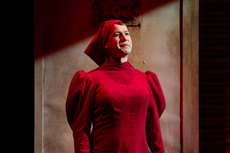
Theatre in Review: Mother Russia (Signature Theatre Company)When an actor, especially one as gifted as David Turner, is cast as an entire country, you can expect that scenes will be stolen. As, yes, the title character in Mother Russia, who represents the spirit of a nation, Turner enters, dressed entirely in red down to his neat little babushka, and seizes the stage with a vigor that calls to mind Napoleon taking Moscow. "I have been let down by so many shitty men," she begins, the voice of bitter experience. Living through several centuries of loss and betrayal, Mother Russia has seen it all. She mourns the failure of "Gorby," who didn't take her advice and lost control of glasnost. Ivan the Terrible, she concedes, "was not so bad." Then there's her professional nemesis, Olga Knipper, whom she insists, nabbed all the best roles at the Moscow Art Theatre by taking up permanent residence on Anton Chekhov's casting couch. Playwright Lauren Yee gives her a tour-de-force laundry list, ticking off the many rulers (and their wars) who devastated the country; it's a rant that devolves into a world salad of cultural signifiers ranging from Trotsky to Pussy Riot, detailing Russia's long downward slope. But don't worry about her: With her insolent vocal tone and permanently sour expression, Mother Russia is the ultimate survivor. Next to her, Mother Courage is a piker. You could probably write an entire play around this character, and maybe that's what Yee should have done. Instead, she came up with an often-silly buddy comedy set during the Boris Yeltsin era, when capitalism ran amok, and gang activity reduced the country's already low life expectancy. The sad sack pair driving the action consists of Dmitri, a "former aspiring KGB agent," turned shady dealer in various goods and services, and Evgeny, whose career as a Soviet apparatchik ended when "Marxist economics turned out to be largely incorrect. They don't need anyone to decide prices anymore. Now they just "let the market decide." Evgeny has been hired by his gangster father, who runs a protection racket, but his heart isn't in shaking down local merchants. The young men are a study in temperamental contrasts. "Now we're twenty-five, it's 1992, and we're free! The world is ours!" exults Dmitri. "The yawning abyss of tomorrow is before us," Evgeny notes. As it happens, Dmitri has a little surveillance business on the side, so Evgeny is engaged to keep tabs on Katya M, a former pop star, who defected to the US after her father, a noted radical poet, was taken away. Alas, life in America was a bust; her star waned next to the likes of Whitney Houston, and she even lost her political currency: "No one wanted to hear me sing 'Tear down that wall' once there was no wall left to tear," she laments. Evgeny, smitten with Katya and assuming Dmitri's name, uses his government contacts to discover who betrayed her father. Then he embroils her in a plot to steal a stash of government vouchers in a brazen redistribution-of-wealth plan. Never mind that the vouchers are possessed by Evgeny's corrupt dad, who plans to use them to corner the Russian oil industry. On film, Billy Wilder could have made a tantalizing farce out of such seamy materials. Onstage, Christopher Durang might have managed it. Yee's approach is surprisingly lightweight; sometimes Mother Russia is very funny, especially when Turner is holding forth. Other tasty bits include the disillusioning moment when Evgeny discovers that Katya's latest artistic project is recording the Russian version of the Folgers Coffee jingle ("The best part of waking up...") But the gags seem to come from second-rate comedy sketches: Dmitri wooing his girlfriend with gifts of live weasel; various sophomoric double entendres around the world "blow;" Dmitri's halting attempts at mastering American slang. ("I gotta put a rang on that fanger.") A bit, noting McDonald's entry into the Russian market, with Dmitri and Evgeny all but worshipping a Filet-o-Fish sandwich before mutually devouring it, goes way, way over the top. (This is probably the show's bellwether; if you find it hilarious, you'll probably enjoy Mother Russia.) In too many cases, the humor's sharp edges have been sanded off in the name of easy laughs. This is satire with false teeth. Teddy Bergman's direction doubles down on the script's flimsiest gags, including a spoof ballet sequence, but his cast is certainly enthusiastic. Steven Boyer infuses Dmitri with so much boyish energy that one wishes he had better material. Adam Chanler-Berat, with his mastery of hangdog looks, makes Evgeny into a most appealing loser. As Katya, Rebecca Naomi Jones is armed with some fabulously lethal looks, but the role is little more than a plot device, even in pained confrontations with her alarmingly pragmatic mother (also played by Turner). Like the play, the production has its droll aspects: The scenic collective dots has supplied a concrete structure with a roll-down facade, spanned on top by a Folgers advertisement; it has the right dilapidated look and the interior is amusingly packed with the inventory of Dmitri's business, including such tempting Western treats as Heinz ketchup, Coca-Cola, and Nestle's Quik. Stacey Derosier's lighting adds to the rundown atmosphere with stark fluorescent looks. Sophia Choi's costumes feature knockoffs of terrible eighties-era American sportswear, a choice that feels exactly right. Mikhail Fiksel's sound design wittily packs in the Ukrainian pop singer Ivan Dorn, Swan Lake and "Lara's Theme," from the film Dr. Zhivago, as well as machine guns, in the violent climax. That last scene illustrates the gulf between the play's dark subject matter and its often-giggly sense of humor. The latter is a feature of Yee's work, having, in earlier plays, taken a soft-pedal approach to Mao's Cultural Revolution and the horrors of the Khmer Rouge. She has a nose for rich material, but she never exploits it with total effectiveness; she especially struggles to find the right comic tone. Thank God for Mother Russia, however. "There is not enough of me in this play," she notes. She's right about that. --David Barbour 
|