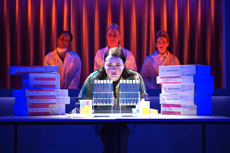
Theatre in Review: Predictor (AMT Theater) A strong point of view is a good thing, to be sure, but a playwright should leave room for the audience to discover something. If fed too many cues, alienation will set in. This is the main problem with Predictor, which only intermittently succeeds in telling a fascinating story. Its heroine is Margaret Crane ("Meg" in Jennifer Blackmer's script), who invented the home pregnancy test in 1967; that this perfectly viable product didn't get to market until ten years later is the heart of Blackmer's tale. Well-told, it could make a honey of a play. Among other things, Meg's story has that undeniable stranger-than-fiction quality. Young and just out of school, she is hired by the pharmaceutical company Organon to oversee a line of aloe-based cosmetics; a graphic designer, she knows little about such things but proves adept at finding ways to cut costs while maintaining product integrity. (Not that her skills earn her much credit in a corporate environment populated entirely by extras from Mad Men, most of whom think women belong in the typing pool.) Meg comes across a pregnancy test manufactured by Organon, an unwieldy thing marketed strictly to medical professionals. (One of the play's revelations is how onerous and lengthy the process was in decades past; Blackmer suggests that, rather than bothering with it, and killing another rabbit, many doctors made diagnoses entirely based on fairly reliable external signs like nausea, headache, and fatigue. God help you if only you had the flu.) Meg, whose mind runs toward efficiency, figures out a quick and simple way for a woman to test her urine, learning, in fifteen minutes or less, if a baby is on the way. Her solution is elegant, cheap, and easy to reproduce. You might think that such a development would be greeted with hosannas. You would be wrong. First, nobody at Organon believes that a woman in her twenties is capable of inventing such a sophisticated device. Then there are worries about pushback from doctors, who don't want one of their essential functions put into patients' hands. And everyone fears that the test, which Meg names "Predictor," will be seen as promoting premarital sex and abortion. The latter is legal, Meg points out. Yes, but only in a handful of states, she is told. Can't she stick to her nice, uncontroversial aloe cosmetics? It's a potentially gripping account of sexism, corporate bureaucracy, and plain, old-fashioned cowardice, but Blackmer takes a blatantly satiric approach, with many scenes playing like sketch comedy. We keep returning to a fantasy game show called Who Made That?, featuring Meg as a reluctant contestant. This sort of entertainment has been spoofed to death, and nothing is gained by having an unctuous announcer assert that the show "is brought to you by Sanitized Tape Worms." Another facetious TV spoof features a proposed marketing approach in which the offending word "pregnancy" is replaced by "enceinte" (Yes, it was used fifteen years earlier on I Love Lucy. But Predictor never seems to recognize that, offstage, all sorts of social revolutions are brewing, including a little thing led by Betty Friedan and Gloria Steinem.) Meg's youth is depicted as a sitcom titled Daddy Knows Everything. And I haven't yet gotten to the wacky commercials for sanitary napkins and tampons, the latter of which, "are not recommended for women of virtue." (The actors pronounced the word "tam-PONN," in hushed tones, like they're exotic, black-market goods.) Or the press conference discussing the questions, "Can women be trusted with their own pregnancy tests?" The issues are real, their treatment frivolous and lacking in wit. This vein of humor was tapped out five decades ago, and Blackmer doesn't bring anything fresh to it. Indeed, the overall attitude of amused condescension is counterproductive. Some sequences work, including a presentation of rival products, one of which comes in a "lovely reusable box, which doubles as a keepsake." But with every new twist of the plot, one is told what to think. Because the show's creators, working in 2025, can't quite believe that, sixty years earlier, people didn't think exactly like them, they have a hell of a time putting over Meg's story. At least, Alex Keegan's production showcases Caitlin Kinnunen, formerly Broadway's queen of The Prom, who captures Meg's initial lack of confidence, cannily keeping track of her growing determination with each new setback. If Jack, Meg's ad-agency nemesis, is a one-note chauvinist, Eric Tabach has fun with a speech in which, melting down spectacularly, he accuses Meg of being overemotional. Much more appealing is Nick Piacente as Ira, Meg's main defender in the boardroom and a possible soulmate. John Leonard Thompson is an asset as Meg's supervisor and sometime ally. Jes Washington has a nice bit as a young woman in a spot of trouble, desperate to get her hands on the as-yet-unsold Predictor. Other benefits include Cat Raynor's hospital-green conference room set, framed in a series of translucent panels backed by color-changing units that lighting designer Zach Blane skillfully uses to alter the mood onstage. Alicia Austin's costumes have a solid period feel, especially the loud plaid sport coats sported by many game show hosts of the era. Uptown Works' sound design includes applause, audience gasps, ticking clocks, typewriters, and Muzak-style melodies designed to soothe jangled nerves. It doesn't help that Meg's story ends in a kind of stalemate. Still, it's good to know that she is still with us and was eventually recognized for her accomplishment. One wonders what she has been doing since. A fun fact you won't learn at the AMT Theater: Meg was a juror in the Martha Stewart trial. Surely there's a play in that. --David Barbour 
|