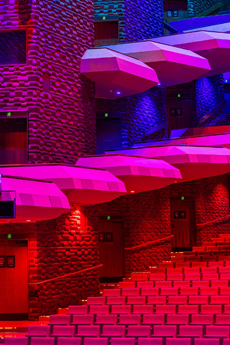
Adelaide Festival Centre Features New Anolis Installation Two venues at Australia's Adelaide Festival Centre multi-purpose arts center complex now feature house lighting installations, consisting of more than 200 fixtures from Anolis' highly flexible Ambiane range. The installation has reportedly transformed the audience experience in the 2,000-capacity Festival Theatre and the Dunstan Playhouse, which seats 590; it has also resulted in an approximately 50% reduction in power. Adelaide Festival Centre's head of technical and production, Nathan Luscombe, says the original 1973 house lighting installation, consisting primarily of PAR 56s and other downlights, all incandescent, needed replacing after 50 years of service. "Professional high-grade dimming was high on our list of requirements for the new lighting," Luscombe says. "We tested numerous products that snapped off or on during the last 5-10% of the dimming curve, and with a system life expectancy of around ten years, it was vital to get details like this correct with any new installation." Luscombe pushed for Adelaide Festival Centre's environmental/architectural lighting to be DMX or DMX-over-Ethernet-controlled, learning from the experience at Her Majesty's Theatre, another venue in Adelaide also run by the AFC, that this would be technically beneficial. He also wanted color-changing lights for their imaginative possibilities, including custom lighting for showcases, special occasions and immersive moments. Together with the DMX/Ethernet control options, it would also allow incoming productions to integrate the house lighting into their own systems. Eddie Galak, from Anolis's Australian distributor, Jands, designed the lighting. He notes that Luscombe and his team were impressed with the options of angles and lensing available with Anolis products, as well as the quality and vibrance of the light output. Another requirement was that the signature white walk-in lighting should be 3,200K, a bit cooler than standard. However, the desire was to replicate the previous look. The individual fixture breakdown includes 12 Ambiane XP56 Recessed units with 45-degree lenses; 56 Ambiane XP56 recessed luminaires -- 36 with 45 degrees and 20 with 60-degree lenses RGBW (3200K); 93 Ambiane MP111s, 75 recessed with 80-degree lenses and 18 recessed with 60-degree lenses, all RGBW (3,200K) and with custom RAL trim; and 36 Ambiane MP111 surface-mount 60-degree lensed RGBWs (also 3,200K). A combination of these luminaires is used across both venues. In Festival Theatre, they are installed in multiple positions -- in the ceiling, under the bridges, recessed on the balconies, under the boxes and in up / down configurations grazing along the walls. The scalloped side column covers were replaced as part of the general room refurbishment and interior upgrade, and the new Anolis fixtures are mounted in the up and down positions complete with bespoke covers for heritage compliance. In Dunstan Playhouse, the new fixtures are installed on five different levels and under the balcony, also retrofitted into the previous lighting spaces. Luscombe says the house lights can now be run at around 70% intensity to produce the requisite 150/160 white lux levels (200/220 for colors), leaving plenty of headroom and removing the need for staff to work at heights to replace broken bulbs. Galak, who has specified and designed Anolis lighting solutions for several leading auditoriums in Australia, says another advantage of the Anolis Ambiane range is that the power supplies are available locally if needed. Lighting control for these two venues is through ETC Paradigm. The lights are on their own networks but can be hooked into a production lighting network/console extremely easily. The new lighting installation was completed by ITE, having previously worked with Galak at Llewellyn Hall in Canberra. Luscombe says the firm's work was excellent -- helpful and knowledgeable, understanding how we function and having worked with Anolis before." 
|