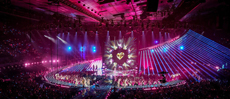
Robe Lights Eurovision Final in Vienna Robe lighting was a technical partner for the 2026 Eurovision Song Contest, held last weekend at the Wiener Stadthalle in Vienna, Austria. The 70th edition of the world's best-known international pop extravaganza was organized by the European Broadcasting Union (EBU), together with the host broadcaster, which this year was Austria's Osterreichischer Rundfunk (ORF). A production lighting design, featuring nearly 550 Robe luminaires, was created by Tim Routledge and his team, working on their third ESC event, and collaborating closely with set, video, and production designer Florian Wieder. Prominent on the lighting rig were 190 of Robe's just-launched GigaPointe laser-source multifunctional moving light, 98 WTF! IP-rated LED strobe-wash-blinder fixtures, and 25 Robe HolyPATT vintage-style LED "scenic" luminaires. Routledge's general lighting rig included 182 Robe SVB1 multisource LED wash beams, which he also used on last year's event in Basel, Switzerland. He also chose 64 Robe iFORTES and iFORTE LTXs, fitted with the HCF (high color fidelity) engines for all the key lighting and specials on the main stage and in the green room, this year located in the arena opposite the stage. A large, sweeping passerelle feature with video floor started at ground level, stage left, and looped around the middle of the room in front of the stage, curving upwards at stage right in a giant rollercoaster-style loop, snaking around to finish high up in the roof, stage left. A portrait-oriented central LED screen curved from above into the stage floor below and extended into a central thrust that traversed the arena floor, splitting into a double staircase at the other side, ascending to the green room. The central screen was framed on either side by seven columns of moving lights, bringing a cinematic feel to the entire space and giving clear sightlines from all around the arena. Routledge's team included his associate lighting designers, Morgan Evans and James Scott; moving light programmers Alex Mildenhall and Martin Higgins; key light programmer Marc Nicholson; overnight programmers Olly Martin and Manfred Nikitzer; follow spot caller Louisa Smurthwaite; and playback video producer Sam Lisher and team. His gaffer and crew chief was Keith Duncan. All lighting equipment for the event was supplied by rental company Neg Earth out of the UK, with whom Routledges also worked on last year's event and on his first ESC as lighting designer in Liverpool in 2023. The GigaPointe launched at ISE in February; it is powered by a 350W white phosphor laser source engine, In Vienna, they were positioned all around the space and were prominent along the top of the front sections of the passerelle and underslung below its elevated sections upstage. They were rigged around the central semi-circular trusses in the roof, right at the heart of the rig, and were on all four sides of the main stage at floor level. GigaPointes were used extensively throughout all performances, especially for gobo and beam looks, with the SpectraBeam effect utilized to create effects, most notably for San Marino, which comprised rainbow-focused looks. They also featured prominently in the "stage-ready" sequence that cut in just after the postcard video sequence -- in the upcoming country's flag colors -- for each contestant's intro, accompanied by an orchestral stinger. Evans comments, "They were excellent workhorses; we all loved them. Nice and bright, they worked hard, reliably, and extremely well throughout the event in these multiple different positions. A highly versatile multi-use product." Routledge adds, "GigaPointes provided us with an aesthetic backbone," revealing that has specified them for Take That's summer 2026 Circus stadium tour. The 98 WTF!s functioned as the main strobe units, deployed on the roof trusses running the length of the room, either side, and on the large central "crown" semi-circular trusses -- the innermost ring -- above the stage, alternating with GigaPointes and other fixtures. "I love their directionality, and we fully used all the sets of LED chips and the zoning for various effects," Routledge says, adding that he and his team appreciated being able to pan and tilt the fixtures, which, together with the zoom, proved handy at times for reducing glare into the cameras. Conversely, they utilized zoom and LED zoning to create cool color-temperature effects; the units along the audience trusses helped with washing the arena. Eurovision is one of the most-watched/highest-rated live music broadcast shows in the world, and key lighting is paramount. The iFORTE's high CRI and quality of light have made the unit a white light go-to for Routledge since its launch. Here, they were rigged strategically in all the main key lighting positions for the main stage and green room. iFORTES were positioned all around the arena on the periphery trusses and the two outer ring trusses above the stage -- their power was ideal for the long throws from these positions. Twelve were paired with different remote follow systems, including three Robe RoboSpots. "They are one of the best -- I absolutely would not be without iFORTES on a show like this," Routledge says. The SVB1 fixtures were spread out around three of the four large circular roof trusses and helped emphasize the structure. They created the base looks for a host of versatile twinkling kinetic effects, which could be bold or subtle depending on the artist. The green room design stood out this year for its retro, cosy, classic Viennese-style coffee house concept, and the 25 HolyPATTS provided a highly stylised spherical tungsten glow, visible in every wide and medium-wide shot. The Vienna Radio Symphony Orchestra, positioned in the Green Room for the grand finale, was also dressed with HolyPATTS behind their risers. One of the major technical and creative challenges this year was the decision by ORF to shoot the shows, which also included two televised semi-finals to narrow down the field to the 25 finalists, on large chip film cameras, an ESC event first. For Rouledge and the lighting department, this meant that more depth, definition, and detail were visible, so they had considerably more latitude to play with lighting adjustments and fine-tuning, affecting how elements like strobes and pyro would look on camera. "It enabled us to add more texture and finesse to every performance," he says. Linked to this, the LiveEdit camera software used to cut the broadcast mix could also pre-select different color LUTs that would run on all cameras for the different artists, so more stylised lighting looks and treatments could be developed and optimized. Eurovision 2026 was presented by Victoria Swarovski and Michael Ostrowski, plus green room host Emily Busvine, and the winner was Bulgaria, whose DARA gave a stonking performance of her catchy Balkans banger "Bangaranga", heading off Israel's Noam Bettan, who came second with "Michelle" and Romania's third-placed Alexandra Capitanescu with her song, "Choke Me." 
|