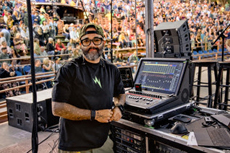
Michael Franti & Spearhead Tour Powered by Waves LV1 Classic and eMo IEM Immersive In-Ears When Michael Franti & Spearhead closed their summer run at Red Rocks Amphitheatre, touring engineer Lucas Pinzon was in monitor world -- building an individually spatialized immersive in-ear mix for every musician on a Waves LV1 Classic with Waves eMo IEM, the SoundGrid-based immersive IEM mixing engine that lives inside the same LV1 environment the console already runs on. Sixty-four inputs sat under Pinzón's hands on an LV1 Classic running in its full 80-stereo-channel configuration -- the headroom he wanted for a band of veterans who know exactly what they need to hear, on a tour where rehearsal time was thinner than anyone planned. "In real life, we don't listen in 2D. We listen in 3D," Pinzon says. "So this gets us closer to that reality, and reduces some of the mental stress that can happen with traditional in-ear mixes." Pinzon is a Latin-music veteran - 26+ years in audio, with front-of-house and monitor credits across artists including Maluma, Becky G, and many of the genre's biggest live productions. He is also a long-standing early adopter, an engineer who picks up a new console, channel strip, or processing tool the moment it ships and pushes on it until he finds what it can really do. He had used immersive monitor mixing once before -- on a Becky G run -- and came away convinced of the principle. So when his friend Karl Milan, mixing front-of-house for the Franti tour, called and asked if he was in for a short summer run that ended at Red Rocks, Pinzon said yes before he knew much else about the gig. "Red Rocks? Let's go," he laughs. "Wait -- who did you say the artist was?" What he found, once he got there, was a band that had been playing together for decades. Still, there were challenges. The band hadn't played together in six months, the crew was meeting for the first time, and a show was added before rehearsals were supposed to begin. Pinzon's first night with Michael Franti & Spearhead was effectively cold: no proper soundcheck, no calm setup, no familiarity with the band's specific tastes. What he did have were presets, a clear mixing logic, and the LV1 Classic's full 80-channel session waiting for inputs. "I was able to load my presets and build each mix with a clear logic, prioritizing the most important elements for every musician," he recalls. "The reaction was excellent. Everyone really loved the result -- and at that point, most of them didn't even know they were listening to an immersive mix." That, for Pinzon, is the test. When the tool is doing its job, it disappears. Pinzon's approach to eMo IEM is the part he most often passes on to colleagues. "I think in layers of importance," he explains. "Not only by volume, tone, EQ, compression, FX, or left-right panning -- but also by position. Where something lives in the space becomes another mixing decision." A practical example: for Carl Young, the bassist, Pinzon placed the most critical elements up front -- bass, sub Moog, kick, hi-hat, and his own vocal. A second layer sat slightly farther back -- beats, synths, backing vocals from the tracks, click, count-offs, and keys. The sides and the rest of the stereo field carried a third layer of information. "That gave me a huge amount of space in the stereo field, a lot more dynamic range, and it made the mix feel like it could breathe," he says. "Immersive audio makes more sense to the brain. "The goal is not to make it sound 'processed' or impressive for the sake of it," Pinzon continues. "The goal is to make it feel open, clear, musical, and natural." Most of the band received fixed eMo IEM mixes -- built once, then trusted across the set. Michael Franti's mix was different. "He openly told me that after more than forty years of career, he feels he has some high-frequency hearing loss, which makes monitoring more challenging," Pinzon says. "At the same time, Michael knows his music perfectly. Every chord, every cue, every section, every bar -- it's all in his head. So he wants to hear everything, but he wants to hear everything in the right context for each song." So Pinzon treated Franti's in-ear mix less like a static monitor mix and more like an evolving front-of-house mix -- shaped song by song, with vocal and guitar always anchored up front, but with the rest of the band rebalanced around the demands of each cue. That dynamic, immersive image is what travels with Franti when he leaves the stage -- climbing into the audience at Red Rocks, performing in front of the PA, or playing stripped-down sections from the middle of the crowd. "When you're away from the stage, especially in front of the PA or surrounded by the crowd, the in-ear mix has to give you a sense of orientation and confidence," Pinzon says. "eMo IEM helped keep the musical picture open and connected, instead of everything collapsing into the center of his head. "One of the reasons I enjoy mixing on LV1 so much is the space, detail, and resolution of the audio. Everything feels very real. And in monitors, that's usually the main thing I'm looking for." The other reason is workflow. Pinzon runs the console in the 80-stereo-channel configuration, even when he isn't using every channel, because the system feels like it has more room to work in. With 64 inputs and eMo IEM enabled across the production, the integration felt native -- not a layer bolted on top of the console. "The main difference I feel with LV1 is that everything is possible," Pinzon says. "Any routing, position, send, or workflow idea can be built. That makes the process very fast and flexible -- extremely important when you need to create a solid starting point before rehearsals, or solve last-minute situations quickly. eMo IEM became another creative and practical tool inside the workflow." Pinzon's advice on eMo IEM is the same advice he'd give about any new tool -- but with a particular emphasis on what makes immersive different. "Take a virtual playback, play with it as much as you can, and really get familiar with the tool," he says. "Explore it. Push it. Understand what it can do and where the limits are. Then, once you find the logic of immersive audio, apply it to your mixes in the most basic and natural way possible." The trap, he says, is treating immersive mixing as an effect -- moving elements around just because the system can move them. The win is using it the way the brain already listens. "If I'm a musician standing in the middle of the stage, with musicians in front of me, behind me, and around me, then I want the mix to give me that same 3D feeling," Pinzon explains. "When you use it that way, it becomes more than a feature. It becomes a very musical and very human tool. And when a musician experiences that in a good way, it's honestly very satisfying." Pinzon heads into the fall on the Gigi Perez tour -- this time at front-of-house, with his colleague Andres Gomez handling monitors and bringing eMo IEM into that camp as well. The lesson he carries forward from the Franti run is less about a feature set than a posture. "It's not about moving things around just because you can," he says. "It's about giving the musicians space, clarity, and a mix that feels closer to the way we naturally hear. When the band is comfortable and confident in their ears, they perform better. And when they perform better, the whole show feels better out front, too." 
|