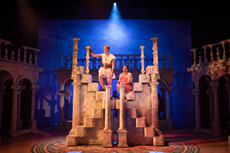
White Light Powers Thespians As the production company Mischief continues to expand beyond its best-known Goes Wrong titles - The Play That Goes Wrong continues its lengthy New York run --Thespians represents an important new chapter. Written by Jonathan Sayer and Ed Zanders, and co-produced by Mercury Theatre Colchester, HOME Manchester, and JPT Productions, the touring product takes audiences to Ancient Greece for a deadly prayer contest, told with Mischief's unmistakable comic energy. For lighting designer David Howe, the challenge was to create a world that felt ambitious, theatrical, and full of color, while remaining practical enough to tour. "Lighting Thespians was about creating a bright, warm, slightly ridiculous world where the audience immediately understood the tone and wanted to be part of it," says Howe. "The design was never about making something grand for the sake of it. It was about supporting the storytelling, the music, and the comedy." Director Robyn Grant and designer Jasmine Swan established a visual language that deliberately avoided museum-piece Ancient Greece. Instead, the production's world sits somewhere between myth, musical theatre, and cartoon. "Robyn and Jasmine had a very clear visual world in mind," Howe explains. "It was a playful blend of Disney's Hercules and The Flintstones, which immediately gave me permission to think in bold, graphic terms. I wanted the color palette to move from warm Mediterranean daylight, sunbaked stone, terracotta, and sunset tones into bolder musical and comic moments. The Grecian sky backdrop became central to that world, helping the lighting shift between daylight, sunset, and theatrical night, with strong backlight at times to accentuate the show's bigger 'hero' moments, while keeping everything inside its bright, cartoon Ancient Greece." A key part of Howe's approach was not to "light the jokes," but to make sure the world of the show remained clear, inviting, and alive. As a musical, the production moves constantly across the set, so the lighting had to create spaces, environments, and tone for each scene and song, while keeping the performers connected to the audience. With the budget unable to sustain followspots, precision became essential: the design relies on a detailed network of specials, meaning reliable equipment and accurate positioning were vital from the outset. "I don't think comedy wants to be lit with a wink," he says. "The lighting still has to believe in the world. If the audience feels comfortable, included, and able to read the actors' faces clearly, then the comedy has the best chance of landing. The danger is over-signaling the joke." The budget was tight, so every fixture had to work hard. Howe worked with White Light to create a practical touring rig that could still deliver scale, color, and flexibility from venue to venue. "This was not a case of throwing a large rig at the problem," says Howe. "We had to be disciplined about what toured, what could be picked up from each venue, and which units genuinely earned their place. Every moving light had to do several jobs: specials, texture, scenery, sky, and the occasional piece of theatrical mischief." The production uses a very small touring package alongside house equipment, including the Mercury Theatre Colchester's upgraded LED rig and existing tungsten fixtures. This allowed the design to feel richer than the equipment list might suggest, while remaining adaptable. "White Light's role was not just supplying the fixtures," Howe continues. "They understood the brief and supported what we were trying to achieve. The useful conversations were around making the package robust enough to tour, simple enough to re-create quickly, and flexible enough to cope with different venues. On a show like this, the success is often in the unglamorous details -- data, power, cable runs, sensible fixture choices, and knowing what can be achieved repeatedly without making each Monday feel like starting again." Howe drew on the following fixtures: ETC ColorSource Profiles, High End Systems SolaFrame Profiles, and Chroma-Q Color Force battens, each chosen for their ability to serve multiple purposes across the production. They played a vital role in shaping the visual identity of the show, from detailed key lighting to color, texture, and the atmospheric illumination of the Greek sky backdrop. The design was programmed by Freddy Sherwood, who has also taken on the role of Touring Production Electrician and weekly re-lighter, giving the production valuable continuity as it moves between venues. "Freddy understands the tone of the piece -the pace, the musicality, the comedy, and the warmth," says Howe. "That makes a real difference when the show has to be re-created quickly each week. It is not just about putting lights in roughly the right places; it is about protecting the spirit of the design." Reflecting on the project, Howe says: "I'm proud that the show feels bigger than the equipment list. That's always the exciting challenge - when the audience hopefully see a bright, confident, theatrical world, rather than the compromises that made it necessary." 
|