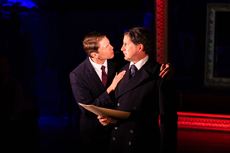
Robe T11s Hold Court in Christchurch Lighting designer Rachel Marlow, of Auckland-based visual design studio Filament Eleven 11, used Robe T11 Profiles and T11 Fresnels at The Court Theatre in Christchurch, New Zealand, where she lit two new productions in succession at the end of 2025 and the start of 2026. The new venue is part of Christchurch's earthquake recovery plan -- enacted after the devastating 2011 event -- which, rebuilt, opened in May 2025, complete with the Robe T11s on the house lighting rig. The opening shows were The King's Speech, about how King George VI found his voice, based on the Academy Award-winning film, which ran for four weeks, and was followed by the musical 9 to 5: The Musical, featuring the music and lyrics of Dolly Parton. The theatre had just taken delivery of 50 new Robe T11 fixtures, 30 T11 Profiles and 20 T11 Fresnels, which are now part of the house lighting rig. As the two productions required completely different aesthetic approaches and treatments, the T11s proved their versatility, the company says. With The King's Speech, most of the T11 work involved illuminating Daniel Williams' set design, which included a large, gilded picture frame centrepiece that broke up the stage into different areas and required very precise lighting. The fixtures' accurate shuttering was very helpful here. Marlow was "impressed" with the fixtures' punch, especially in relation to their compact size. She also used T11s for set wall washes, with two fixtures creating slats of light along the back in a very collaborative workflow with Williams that brought the various environments and locations to life onstage. For 9 to 5: The Musical, the T11 Profiles were utilised upstage as high side and top lights to highlight a spectacular honeycomb-shaped set designed by Mark McEntyre and Rosie Gilmore. Color transformations accompanied the character arcs, and Marlow developed key color looks for each person that evolved and became richer and more symbolic as the action unfolded. She also took inspiration from the costumes for some of this treatment and crafted plenty of set illumination and eye candy that complemented the overall thematic looks. She also used one of the T11 Profiles as a followspot, manually operated diligently by Geoff Nunn from the house lighting crew, using a "Number 8 Wire" system. This is a technical term originating from the 4.0mm diameter galvanized steel wire used for New Zealand sheep farm fencing; it has become cultural-speak for Kiwi ingenuity, versatility, and handling of improvisational moments. It was the first time that Marlow had used T11s to light any of her productions, and she thinks that "the color mixing and the clarity of the output are great," and it certainly won't be the last time she includes them in her designs. Bradley Gledhill was the lighting co-programmer, an Auckland-based lighting, set, and video designer and co-founder of Filament Eleven 11, together with Marlow. Giles Tanner, the theatre's chief LX, knew that LED units would play a major role in the new rig. "From the outset, Robe's T11 series fixtures seemed to be strong contenders,' he says. "They easily aced the noise and dimming tests. We liked their 'design ethos,' and they appeared to be designed with theatre applications in mind," he says. He cites the units: five-to-50 degree zoom, gobo image quality, edge quality (of the profile version), and color rendering. "The light output and build quality were also impressive," he adds. Other features included the TE replaceable light engine and power supply units, which, combined with the high build quality, were judged to be great for longevity; additional options (like rotating gobo, iris etc.), according to Tanner "offered a huge degree of flexibility going forward, and little touches -- shutter lock and variable inbuilt frost -- all added to a very compelling package." 
|