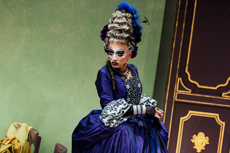
Theatre in Review: Tartuffe (New York Theatre Workshop) Venues create expectations: If New York Theatre Workshop is going to stage a Moliere classic, one quite reasonably expects something wild, even shocking. This is, after all, the company that presented Ivo van Hove's version of This Misanthrope, a reportedly odorous spectacle that had the actors rolling around in garbage. Not one that is yearning for that, exactly, but still, what most surprises about this Tartuffe is how much it minds its manners. At a time when religious nationalism is running riot, the sitting president (a walking advertisement for the seven deadly sins) brazenly hijacks the language of faith, and the outgoing Cardinal Archbishop has the temerity to frame the late Charlie Kirk as a latter-day St. Paul, the time is more than right for this supremely mordant spoof of religious hypocrites. Sarah Benson's production says...well, what, exactly? One's expectations are raised by Lucas Hanth's new version of the text, a purposely rougher-than-usual version, with dialogue along the lines of "You were the biggest slut in the whole entire city," "Christ, you're a fucking pain in the ass," and "That's it, we're fucked," in addition to such pop culture references as "cone of silence." But it's often a half-hearted effort. The dialogue is written in the script as prose, but it has the cadence of verse and is filled with near-miss rhymes such as "does/putz," "lived/did," and "respective/perspective." If you revere the immaculate couplets of the extraordinary Moliere translator Richard Wilbur, prepare yourself for some clinkers. Even the production's seeming innovations are homages to the past. The elegant set, by the design collective known as dots, features overtones of the tennis court, with characters toting rackets and balls during the stylized scene changes choreographed by Raja Feather Kelly. It's a sly nod to the fact that Moliere's plays were sometimes presented in such venues. The casting of the garishly made-up drag performer Bianca Del Rio in an otherwise straightforward company is not the head-scratcher it first appears; the role of Mme. Pernelle, Del Rio's character, was created in 1664 by Louis Bejart performing en travesti. Otherwise, it's a fairly routine Tartuffe, absent a strong sense of purpose, but with a largely appealing cast delivering scattered laughs. I am not the first to note that, dressed by Enver Chakartash and bewigged by Robert Pickens, Matthew Broderick in the title role is a dead ringer for the Quaker Oats man. (I kept waiting for him to say, "Nothing is better for thee than me.") But the actor's typical approach, which involves standing outside his character, is ideal for playing a flagrant con man. Indeed, he looks like he can't quite believe he is getting away with his grift. "Thinking of others before myself is my greatest vice," he admits in a flawless imitation of candor. "You know who else had this problem? ... Jesus Christ." He also has a pearly bit when he effortlessly slides across a table in pursuit of a lust object. But even when the action turns farcical, he sticks to his low-energy approach. Equally muted is David Cross as Orgon, the well-off idiot taken in by Tartuffe's saintly posturing. Orgon is a perfect fathead, given to rages and quick judgments, ready to traffic his daughter and disown his son if it keeps him in Tartuffe's good graces. Yet Cross is almost unnervingly calm, untouched by extreme emotion; it doesn't suit the role. Otherwise, everyone bustles about the stage, taking care of business as best they can. Emily Davis' Mariane, the daughter Orgon wants to marry off to Tartuffe, has a nice line in low-level panic, especially when psychologically fencing with Ikechukwu Ufomadu as her sweet, but gambling-addicted, lover. Amber Gray is solid as Elmire, Orgon's wife, grimly determined to turn the tables on the handsy Tartuffe. Ryan J. Haddad's jarringly contemporary vocal manner, fine for his solo performance pieces, makes him a slightly odd choice for Orgon's son Damis. (The role isn't terribly interesting, however.) Francis Jue has technique to spare as Elmire's appalled brother, forever trying to talk sense into Orgon. Lisa Kron, absent-mindedly dusting the air while eavesdropping on her employers, amuses as the all-knowing maid Dorine. (I treasure her advice, offered to a horrified Mariane, suggesting that she simply keep postponing her nuptials to Tartuffe until either he or Orgon dies, whichever comes first.) Somebody ought to tell Del Rio that actors who aren't the focus of a scene shouldn't fidget so much; they look like they're trying to steal some attention. Benson's handling of the play's most famous scene is indicative of the production's so-so nature. Elmire, trying to get rid of Tartuffe for once and for all, aims to entrap him in a seductive embrace, with Orgon hidden under a table, a witness to his cuckolding. The scene is typically staged using a cloth to hide Orgon; the joke is that he doesn't react to Tartuffe's most provocative moves, even as Elmire frantically deploys their prearranged distress signal, a knock on the tabletop. It is only when Tartuffe insults Orgon that he emerges, ready for revenge. At NYTW, the scene is staged without a table covering, forcing Gray and Broderick into all sorts of awkward blocking and leaving Cross oddly exposed. I always thought this scene was sure-fire; apparently not. The production looks great, however. Chakartash's costumes wittily capture the outrageous female silhouettes and male peacockery of the period -- love the ribbons decorating Haddad's costumes -- and Pickens' wig designs are impressively vertical creations. (Chakartash cleverly arranges it so Ufomadu can play no fewer than three characters in the climactic scene.) Stacey Derosier's lighting is pristine and, even though I don't know why a theatre as small as NYTW requires audio reinforcement, at least Peter Mills Weiss' contribution is discreet; he also does nicely by Heather Christian's music, which is heard the finale. The production's most original idea arrives at the end, with the strong suggestion that everyone in the play is corrupt to a greater or lesser degree, and morality is a matter of taking the most powerful side. That's not really what Moliere had in mind, I think, and it isn't articulated strongly enough to stick; if you're going to overturn the work of one of history's greatest playwrights, you'll have to put more effort into it. Tartuffe is a pretty ferocious play, but, given the modest, moderately entertaining doings on East 4th Street, you'd never know it. --David Barbour 
|