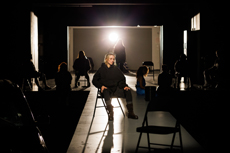
Theatre in Review: Elektra (Theatre for a New Audience) In this new production of Sophocles' tragedy, Tina Benko finally gets her revenge. If we're being precise, the vengeance belongs to the title character she plays with such fearsome authority, but she, too, must be savoring a feeling of vindication. Long one of New York's most skilled and enjoyable ensemble players -- her name in a cast list instantly increases one's desire to see a show -- she has reliably flown under the radar. (Among other things, in the Off-Broadway production of Eureka Day, she originated the role later played on Broadway by Jessica Hecht.) Her longtime followers, like me, have long wondered when she would indisputably stake a claim to center stage. At Theatre for a New Audience, you can find her in the middle of the long, narrow platform designed by Jim Findlay, Josh Higgason, and Amy C. Rubin. Dressed in a T-shirt, denim shorts, and boots; hollow-eyed, her hair askew; looking like a refugee or the victim of a natural disaster, she is a monumental witness to atrocity, namely the murder of her father, Agamemnon, by her mother. Clytemnestra and Clytemnestra's lover, Aegisthus. Forced to say either name, Elektra spits on the ground, as if her revulsion toward them has a physical and moral component. The Chorus, taking note of Elektra's fury, worries about "so much evil stored up in that cold dark soul of yours," adding, "You breed enemies everywhere you touch." Taking a cue from Anne Carson's blunt-force translation, which gives the text a contemporary flavor without sacrificing its essential dignity, Benko's Elektra is a figure of pure will, commanding the universe to satisfy her bloodlust. Forced to live with murderers, she draws power from such unthinkable circumstances, regarding her enemies without a shred of pity. "Behold the man who pleasures my mother," she says, adding, "Should I call that thing 'mother' that lies at his side? God! Her nerve astounds me. She lives with that polluted object, fearing no fury." Warned by the chorus that she is headed toward a point of no return, she unblinkingly confronts her fate: "I see the trap closing. I know what I am. But while life is in me, I will not stop this violence." Facing Clytemnestra, who calls out her lack of shame, Elektra denounces her mother's depravity in no uncertain terms, noting that the stain reaches across generations: "I am the shape you made me. Filth teaches filth." I've always appreciated the understatement and sly wit that Benko brought to so many characters; here, she makes plain the world-shattering nature of Elektra's thirst for justice, her implacable need for the blood sacrifice of a woman she probably once loved deeply. Benko has an equally forceful antagonist in Sally Wingert's Clytemnestra, made murderously indignant by Agamemnon's killing of Elektra's sister, Iphigenia. Equally cold, furious at having her motives questioned, and hardened by the chain of violence that has sundered her family, she surrenders not an inch when faced with her daughter's ugly indictments. Also standing out is Rebecca Naomi Jones' sullen, vacillating Chrysothemis, who, unlike Elektra, counsels living to fight another day: "But now is not the right time. In rough waters, lower the sail, is my theory. Why pretend to be doing, unless I can do some real harm?" Yes, but does she mean it? Witnessing the unfolding of tragedy is a chorus of six singers, their words set to music by Ted Hearne that catches the rhythm of Carson's words, adding a note of stylization that further heightens the drama. I'm less sold on Cricket Brown's Orestes, whose first appearance, pretending to be a messenger announcing Orestes' death, is delivered in a rushing monotone that becomes difficult to take in. But whether this is entirely about her performance or another issue is difficult to say. About the time of Orestes' entrance, Scott Zielinski's lighting design becomes an active irritant. It gets in one's eyes, spilling into orchestra-level side seating. (The audience wraps around the stage on three sides.) It gets in one's eyes later, when a single source located upstage blasts the space. It gets in one's eyes yet again, from a triple battery of units on the fascias of the orchestra, mezzanine, and balcony. (Oddly, it rarely illuminates Jones' face.) Besides pity and terror, this production delivers considerable eyestrain; the only time free from it is when the stage is briefly lit from below. Then you can't see much of anything. Zielinski, no rogue agent, is surely carrying out the orders of Daniel Fish, the director. Fish has noted in interviews that he doesn't feel the need to make cosset audiences. Fair enough; we're talking about Elektra, after all. But there's no point to inflicting physical pain, making it hard to concentrate. Looking around and seeing the number of patrons shielding their faces, I wondered why Fish would undermine his best efforts. I resisted the urge to put on my sunglasses; maybe I should have given in. Also, when the moment of violence arrives, the staging is surprisingly mild, signified by unceremoniously splashing buckets of blood being splashed onstage. Then Wingert delivers a speech (apparently not in Carson's original text) about the failed execution of Christa Pike in Tennessee. It effectively sums up the cruelty inherent in Pike's situation, but it is crudely inserted and feels oddly irrelevant. The government-sanctioned murder of a convicted criminal may very well be an outrage, but it is one of a different sort, with little relation to the cycle of violence that concerned Sophocles: father killing daughter, wife killing husband, and son killing mother and stepfather. The Oresteia is about individual moral choices, an illusory concept of justice that only leads to more violence. It is not about institutional murder. The set provides a fine staging ground for tragedy, especially the mitter curtain that sweeps the stage before curtain time, bearing the sign "The Gods That Always Fail." (The van parked in the moat next to the stage seems like a waste of time and money given the few minutes it is used, but whatever.) Doey Luthi's costumes are appropriately grungy; one striking touch is the plaid shirts, sprinkled with glitter, for the chorus. Brendan Aanes' sound design preserves an excellent balance between the text's spoken and sung passages. Whatever one thinks about the production's oddities, however, it is Benko's triumph, serving as a notice that despite her busy career, she is a seriously underused talent, ready, willing, and able to take on the most challenging roles. I hope everyone pays attention. --David Barbour 
|