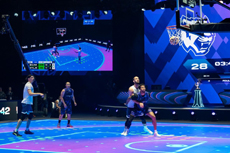
Games of the Future Uses Stage Precision's SP Grid on Large-Scale Project with bright! StudiosGames of the Future offers a mix of physical and digital gaming, known as "phygital sports," across a ten-day-long tournament that is held in a different location every year. For the 2025 edition, which took place in December, Games of the Future headed to the ADNEC Centre in Abu Dhabi, bringing together a mix of real-world and digital disciplines, including Phygital Fighting, Phygital Football, Phygital Basketball, plus VR Games and Drone Racing, among other exciting pursuits. cbright! studios, who specialize in bringing complex event and brand experiences to life through technology, led the integration of a vast network of devices, concepts and creative media for the project. The SP Grid platform from Stage Precision proved to be a trusted foundation on which the team would build a highly scalable and sophisticated experience workflow, the company says. "This was the first time working on Games of the Future, and the project involved two clients: lead agency, Ethara, and the broadcast provider, PLG," explains Leon Herche, project lead at bright! "We were hired to handle everything content-related and to also develop creatives to enhance the overall viewing and game-play experience, from AR concepts to digital worlds for at-home viewers to interact with." From the initial design and build phase, the SP Grid platform was a core component of the technical integration. With an "integrate anything" approach, the platform's central software, Grid Studio, allowed the bright! team to connect any API into the control ecosystem, bringing together dozens of technologies and data streams, from gameplay statistics to media servers, into a single unified control environment. Given the scale of the deployment, the Stage Precision team provided additional support, including on-site assistance to ensure all integrations were running smoothly. The tournament was split across disciplines and into two distinct parts: virtual competition and physical gaming, apart from DoTa 2 and Mobile Legends: Bang Bang (MLBB), which were held entirely online. "Firstly, we used SP Grid for show control of the media playback," continues Herche. "A lot of this was focused on API and data integration with content to display different stats and milestones from the gameplay. In SP Grid, we have data coming in from the games, which is merged, translated and, in turn, triggers Disguise media servers to play relevant content on the screens around the gaming stages." The bright! team had full visibility of the various data streams and their progress within the SP Grid platform, providing a level of overview that is difficult or near impossible to achieve with alternative workflows. Back-up switching is also configured directly in SP Grid, eliminating the need for extra failover protocols or programming. The ability to build custom UIs to display simplified or stylized breakdowns of game stats from within the SP Grid platform was another advantage, allowing for less technical members of the operations team to receive the relevant information they need before authorizing important game-play announcements and the deployment of content scenarios. "We'd be able to show the operators one of the custom UIs we had built in SP to display the data they're interested in to help them make decisions and instruct the production team during these live gameplay moments," explains Herche. "The new extension capabilities in SP Grid meant that even in case there were no existing plug-ins for the integration we needed, our team could code an extension using Python to adapt quickly to changing needs or different hardware. No matter how much planning goes into a production, you're always going to need to adjust things on the fly. The addition of Python-scripting programming in SP Grid just extends the platform's flexibility even further." Aside from the show and media control elements, bright! worked closely with broadcaster PLG to incorporate exciting digital concepts for broadcast audiences. Those watching on streaming platforms such as Twitch or YouTube were able to interact with a virtual universe, created by bright! to represent the tournament and its many disciplines, bringing a world of creative storytelling elements into the broadcast. "We built a city with eight districts to correspond with the different disciplines in Games of the Future," says Herche. "This helped to engage remote viewers, and the broadcasters had the option to use this created universe in different ways between gameplay sequences. We used SP Grid to write a fun data integration where viewers in Twitch could enter a specific command into the Twitch chat to name characters in the content of the virtual districts that was being broadcast." Alongside a virtual universe to explore, broadcast audiences were treated to various augmented reality (AR) elements throughout the tournament, most of which were related to gameplay moments in DoTA and MLBB, such as dramatic explosions and transition sequences. On the other hand, the Laser Tag and Basketball physical games also included AR elements. Using a Kinexon tracking system, each player had health stats displayed over their heads during the Laser Tag and Basketball games broadcast. Data from Kinexon trackers is fed into AVLM+ Sensor Technology workflow in SP Grid, where the data is translated into content that is incorporated into the broadcast streams for viewers to enjoy. As well as displaying player health stats, a floor display on the basketball played LED animations to correspond with player progress across the court. "The toolkit for AR camera calibration is both effective and accurate in SP Grid, cutting down set-up time considerably," confirms Herche. "That's what we find with SP Grid, it just makes complex stuff a lot simpler to handle." Alongside simplicity, bright! find the scalability and repeatability of SP Grid projects to be a real advantage. Once a workflow is built for one stage, the project file can be duplicated and adapted for other stages or projects, and the extensions can be reused on different projects. This brings obvious benefits to productions of this size, but also provides a solid foundation when sharing project files with new team members and departments. "The creative freedom we have on site with SP Grid is second to none," confirms Herche. "The data is clearly displayed, and with the almost limitless opportunities for integration you have in Grid, you can use this data to feed graphics or trigger some kind of AR event, or merge it with information coming from sensors to create something entirely unique. It's the greatest tool we have for flexibility, and Games of the Future was a perfect demonstration of the potential of SP Grid and its features in action." 
|