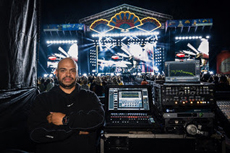
Ryan Castro Tour Powered by Waves LV1 Classic and eMo IEMWhen Ryan Castro's Sende Tour rolled into Atanasio Girardot Stadium in Medellin, Colombia, the audio team didn't just deploy a console. They deployed four Waves LV1 Classics -- one each for front-of-house, monitors, guest monitors, and a live broadcast feed sent to a second site across the city -- with Waves eMo IEM handling the in-ear mixes for Castro, his band, backing vocals, dancers, and playback. The monitor desk ran in the LV1 Classic's full 80-stereo-channel (160-input) configuration, the depth the production needed to absorb the full live input count -- band, dancers, guest performers, RF returns, ambient mics, and comms -- on a single surface. It was the scaled-up version of a system Castro's team usually tours with as a pair (one LV1 Classic at front-of-house, one at monitors), opened out for a hometown stadium night with more guests, more rooms to feed, and more demands on the rig. At the center of that production, behind the front-of-house desk, was Robinson Barrera -- head of audio for the Awoo Team and Ryan Castro's front-of-house engineer since 2021. Barrera has been mixing on the Waves LV1 platform for a decade: he picked up the original modular LV1 when it launched in 2016 during his Karol G era, and moved to the LV1 Classic as soon as the channel-strip surface shipped. "A great Latin urban mix isn't the one with the most level," Barrera says. "The vocal is the center of everything. You build the mix out from there." Barrera came up in Medellin, Colombia, at an audio company that handled most of the international productions coming through the country. He started as a system tech -- designing rigs, tuning PA -- and gravitated to front-of-house from the beginning. Local bands led to international travel. By 2011 he was working with Reykon, and by the end of that year he had stepped behind the desk for Maluma, where he mixed front-of-house for three years. In 2014, he joined Piso 21, working both front-of-house and monitors, and later that same year he started with Karol G. When the LV1 launched in 2016, it found its way into his Karol G rig -- and that's where the platform entered his life. Three years mixing front-of-house and monitors on a single LV1 surface. Two more years on front-of-house. By the end of 2019 he was back on monitors -- a role he held until May 2026 -- but in parallel, in December 2021, he was invited into Castro's crew. He's been on front-of-house for Castro ever since -- first on the original modular LV1 he'd known since his Karol G years, then switching to the LV1 Classic when its channel-strip surface launched. "It's a huge responsibility," Barrera says of the chair. "Being here makes me excited to once again be part of the great singers coming out of Colombia. I know the sound of the urban genre -- that's what it takes to translate what Ryan wants to transmit to the audience every night." Castro's catalog leans on a singular vocal signature and the deep, dynamic low-end the genre demands. Barrera's mix philosophy is built around both. "You want the vocals up front -- not strident, but powerful," he explains. "You want great low-end definition. And the mid-highs can't fatigue your ear when the show runs longer than two hours. Above all, you have to translate what the artist wants, so the audience leaves connected to him." His view of "live" is just as deliberate. "We're in a time when some mixers are dedicated to making the mix sound 100% like the record. That's fine -- but I think audio also tells a story, and it has to feel alive, not just perfect. Most people come to a show to see and hear something different -- otherwise they'd stay home listening to the record." To stay sharp between dates, Barrera turns on the LV1 at home and mixes the show at least four times a week. On a typical Sende date, the PA is built around L/R mains, subs, and front fills, all routed and time-aligned through the matrices of the LV1 Classic. Regardless of which PA brand the venue throws at him, Barrera tunes every system with Waves TRACT. "The various tools the LV1 gives us mean that show after show, we stay consistent and powerful across very different systems," he says. With the LV1 Classic at the center of the chain, Barrera can land in a venue and be show-ready in roughly half an hour. "The consistency and the speed when installing the LV1 Classic means we can do a show with only 20, maybe 30 minutes of setup and line check -- and be confident everything is going to be fine. "Honestly, the system is very reliable. In the last three years we haven't had a single bad experience with it." The standard tour package is two LV1 Classics -- one for front-of-house, one for monitors. For tentpole shows like Castro's hometown date at Atanasio Girardot Stadium in Medellín, the system scales to four, each desk handling a discrete job: *Front-of-House -- the full mix for the audience, on Barrera's desk. *Monitors -- the main artist's IEM mix, the band, dancers, and comms. *Guest Monitors -- a dedicated desk for the night's guest artists and guest band. *Broadcast -- a separate mix for a live broadcast to a second site in the city (Feria de Ganado), streaming, and multi-platform recording. The four consoles are tied together in a star topology, each console backed by a Waves Extreme C-Server alongside its internal server. The architecture is deliberate: every desk can be powered up independently, can run its own processes, and can keep working if any other node fails. Monitor world is built around a single LV1 Classic running in the platform's 80-stereo-channel (160-input) configuration, three Shure AD4Q wireless receivers (12 channels of vocal RF), an ADTQ for stereo IEM transmission, a Directout EXBOX.MD for sequence playback, and a Hear Technologies WSG Bridge for Dante -- the connective tissue that lets the SoundGrid network and the Dante systems share routing cleanly. For Atanasio Girardot, the production added more Shure RF for the guest artists and two DSPro StageGrid 4000 stage boxes -- one in guest monitor world for the guest band's percussion, guitars, bass, and keys, and one at front-of-house carrying comms mixes, comms inputs, and SMPTE distribution to the production. In-ears across the production -- Castro, backing vocals, keys, dancers, and playback -- run through Waves eMo IEM, Waves' SoundGrid-based in-ear monitor mixing engine, which lives inside the same LV1 / SoundGrid environment the consoles already run on and lets the team build personalized in-ear mixes with rich spatial imaging directly within the rig. "It lets us generate great spatiality and great definition of each element in the production," Barrera says. Barrera is quick to credit the engineers around him. "In monitors I'm joined by a great professional but above all a great human being -- Felipe Montoya," he says. Montoya, also out of Medellin, runs RF coordination, network management, monitor mixing, and comms for the entire Ryan Castro team, with a resume that includes Felipe Pelaez, Karol G, and Don Toliver. On the Atanasio Girardot show, guest monitors were handled by David Parra -- "representing the new generation" -- and the broadcast mix sat in the hands of Roberto Almodovar, whom Barrera calls "my great friend, the legend." For Barrera, the case for the LV1 Classic is the case the tour itself makes -- night after night, in different rooms, in different cities, with shows that turn on vocal nuance and low-end punch. "It really is one of the most practical consoles, with the most advantages, to deliver punch and a mix people envy," he says. "This setup gives you speed, flexibility, and character -- your own identity." Asked what he'd tell another front-of-house engineer considering the platform, especially someone working in Latin music, his answer is direct: the workflow gets out of your way, the plugin ecosystem lives inside the console rather than alongside it, and the system has earned three years of unbroken trust on a tour where there's no margin for error. The Send Tour continues across Central America and the United States. In October, Ryan Castro returns to Colombia for a special 360 show at El Campín Stadium in Bogota -- a homecoming Barrera and the Awoo Team are already building toward. 
|