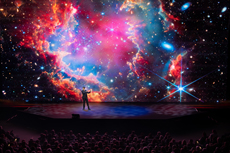
Brompton Tessera Processing Takes Professor Brian Cox's Emergence World Tour in AustraliaBrompton Technology's Tessera SX40 LED processors and Tessera XD data distribution units are powering the visuals on Professor Brian Cox's Emergence World Tour. These live arena shows explore cosmology, quantum mechanics and the origins of life, combining LED screens displaying cosmological data, supercomputer simulations and graphics, and advanced lighting and high-end sound design. Produced by Lateral Event Management, the tour's Australian leg has been delivered by Creative Technology Australia and New Zealand (CT ANZ), which acted as technical and AV systems integrator. The brief for every stop was the same: maximize the screen size within the constraints of the room. At ICC Sydney, CT ANZ deployed a 32-by-15 array of ROE Visual CB5 panels for a 3,328-by-1,560 pixel canvas, with the same CB5 product used in a 30-by-15 panel configuration for Wollongong and Newcastle Entertainment Centre. Brisbane housed the largest screen of the tour, a 36-by-18 panel CB5 build delivering a 3,744-by-1,872 pixel canvas. At Exhibition Park in Canberra, a 28-by-5 array of Uniview Tekken 3.9 panels produced a 3,,584-by-1280 pixel screen, while Melbourne Convention and Exhibition Centre saw a 21-x-9 panel configuration of ROE Visual Vanish 6 Solid panels for a 3,024-by-1,296 pixel canvas. Every screen was driven by the same core processing package: two Tessera SX40 processors, one main and one redundant. These were paired with four Tessera XD 10G data distribution units at most venues, with two in Melbourne. To get the most from each configuration, CT ANZ used range of Tessera's color and image features. Extended Bit Depth added extra steps of brightness to the panels, helping to eliminate banding, while Dark Magic preserved clarity and shadow detail through the show's darker, more immersive sequences. Screens were run at 10-bit color to match the mastering of the show content, and On-Screen Color Adjustment (OSCA) was used at every venue to keep each screen looking uniform and visually seamless, particularly important on the screens with a tighter pixel pitch where viewing distances were closer. Given the show's scale and the demands of a fast-turnaround tour, CT ANZ also relied on Tessera's workflow features to keep every load-in on schedule. The main and redundant SX40 processors were stacked so that color and brightness corrections applied automatically to both, while Frame Store was used to load test patterns during the build and hold a backup graphic in reserve. Live control of brightness, freeze, and a one-second fade to blackout were handed to the touring media server operator, providing direct control of the screen during the show. With elements of the tour filmed and streamed, redundant 12G SDI feeds, one per processor, kept the video signal secure throughout. "Roof load limits were probably the biggest challenge," says Herman Putter, project manager at Creative Technology Australia and New Zealand. "The goal was always the largest possible screen at roughly a 2:1 ratio, and as high-resolution as we could get while still fitting on a UHD raster." Putter also points to the load-in process itself as proof of how the system performs under pressure. Load-in typically began the morning of the show; the screen was built by lunchtime, with a few module swaps in the early afternoon before sound check and rehearsal if required, then straight into the show that night. Being able to identify a panel from the front with a dead LED or a bent louver and point the climbing technician straight to the correct module using the LDM test pattern, made a real difference to how smoothly those turnarounds went. Having crossed Australia, Professor Brian Cox's Emergence World Tour continues through UK arenas this autumn, including a show at The O2 in London on October 23. Touring at this scale, and at this pace, is exactly the environment Tessera was built for," says Sebastian Kanabar, head of sales (APAC) at Brompton Technology. "It's fantastic to see CT ANZ getting this level of image quality and reliability out of the SX40 and XD combination across such different venues in a matter of weeks. We're proud our processing is helping bring Professor Cox's vision of the universe to audiences across Australia." 
|