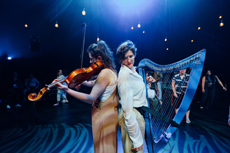
TiMax Tracks 20 Mobile Performers in Paraorchestra's The Nature of Why at Hong Kong's No Limits FestivalThe UK's Paraorchestra brought The Nature of Why to Hong Kong's No Limits Festival in March, as a celebration of unconventional concert touring. Up to 250 audience members shared a 15m circular space with around 20 musicians, singers, and dancers, most almost constantly on the move. To track every performer in real time and give the audience precise directional information, front-of-house engineer Simon Honywill deployed TiMax SoundHub with TiMaxTrackerD4. Founded by conductor Charles Hazelwood in 2011, Paraorchestra creates professional opportunities for disabled musicians. Breaking boundaries in every sense, the staging of The Nature of Why in earlier iterations highlighted an audio problem Honywill had struggled to solve. Honywill's experiments to create an "acoustic bubble" around the performance lacked the precision he was looking for, but most importantly, the performers struggled to hear themselves clearly through a monitoring system that doubled as the PA. Honywill researched the options and reached a clear conclusion: "The only way to go, really, was to use a TiMax immersive sound solution." The system installed for the five performances at the Kwai Tsing Theatre in Kowloon was built around real-time performer tracking. Six TiMax Tracker D4 sensors mounted overhead triangulated the live positions of performers and instruments, feeding TiMax SoundHub, which in turn, drove a ring of seven Martin Audio FlexPoint FP12 loudspeakers at a height of 2.5m, augmented by a Martin Audio SXCF118 cardioid subwoofer. Around 20 mobile sound sources were fitted with trackers, some performers wearing multiple units; the wheeled marimba alone required three. Honywill accurately represented the audio performance in the space through an object-based mix. DPA microphones were routed individually to TiMax via Dante, bypassing conventional subgroup mixing entirely. It is this direct, per-source routing that enabled the spatial precision the piece required. "Using a system like TiMax, every source has its own unique amplitude and phase relationship to the sound system," Honywill explains. "There's no problematic phase interaction between sources, so the clarity is exceptional, and it gives that positional information within the space." The Martin Audio loudspeakers delivered on that TiMax design intent. The seven FP12s formed a reinforcement ring around the performance area, allowing TiMax to generate a unique Image Definition -- a bespoke set of per-cabinet level and delay values that placed every source precisely in space -- for each performer in real time. The SXCF118 cardioid subwoofer added low-frequency energy while its cardioid pattern reduced rearward radiation, preserving the clean spatial image inside the circle. The full audio equipment package was supplied by Martin Audio's APAC sales agency Generation AV, whose technical manager Jeremiah Joseph also joined the production team as both system tech and TiMax engineer. "A valuable addition to the team and very talented," says Honywill of Joseph. For Honywill, the experience has reshaped how he thinks about live mixing. "TiMax has given the performance a new dimension," he reflects. "It's made the sound such an essential part of it, enabling me to elevate the whole thing sonically to a new level and giving it a bigger energy. It's not devastatingly loud, but the difference between being within the loudspeaker system and outside it, from an energy point of view, is very marked. You're either in the show or you're out of it." 
|