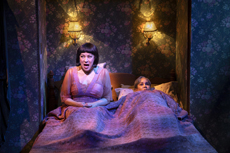
Theatre in Review: The Adding Machine (The New Group/Theatre at St. Clement's)In The Adding Machine, Jennifer Tilly is a household demon, a walking aggravation, a nagging chatterbox, and one can't help loving her for it. As the aptly named Mrs. Zero, ensconced in her marital bed, draped in a purple peignoir, a Louise Brooks bob framing her face like a pair of pincers, she natters on relentlessly, a tickertape machine spitting out empty opinions and meaningless truisms. While her husband lies silently beside her, she details the plots of her favorite films (For Love's Sweet Sake and A Mother's Tears), gossips about a certain star's dubious moral and fashion sense, and, gazing out a window, notes with bitter satisfaction, "That little whore ain't walkin'in' around in her panties tonight, you can bet your sweet life on that." Mrs. Zero is aware that the neighbor in question has aroused her husband's lustful attentions ("Imagine my surprise-walkin' in on my husband, pants around his ankles watching that whore, diddling himself") but that's just another entry in her mental ledger: "Adding the days, my gray hairs, and the silences you could bury a life inside. Adding and adding until the total's too much to bear." Still, regarding Mr. Zero with a pronounced hardening of her mouth, she adds, "I made an oath to God to love, honor, and obey you, and I'm stickin' with it." It's a brief, terrifying turn, a picture of marriage as a portal to hell; in contrast, solitary confinement would be a breeze. Tilly also sets a standard that the rest of Scott Elliott's production never again matches. A truly satisfying revival would be a tall order: The Adding Machine is Elmer Rice's 1923 expressionist nightmare, originally presented by the Theatre Guild when such plays were considered high art. A vision of little people toiling away joylessly, cogs in the capitalist machinery that will ultimately chew them up and spit them out, it follows Mr. Zero across seven scenes as he loses his job, murders his boss, is swiftly convicted, and gets put to death. The afterlife proves no relief, and soon, he is being prepped for a return visit to Earth, where his next life will be similarly bleak. The Adding Machine has its moments of blunt power -- Rice was getting at something disturbingly true about the ruthlessly utilitarian bent of the American moneymaking machine -- but its style is wildly out of date, it rams home its points with no letup, and the final scenes, in the Elysian fields, are filled with windy speeches about the Meaning of It All. Elliott's production is filled with random choices seemingly intended to jolt the text to life. Chief among them is the casting of Daphne Rubin-Vega as Mr. Zero. She is a formidable performer, and to a large extent, she disappears into the role; you have to look closely to recognize her. But Mr. Zero is an archetype and, in this case, looks are everything: The role cries out to be played by a dumpy, balding, middle-aged man. As costumed by Catherine Zuber, Rubin-Vega looks disconcertingly dapper, readying for a night on the town. And although she attacks it with furious energy, she never suggests a soul worn down by drudgery, goaded by primal fears and rages. Her casting feels like a stunt, a stab at originality that misses the mark. Even odder is the employment Michael Cyril Creighton as a narrator, not included in Rice's script. His passages, inserted by the playwright Thomas Bradshaw, are at best redundant, at worst outright boring. Setting the first scene, Creighton says, "This isn't a place where life is 'lived,' but rather 'endured.' A world of worn-out routines, frayed tempers, and dreams so thoroughly flattened that no one even remembers having them. It's a place where the walls are thin, the carpet is tired, and hope tends to collect dust in the corners." Commenting on Mr. Zero's workplace and his colleague Daisy, the actor adds, "They have worked side by side for twenty-five years. That is practically a marriage. No romance. No surprises. Just figures. And time. And thoughts. And fantasies. We all know what that's like, right?" Yep, we know what that is like because Rice makes it blindingly clear. If ever a play didn't need this sort of exegesis, it's The Adding Machine, which practically shouts its themes in every line of dialogue. Such editorializing is almost offensively patronizing, as if we're too dim to grasp Rice's ideas. Bradshaw also interpolates vulgar jokes about Mr. Zero's penis size, along with racial, antisemitic, and anti-gay epithets, but these forced shock tactics fail to pay off. Indeed, a certain rote quality prevails, as if nobody involved can decide whether to spoof the script's affectations or play them in all seriousness. Everyone in The Adding Machine is at the end of his or her rope, eaten up with dissatisfaction and regret; they should seethe with rage, frustration, and misdirected hate. But, except for Tilly, none of the others, including Sarita Choudhury as Daisy, the suicidal office clerk, delivers the necessary desperation. (At least Creighton, who plays several roles, gets to deliver an amusing tour de force as all the guests at Mrs. Zero's party, offering a rapid-fire volley of blindingly hackneyed conversation.) Nobody can do a thing with the final scenes, which stop the play cold to expound on the transmigration of souls and to suggest, sourly, that Mr. Zero is on track for an even worse life the next time around. But the overall tone of Elliott's staging is stuck between satire and a scream of despair, and it never satisfies as either. What this revival has is a stunning production design. Derek McLane delivers one of his Joseph Cornell box sets, featuring an upstage wall packed with period lamps, radios, and typewriters, the detritus of 1920s' life. The scenery is filled with visual surprises, including a box that opens to reveal a stand-up coffin for Mr. Zero and a comically long dinner table partly blocked by a downstage wall. Jeff Croiter's lighting is beautiful (check out the diagonal slashes on the upstage wall) and sinister, carving the cast out of darkness and pairing with Stan Mathabane's sound effects to evoke death in the electric chair. If Zuber could do more to emphasize Mr. Zero's essentially seedy demeanor, she has her successes, especially Mrs. Zero's elaborate black mourning outfit, complete with sunglasses and an all-enveloping veil, proof that she enjoys widowhood rather more than married life. Presumably, Elliott and company see The Adding Machine as a mordant commentary on twenty-first-century unease, defined by uncertain employment, a shaky economy, and the creeping fear that AI will devour us all. It's not the aptest vehicle for such thoughts, however, and it is further undermined by uncertain direction and needless interpolations. But Tilly is a wonder, turning marital disharmony into arrestingly discordant music. "I talk too much, I know that," Mrs. Zero says. "But if I don't fill the air with something, I'll choke on all the unspoken. I have to speak, just to prove I exist." Tilly proves it, in spades --David Barbour 
|