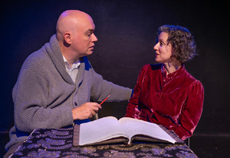
Theatre in Review: Night Stories (The Wild Project) If you've overdosed on holiday cheer and are of a literary turn of mind, you could do worse than Night Stories, a collection of pieces by the Yiddish poet Avrom Sutzkever. It is a full immersion in the dark side of the twentieth-century Jewish experience, delivered, with blunt force, in Yiddish (plus English surtitles) by the actors Shane Baker and Miryem-Khaye Seigel. The pieces include "A Child's Hands," in which handprints on a window evoke the murders of the Holocaust. The story is also informed by the fact that Jews living in the ghetto had to resort to the eating of horsemeat to stay alive. The title character of "Lupus," the longest piece, is an elderly cyanide dealer who exists in shadow form and wants to be "unalived." (In World War II, Jewish partisans kept cyanide pills against possible capture and torture by the Nazis.) "Where the Stars Spend the Night" is a strange, dreamlike piece in which the narrator is importuned by a woman, "a young old soul," who purports to know him and wants to apologize for eating his soul(!). The final (and, to my mind, the weakest) offering, "Portrait in Blue Sweater," is the autobiographical account of a painting of the author, done by a murdered artist, that is presumed lost only to make a surprise return. The story does feature a cameo appearance by Marc Chagall, and the painting, by Chaim Uryson, a gifted painter who was murdered in the Bialystok Ghetto at 38, is something of a stunner. I suspect that virtually everyone in the audience at the performance I attended was conversant in Yiddish. And yet -- kudos to whoever did the translation -- the English words are equally forceful. Consider this description for "A Child's Hands:" "From outside, the sun penetrates the cellar like a corpse falling into its grave." A single image sets the tone for the piece while seizing one's attention. Or this comment from "Lupus:" "Acquaintances are amazed I won't touch an electric button. But when I do, my nose is sickened at the scent of burning flesh." In two brief sentences, describing a mundane task, the author chillingly alludes to the Holocaust. The narrator of "Where the Stars Spend the Night," sharing a park bench with a companion, urges him to stay, adding, "If you sink into the sea, sharks will butcher you and the coral will build a city on your golden bones." Delivered in Yiddish, surely the most expressive of languages, these words take on an unusual power, but, even in translation, they can shake one's consciousness. Something less than a fully realized evening of theatre, Night Stories is aimed at an audience that already has an interest in Sutzkever and his work. (His life, by the way, would make quite a drama: An anti-Nazi partisan smuggled into the Soviet Union, a witness at the Nuremberg Trials, a traveler through Africa and South America, and the winner of the Israel Prize, he also endured the unspeakable, seeing his mother and infant child murdered by Nazis.) He lived to the age of ninety-six.) The directors, Moshe Yassur and Beate Hein Bennett, seem to have envisioned the evening as a reading with benefits. But both performers are distinctive presences, the uncredited projected images are haunting, and Cameron Darwin Bossert's lighting carves out the performers with precision. Presented by the Congress for Jewish Culture, Night Stories shines a light on a writer who should be better known, even if one doesn't speak Yiddish. Written in the shadow of the ghetto and the death camps, his work can feel relentless, and one may want to turn away from his bleak vision. But what Sutzkever has to say is important, possibly priceless. --David Barbour 
|
|