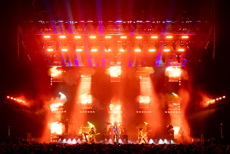
CHAUVET Professional Helps Bryan Barancik Create Living Architecture on Stage For Lenny KravitzThere are many reasons why a lighting designer and an artist-client just seem to click. A shared creative interest is almost always high on that list. It certainly has been for Bryan Barancik and multi-Grammy winner Lenny Kravitz. Barancik has an affinity for architecture, an interest shared by his acclaimed client. The space-shaping power of architecture resonates in his inspired work on the Lenny Kravitz Live 2026 Tour. Artfully arranging the fixtures and pods in his rig in distinctive shapes and patterns, Barancik constructs a geometrically defined environment on stage that allows his client's performance to flourish. Describing how his design evolved, Barancik says: "It really came from a few different places. Lenny loves architecture. We both wanted to move away from video content and more into the tangible feelings of light, shadow, and smoke -- and especially how a physical, tangible scenic structure can affect mood and emotional resonance for Lenny, the band, and the audience." Since the tour includes both arena and outdoor festival dates, Barancik wanted the design to be venue-independent, able to expand or contract depending on the setting without losing its core identity. With this goal in mind, it was decided to go with a pod-style design. "We felt this as the best route -- both logistically and emotionally," says Barancik. "We're able to fit medium-sized festivals as well as stadiums without changing the integrity of the visual resonance and emotional statements. Linear was intentional, but also practical." A collection of 87 CHAUVET Professional COLORado PXL Curve 12 fixtures supplied by 4Wall UK were a key element in Barancik's design. The majority of the motorized battens are placed inside the pods, hung out straight at 90 degrees. This allows the PXL Curves 12s to light the pods themselves, one of the many roles they play during the show. "Really, we use these fixtures for many different purposes," says Barancik. "We reply on them for band backlight, visual stage picture in smoke, FX, etc. We adjust their intensities constantly depending on their angle to the audience. I don't think they were ever programmed at 100%. They become really interesting architecture both in their light and their physical structure. Often in the overhead system of curves, we would just make a snake curve and use them without ever turning them on. Just the look is unique, and it adds an interesting layer." Darkness and shadows also contribute layers of depth to Barancik's design. Working with production manager Dave Bruster, lighting programmers Joe Bay and Chris Fernandez, as well as lighting designer Mike Gionfriddo, he deftly plays off black space against his light to add an extra dimension to his design. By juxtaposing light and darkness, Barancik creates a variety of intriguing looks that provoke the imagination. At times, the stage is dominated by columns of light alternating with columns of blackness, begging the question: Is it light broken by darkness or darkness broken by light? At times, the stage is radian with bright monochromatic looks. Then there are others dominated by darkness, animated by subtle patterns of white light. "Musical lighting works better with contrasts," he explains. "It helps keep focus or draw attention. Same thing goes for musical cueing - the best music ebbs and flows, builds and recedes, or even disappears at times. It keeps you wondering. Our job is to echo that musicality with light - to support the musical story." Something that was not included in Barancik's design was a large center-stage video presence. Other than SL and SR walls used for IMAG, video did not play a role in this design. Moving aerial effects were also relatively scarce. That was no accident. "The band, stage, and smoke were our canvas," says Barancik, explaining the relatively small role of video and movers. "Any screen use was purely IMAG - sometimes treated, sometimes raw...sometimes none at all. There were certainly some aerial FX, but they were used more cautiously purely because we wanted to keep focus on the stage and band. "This is a live band -- they play it all," he continues. "We wanted to see them. Movement FX have their place, and we definitely pushed them into high gear in a few songs...But mostly the show was more about the environment on stage." 
|