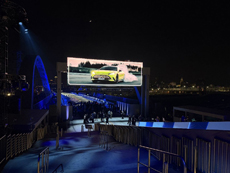
TiMax Powers Real-Time Spatial Audio for Mercedes Coupe Global Premiere on LA's Sixth Street BridgeMercedes-AMG recently transformed Los Angeles's Sixth Street Bridge into a mock Autobahn for the global premiere of its new all-electric AMG GT 4-Door Coupe, and the audio brief was as audacious as the staging: track the car in real time as it raced across more than 300m of bridge, with absolute spatial precision. Delivering on that brief was a collaborative effort built around TiMax SoundHub, supplied by PRG. PRG's technical product manager - audio, Douglas Plander explains, "We were tasked with providing a large Main PA system for the audience with the inclusion of an A-list musical act, but to also include multiple smaller flown systems that would make the audience feel like they were in the middle of it all. Without the TiMax system in place, the event wouldn't have been as easy or sounded as good. The special environment, cross fades, and the precise timing of the event was all brought to the forefront of the experience." Sound designer Anthony Narciso was introduced to deploy the spatial rendering required to realise the creative vision of event sound designer Peter Phillips. For Phillips, TiMax was "the only system that allowed for a completely bespoke approach to spatializing live audio," which was essential on this project. The AMG GT remained under wraps until a single rehearsal before showtime, meaning the entire spatial design had to be built, and refined without it. Narciso's pre-production tests proved so convincing that, as he puts it, "several people who heard them actually thought the car was physically present during playback." Without access to the car, Narciso mapped over 300m of bridge within TiMax Panspace. During pre-programming, he generated around 26 test cues referencing a variety of Image Definitions, fade automations, and movement speeds, ready to evaluate as soon as the bridge system became functional. With the AMG GT off-site, the TiMax built-in playback engine became central to the workflow. Every test cue was run using samples loaded directly into TiMax and refined long before the car arrived on the bridge. With pre-programming complete, the next step was synchronizing cues to the car's movement on the bridge. As the stunt drivers used a test vehicle to map their speed runs, the team stopwatched exactly when the car would pass specific markers, allowing Narciso to fine-tune timing within TiMax. When the live audio feed from the AMG GT itself came online on event night, the team swapped the source inputs and the programming tracked through perfectly with no further adjustment required. The flexibility of TiMax also proved decisive when last-minute changes were needed. Speakers were repositioned and the ground plan was expanded to cover additional distance, both handled in minutes thanks to TiMax SoundHub's recalculation capabilities. After speaker movements were dropped into a scaled ground plan, the Image Definitions were instantly updated without affecting existing work. The team even added localized DJ playback to a dedicated section of the system speakers and used the built-in OSC library to create a custom Stream Deck control panel tailored to the show's operational needs. Narciso confirms, "The TiMax programming worked flawlessly. We delivered an experience where the audience genuinely felt the sensation of the car whooshing past them at high speeds. The flexibility of TiMax allows you to create extremely precise effects while also enhancing reality in ways that elevate moments like this." Plander, concludes, "While other systems might have achieved similar results, the TiMax system was the one true winner when it came to the immersive movements needed in such a short time frame both in pre-production and in real time. Building on our success with TED and Buena Vista Social Club (on Broadway), we felt that the TiMax system best incorporated the artist vision and demanding needs of the show." 
|