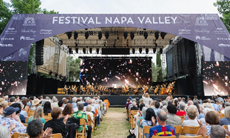
Meyer Sound Supports 20th Annual Festival Napa ValleyFestival Napa Valley marked its 20th anniversary July 4 - 19 with an expansive program bringing more than 300 artists to more than 60 locations, including wineries, theatres, and open-air stages throughout the region. The program ranged from world-premiere opera and symphonic concerts to jazz, ballet, film with live orchestra, intimate recitals, and spontaneous performances. Meyer Sound systems provided by Sound Image, a Clair Global brand, supported programming across the festival. Festival highlights included Renee Fleming's Voice of Nature: The Anthropocene, Wynton Marsalis and his septet at the Arts for All Gala, and the world premiere of Jake Heggie and Gene Scheer's one-act opera The Judgment of Paris, commissioned for the festival's anniversary. "Festival Napa Valley is a landing place for new creative projects," says executive producer Sienna Peck. "We're nimble and trusted enough to be a landing place where artists can take risks, and our audience trusts us enough to grow with them." At the Festival Napa Valley Stage at Charles Krug Winery, the main system centered around LEOPARD line arrays, four flown 900-LFC low-frequency control elements, four ULTRA-X20 point source loudspeakers as front fills, and Galileo GALAXY 816 Network Platforms for processing and control. Eight additional ULTRA-X20 loudspeakers formed a distributed orchestra-monitoring system, with six MJF-210 stage monitors used as spot monitors in some applications when requested by performers. Sound Image engineer Matt Gill served as system engineer and front-of-house mixer for the Main Stage at Charles Krug, navigating dramatic shifts in musical genre and ensemble size from one performance to the next. For Gill, adapting to those changes meant reinforcing each performance without altering its character. "Our goal was to present the music in its most natural way," he says. "If someone was sitting 60' from the stage, it should feel like they were 60' from a string section without microphones in front of the instruments." The addition of a raised seating platform at the rear expanded the coverage target while increasing the need to keep sound out of adjacent areas of the winery. "The right hang and line length gave us coverage where we wanted it," Gill says. "LEOPARD put it right where we wanted it and nowhere else." The 900-LFC low-frequency control elements provided deep, controlled impact while preserving the music's natural dynamics. "When the timpani, tuba, bass drum, basses, and piano all hit low notes together, the 900s thumped in a great way," he adds. "The audience felt that impact without the subs pushing sound all the time." Building on an approach developed over recent festivals, the production team further refined its distributed monitoring system. Instead of using individual wedges for each musician, ULTRA-X20 point source loudspeakers positioned around the stage delivered section-based mixes. "We had our best reception yet, especially from brass and percussion players, who often have trouble hearing themselves and the rest of the orchestra," Peck says. "Everyone was able to hear each other, and the sound onstage was very similar to what was coming out of the P.A.-the closest we've ever come to matching those two spaces." At Nickel & Nickel Winery, two ULTRA-X80 point source mains, three ULTRA X40 fills, two UPJ-1P fills, and four 2100-LFC low-frequency control elements supported the Arts for All Gala, where Marsalis performed with his septet. "It really struck the perfect balance for us in that tent," Peck says. "You could hear every horn clearly; the low end sat right without swallowing anything up. That tent had real balance to it." A compact ULTRA-X40 system moved among 60 locations in 10 days, supporting winery dinners, intimate gatherings, and pop-up performances by artists including violinist Ray Chen and clarinetist Anthony McGill. The same consistency that supported the festival's major stages also made those fast-moving events possible. "Whether it's point-source speakers at an intimate dinner or an 80-piece orchestra on the Main Stage with a flown line array, there is that level of consistency," Gill says. "I know I'm going to have a Meyer Sound system; I know what I'm going to get out of it, and I can make it work in whatever space the festival puts us in." For Peck, that flexibility is essential to the festival's artistic ambitions. "We're looking for a dynamic system that audiences and musicians can both say feels like the best-sounding concert they've ever been to,"" she says. "We used the LEOPARD system on the Main Stage, and it really delivered" 
|