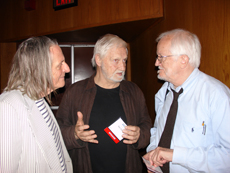
In Memoriam: Ronald Chase Ronald Chase, an artist, photographer, filmmaker, and pioneering projection designer, died on December 20. He was 90. A native of Seminole, Oklahoma, Chase studied dance, design, and direction at Bard College. He appeared with the Jean Erdman Dance Group and Jose Limon Dance Company. Next, he studied painting in Spain and Italy before moving to Quebec, exhibiting his work in Montreal and New York in 1962 and 1963. He subsequently moved to San Francisco. Around this time, he turned to filmmaking and designing projections for theatre and dance. His films include the short subject Pride (1970), about the first Gay and Lesbian Pride Parade in San Francisco, the romantic horror film Bruges-La-Morte (1978), starring Richard Easton, and Lulu (1978), based on Franz Wedekind's play. He also turned to photography in the 1980s, often using large-format Xerox copiers. In 1968, Chase was asked by Richard Pearlman, head of the Washington Opera, to design a production of Benjamin Britten's The Turn of the Screw. Chase agreed on the condition that he would be allowed to incorporate film and slide projections. According to Chase's website, "A year earlier, Gordon Compton and Emelio Ardelino had used film for the Joffrey Ballet's Astarte and were creating a media production with Frank Corsaro for The Makropolos Affair at New York City Opera. These three productions marked the beginning of a development that would bring film and slide projections into the mainstream of opera and theatre in the US. When Chase and Corsaro began work on Koanga the next year (at Washington Opera), it began a thirty-year collaboration in developing the use of film and projection on stage." Chase collaborations with Corsaro included Alban Berg's Lulu at Houston Grand Opera (1975), Eric Wolfgang Korngold's Die Todt Stadt at New York City Opera (1975), Francis Poulenc's Les Mamelles de Tiresias at Opera Theatre of St. Louis (1983); and Ferruccio Busoni's Doktor Faust at New York City Opera (1992). Other credits included The Who's Tommy at Seattle Opera (1971), Alberto Ginastera's Beatrix Cenci at Washington Opera (1971), Frederick Delius' A Village Romeo and Juliet at New York City Opera (1970), and Ian Hamilton's Anna Karenina at Los Angeles Opera (1983). Chase's work was frequently acclaimed. Writing about Die Todt Stadt, Harold Schoenberg wrote in the New York Times, "This production reinforces the impression that Chase had worked out one of the most exciting developments in the history of operatic stage presentation. There can be little argument about the expertise with which the material is handled. This really is a new dimension in opera." Although he mostly stopped designing for opera in the early '90s, he continued exhibiting his artwork through 2018 at San Francisco's Triangle Gallery, among others. He was in several group exhibitions, and his work is part of the permanent collections of the Metropolitan Museum of Art in New York; the San Francisco Museum of Modern Art; the International Museum of Photography; George Eastman House, in Rochester, New York; the Princeton Art Museum; and the Boston Museum of Fine Arts. In 1993, he founded the San Francisco Art & Film Program, which aims to make the arts a constant and inspiring presence in the lives of young people. The organization annually makes more than 100 cultural events available free to Bay Area students. On Facebook, Kristin Cato, a veteran of the program, wrote, "I mentored with his film workshop for many years, and participated in his non-stop outreach to students, introducing them to music, theatre, and art all over the Bay Area. Like many, many others, I learned so much from him. He told me that the mission of his program was not just creating artists and critical thinkers, but to help young people become excellent humans...Years ago, he gifted hundreds of his artworks to friends and strangers in a huge giveaway, though his work appeared in the best of galleries. He treated teenagers with full respect, presenting them with mature material and sophisticated conversation. He used to take a group of kids to Europe every year, instilling in them a reverence for art and culture." Projection designer Wendall Harrington commented, "Ron was truly the father of American projection design. "His film projections on scrim were revolutionary and certainly wowed and instructed me when I saw them in the '80s. He shared his excellent lectures on film and filmmaking to anyone who asked. They are masterworks of understanding. His website is a scholarly discussion of how the operas came together and is well worth a visit, and he offered his categorized photography to anyone who might need them for use in production; who does that? A true artist, he felt so fortunate to be inspired by art himself that he spent his lifetime sharing that spark. "He was a giant. I am grateful to have called him a friend. In a world of design that narrows and specifies hierarchies, let us be inspired by a generous polymath who, using the equivalent of stone tools to make theatrical projection, nonetheless changed the way we see forever." 
|