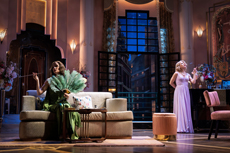
Theatre in Review: Fallen Angels (Roundabout Theatre Company/Todd Haimes Theatre)Rose Byrne and Kelli O'Hara are holidaying this spring, not in Nice or Capri, where surely they would be a sensation, but onstage at the Todd Haimes Theatre, where they are making short work of a minor, rarely seen Noel Coward comedy. As faithful wives "unhinged by sex" when a former lover appears on the horizon, they deftly school the audience in Cowardian etiquette, also known as the fine art of bad manners. Romping through the mother of all drunk scenes, they combine superbly glib line readings with effortlessly executed physical bits. It's no small feat to hang onto one's sang-froid when tipping, head over heels, onto a couch, but these women know what they're doing. If this version of Fallen Angels is a bit of a synthetic -- more about that in a minute -- Byrne and O'Hara are the real thing. Julia and Jane, married to best friends (and golf fiends) Fred and Willy, have, after a decade of wedded bliss, settled into comfortable, passion-free existences. When the men head off for a weekend on the links, the ladies look forward to some shopping and a matinee. Then Jane arrives, panicked and toting a pile of luggage, insisting that she and Julia must flee immediately because Maurice, the Frenchman who, serially, once gave them unforgettable thrills, is coming to London. "Suppose when he arrives, he's just as attractive and glamorous as ever," moans Julia. "Oh, we shall both go down like ninepins." Julia, who is made of sterner stuff, insists that they face this apparition from the past, but their nerves quickly drive them higher than kites. Then, at a dinner at which Maurice fails to show up, Jane and Julie, fueled by martinis, digestifs, and gallons of champagne, turn on each other, staging a verbal catfight marked by ruthless appraisals and charges of treachery. "Julia, I'd like to rush up and down Bond Street with one of your tiny heads on a pole," Jane announces, before staggering out into the night. This sort of sophisticated farce is all in the playing, and the director, Scott Ellis, and his company understand that the root of Coward's comedy lies in dialogue delivered at a furious pace, with cut-glass diction and a frosty detachment. Style is everything: Watch how the ladies light up, using their cigarette holders to strike poses suitable for a Vogue cover, (Later on, note how, in their cups, an attempt at the same task goes riotously wrong.) The laughs come from their all-too-easily surrendered dignity: Jane and Julia, pretending to be glamorous domestic goddesses, are really fate's playthings, unwilling slaves of passion, riding for an epic fall. As Julia notes, "It's perfectly appalling, and we're laughing on the very edge of an abyss!" In O'Hara's characterization, Julia is entirely too comfortable with her domestic arrangements, airily convinced that she and Jane should be congratulated for "having treated their exceedingly nice husbands to the requisite amount of passion and adoration." But grace under pressure isn't her forte: Trying to answer the telephone, she rudely shoves Jane out of the way. Caught in a tangled phone cord, she gets pulled, headfirst, onto a chair, landing unceremoniously on the floor. Driven around the bend by Jane's accusations, she stages a silent, hysterical fit, gesturing like a Martha Graham dancer railing at the indifferent gods. She also makes a riotous morning-after entrance, hungover worse than a crew of sailors, the tiniest noise dispatching exquisite thrills of pain through her. O'Hara is a skilled, subtle technician, to be underestimated at one's peril, but her knack for this type of farce is still a revelation. She is matched, line for line, by Byrne's Julia, her face a carved mask of offended propriety, her words slurring ever more deeply with each sip of the bubbly. She falls into a dark depression, guiltily tormenting herself with visions of their husbands felled by disaster somewhere around the ninth hole. ("We wouldn't break down, would we? We'd face the world with a smile," Julia says, trying to buck her up. "Well, not quite a smile, because we might be misunderstood," replies Jane, always with an eye on appearances.) Having ended up in a Bayswater hotel after her battle with Julia, she enters the next morning, her chic gown in disarray, her coiffure reduced to fright wig, clutching an ostrich fan ruined by exposure to a rainstorm. She's a wraith from Dante's second circle of Hell, where the victims of lust are, like tumbleweeds, blown around by raging winds, a source of laughter even before she speaks. Representing the male contingent are Aasif Mandvi and Christopher Fitzgerald as Fred and Willy, a pair of pouter pigeons steeped in self-satisfaction until driven mad at the thought of their spouses straying with a Continental lounge lizard. Mark Consuelos makes a sensational eleventh-hour entry as the long-awaited Maurice, oozing equal parts charm and brilliantine, more than ready to pick things up where they left off. I'd toast the production as vintage Coward, but this cocktail has been adulterated somewhat thanks to extensive revisions by Claudia Shear. These include some tasteless jokes about a man "trying to have relations with Big Ben" and silly golf-related double entendres. ("May I ask about your balls?" "Well, they're just ordinary balls.") Other changes are much more substantial; Shear completely reworks the role of Saunders, Julia's maid, here possessed of a bottomless fund of esoteric information and anecdotes about her famous former employers. ("I feel I should be following her around, picking up all the names she's dropped," Julia says, bemused.) The device of an all-knowing servant echoes another Coward work, the art-world satire Nude with Violin; I'm not sure it's needed here, but it does give Tracee Chimo a chance to run riot, pummeling pillows like a boxer in training and demonstrating her perfect pitch and fluency in French, among other critical housemaid skills. She also presides over one of the scene changes, delivering "Any Little Fish," one of Coward's delightful revue numbers. At their best, the changes are seamless; still, someday, it would be great to see the original script in a first-class production. David Rockwell's set, depicting Julia and Fred's flat, is a study in Deco run amok, a pale-pink-and-purple living room filled with sleek furnishings and shelves of bric-a-brac ascending to the ceiling. It's a fashionable horror, and it's perfect for the era and the characters. Kenneth Posner's lighting adds to the glamour, especially in the evening look of Act II, which relies on the extensive use of cove lighting. If Jeff Mahshie's evening gowns strike one as a tad contemporary, he makes the stars look great, which is the important thing. John Gromada's solid sound design figures especially in the finale, when the sound of music from the apartment upstairs cues a new round of hanky-panky. Even in slightly diluted form, this production conveys Coward's icily amusing temperament, his knack for treating passion with a clinician's touch. And, with all the pratfalls, Ellis' direction is surprisingly delicate. The prospect of seeing Byrne and O'Hara using the stage as their playground is enough to gladden any heart. We should get a coupe or two of such theatrical champagne each season, so my recommendation is to pounce; the bubbles evaporate quickly. --David Barbour 
|