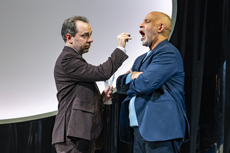
Theatre in Review: Spare Parts (Theatre Row)Spare Parts is best described as science fiction: The topic is science run amok, and the characters behave in ways that only a not-too-fastidious playwright could make up. Welcome to the lair of Zeit Smith, the Elon Musk-style tech titan whose contribution to the world is a Starlink-style system of communications satellites. Like many of his tribe, he has the social skills of a snapping bull terrier and is obsessed with longevity. (He is aging and getting worried about it.) Seeking to beat the grim reaper, he summons Coffey, a researcher at Columbia, dangling millions in salary and research dollars if the good professor will agree to take part in a little experiment. Professor Coffey is an expert in parabiosis, in which the circulatory systems of, say, two mice are hooked up, to study the effects of shared hormones and immune cells. Jeffrey, Coffey's research assistant, notes the findings: "It just shows that the blood from younger mice helped prolong the lifespan of the older mice. The thought is that, as you age, your blood loses certain components that are found in younger organisms. At least that's the claim." It's a case of mice and men: What's good enough for a lab rat is just dandy for Zeit, who wants to be hooked up, pronto, with a young person with a compatible blood type. ("You make me sound like a vampire," Zeit says, offended, to Ivan, his super-smooth personal assistant. "If the shoe fits," Ivan murmurs.) Never mind that this plan wouldn't pass muster in an Ed Wood epic; there are dollar signs in Coffey's eyes, so scientific ethics are quickly kissed goodbye. Jeff, who is entirely too enthusiastic about this mad science project, volunteers to take part, assuming his type matches Zeit's; flexing his ambition, he also haggles for top billing on the science paper that will inevitably follow. As it happens, Jeff is not a match, but Ivan is. And there's a reason for that. You won't get anything more from me, except to note that the playwright, David J. Glass, must have read Kazuo Ishiguro's Never Let Me Go, and that the twisty plot includes a bombshell revelation about Ivan's identity, a romance (between Ivan and Jeff) filled with mutual manipulations, an all-seeing AI system named George, and a revenge plan involving murder by allergy. Some of this is fun in a pulpy way, if only because one wants to see where the story is headed next. But it's fair to note that Spare Parts would never pass a peer review; it's the kind of play that makes up baroque problems that try, and fail, to outdo the real-life dystopian troubles facing us. The actors in Michael Herwitz's production handle these contortions with remarkably straight faces. Rob McClure, best known for his musical-theatre work, makes Coffey's participation in these reckless doings seem halfway possible. Michael Genet's Zeit has the brusqueness and moral blindness endemic to so many of our billionaires as well as an endless talent for self-justification. Jonny-James Kajoba is so striking as friendly, calculating Ivan that one would like to see him in a role that isn't a mere plot device. The same goes for Matt Walker as Jeffrey, who is worried about inheriting his father's schizophrenia, which is supposed to explain his burning interest in these fountain-of-youth shenanigans. The production has a retro sci-fi look, thanks to Scott Penner's set, featuring a tilted, illuminated disk at upstage center, backed by clear plastic strips. Zack Lobel's lighting is generally solid, except for a moody wash, deployed in the climax, which makes it hard to see Kajoba's face. Amanda Roberge's costumes reveal much about the characters' social stations: Note the difference between Coffey and Matt's standard, inexpensive suits and Ivan's sleek, chic wardrobe. Ryan Gamblin's sound design is especially effective when delivering the voice of George, the AI entity that serves as the play's dubious deus ex machina. Spare Parts certainly isn't boring, and it's slicker than Glass' previous work, the rambling AIDS-era drama Love + Science. But it's hard to take seriously, given the playwright's determination to cram every worrying science trend of the moment into one big lulu of a plot. His concerns are real; his story is silly. Like Zeit's proposed blood swap plan, it lacks rigor. --David Barbour 
|