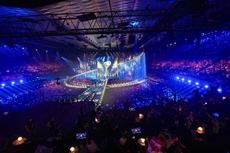
Eurovision 2026 Uses Amadeus Acoustics for Spatially Aligned Arena SoundThe 70th edition of the Eurovision Song Contest at Vienna's Wiener Stadthalle introduced several new approaches designed to enhance the auditory experience for audiences and performers, including Eurovision's first cardioid PA system, built around L-Acoustics K3 loudspeaker clusters, as well as Sennheiser Spectera for microphones and in-ears. The audio team, led by sound engineer Richard Redl and mixing engineer Johannes Minichmayr, also faced the more complex challenge of making sound inside the venue follow the show's visual focus as attention moved between the main stage and the green room. Amadeus Acoustics provided the spatial control needed to make this shift in perspective feel natural to a live audience. Located at the far end of the arena hall, competitors gathered in the green room to wait for their cues and chat with presenters. For the audience, the audio team wanted to create the effect of those voices coming naturally from the relevant area of the venue. This introduced the idea to reverse the perceived direction of the PA, shifting the audience's sonic focus from the front of the arena to the rear. Critically, the team did not want this shift to feel like an abrupt snapshot change. The implementation of Amadeus ART Immersive enabled the team to reposition the sound image in real time, maintaining alignment between what the audience saw and what they heard. Rather than using continuously moving positions, the system was applied to create controlled transitions between two fixed spatial locations of the main stage and the green room. The system was connected to the wider show infrastructure via Dante, with Amadeus' ART::IP providing the immersive processing module and ART::Director serving as the software interface between the mixing console, DirectOut PRODIGY system, and spatial audio workflow. The fixed main stage and green room positions allowed audio snapshots to be triggered through an OSC Stream Deck. Fade times were then used between these positions, enabling the perceived sound image to shift smoothly rather than jump from one location to another. This gave the team a simple operational workflow for switching the perceived sound image during the show. Across the event, the Amadeus ART system was used every time the hosts spoke from the green room, while its use for music was reserved for one key moment: the grand finale opening ceremony. During the ceremony, which featured a performance by the previous year's winner that blended Mozart-inspired elements, dancers, acrobats, and an orchestra, the ART::IP module played a crucial role. With the orchestra in the green room, the team needed to fade the full mix to the reverse PA while preserving timing, localization, and musical continuity. The Amadeus ART system allowed easy alignment of the loudspeaker clusters for the reverse PA setup, ensuring a smooth transition that left no abrupt pauses or noticeable changes. Music, presenters, and wider show audio therefore remained naturally connected to the visual production. "We spent a lot of time assessing the brief and the best way to approach it," Redl says. "We discussed the possibilities closely with our technical production partner, Agora, who had no previous experience with Amadeus Acoustics but were open to trying something new. From the very first test run, everyone was thrilled with the result. During our second check, members of the production team told us they believed it was the best-sounding Eurovision Austria had ever hosted." "This was the first time Eurovision had used immersive spatial audio this way," continues Redl. "Perhaps in future years we can take it further. There may be potential for more targeted uses such as these specific production moments. What we do know is that this year Amadeus Acoustics worked really well, everybody loved it, and we will see what comes next." For more information, visit www.youtube.com/watch?v=DLL5QUwvC1k. 
|