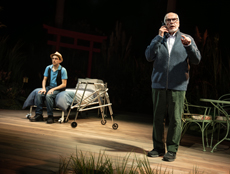
Theatre in Review: Good Time Charlie (Public Theater)Ryan J. Haddad, king of the solo shows (typically exploring the complications of being gay with cerebral palsy), now takes a flyer on a real, honest-to-God play. Well, not quite; even Haddad admits that Good Time Charlie is pretty thin in the plot department. Call it a memoir and a funny, friendly thing it is, focusing on the galaxy of gay adults who provided him with a bevy of role models. If a boy had to grow up queer in Shaker Heights, Ohio, in the 1990s and early oughts, this was the family to have. The play's title alludes to Haddad's uncle, initially seen as a male Auntie Mame who opens his nephew's eyes to the joys of musical theatre. (Charlie makes an attention-getting first entrance on a grand staircase, bursting into "It's Today," from Mame.) But as Good Time Charlie makes clear, raising young Haddad took a village. Also on hand are Lou, Charlie's partner, a noted film scholar; Sheldon, Lou's best friend, owner/operator of a repertory cinema; and Janice, his lesbian aunt, who steps out of the action to note, pointedly, "We have plenty of gay male stories in the American theatre. Where are the women?" Such moments of dramaturgical rebellion are frequent, since Good Time Charlie's we're-putting-on-a-show style is rooted in young Ryan's backyard stagings, featuring family members, of everything from Rodgers and Hammerstein's Cinderella (the TV version, starring Brandy) to Lucille Fletcher's thriller, Sorry, Wrong Number. (I'd have loved to see the latter!) Much of the pushback comes from Charlie, who is flattered to be a dramatic subject but wants to elide the unpleasant details of his family history. (Dreaming of an acting career, his mother and father railroaded him into becoming a dentist. His coming out also caused several frosty years between them.) Haddad, fed up with defending his artistic choices, threatens to cut Charlie's Act I finale, in which he appears in a peach tuxedo to croon "Will You?" from Grey Gardens. In the world of this play, such an act counts as unspeakable cruelty. The uncle-nephew power struggle is the closest thing to a conflict found in Good Time Charlie. Much of the time, it rambles across three generations, focusing on one character or another before moving on to other matters; at times, it feels like a collection of dramatic sidebars. The action is often hijacked by the initially intimidating Sheldon, who becomes a second father to Ryan, schooling him in film and theatre history, brooking no disagreement about the greatness of Judy Garland, and holding forth on "the massive insult" by which Bette Davis, at her peak, was cheated out of an Oscar for All About Eve by that arriviste Judy Holliday, for Born Yesterday. Some of this is fun, and Haddad is undoubtedly faithful to the spirits of Sheldon, Charlie, and Lou's real-life counterparts, but sometimes a certain fatigue sets in. It is awfully late in the day to define gay characters largely by their musical theatre fandom and movie diva worship. It is a little-known fact that gay men occasionally focus on topics other than Bette, Liza, Judy, Patti, and Tennessee, et. al. Also, the talk is pretty mundane, a standard laundry list of likes that delivers little insight into the characters. Read Terrence McNally's The Lisbon Traviata if you want to experience the take-no-prisoners inside baseball practiced by gay men of a certain generation when dissecting their favorite stars. Still, Good Time Charlie has many amusing and touching things to say about Haddad's overlapping families of blood relatives and queer elders. In keeping with the play's self-conscious manner, some of the best bits have a meta quality. Janice, gently trying to nudge Ryan into admitting his orientation, asks if he wants to attend theatre camp. "I can't imagine being that obsessed with theatre," says the future Obie and Drama Desk Award winner. On a trip to New York with Janice, he begs her to get tickets for Fun Home ("A lesbian protagonist! Times three!"), a request given extra spice since Janice is played by Beth Malone, erstwhile star of that musical's Broadway run. In arguably the funniest moment, Ryan, screwing his courage to the sticking place, comes out to Charlie, Janice, Lou, and Sheldon, earning nothing but unsurprised, even bored, looks; they've been anticipating this moment for years. Good Time Charlie also teems with canny observations about problematic parents who make excellent grandparents, the fact that one's lover and soulmate may not be the same person, and the hellish challenge of caring for loved ones as they age and begin to fail. Charlie has the latter problem in spades, tending to his ailing parents while also trying to help Sheldon, hobbled and embittered by a stroke. (He is also painfully aware that the still-vital Lou has twenty years on him.) "All of my constants are slipping away," he sadly admits. Haddad doesn't shy away from presenting his younger self, launching a career in New York, as too self-involved to see the trouble unfolding back home. But there's a reason Good Time Charlie unfolds in a sylvan setting that, Ryan notes, "looks like a revival of The Secret Garden." Despite its occasional dark moments, the play is essentially nostalgic, showing how a boy with unusual challenges was allowed to mature in a nurturing environment, giving him the space to accept his disability and sexual orientation, along with the moxie to forge a successful career as an artist. The director, Danny Sharron, emphasizes the play's many strengths; he has also found the right cohort to embody this functionally dysfunctional clan. Jonathan Raviv captures the essence of Charlie, whose light touch in the face of the worst crisis is its own form of bravery. Tim Bagley is a warm, affable presence as Lou, explaining that, at the onset of the AIDS epidemic, he and Charlie chose each other as a way of embracing life. Malone's Janice is an endless fund of wisecracking good sense. Nael Nacer and Artemis Pebdani nimbly pull off a double act as Charlie's and Ryan's parents, both pairs struggling to understand a complicated son. (Hang on for the moment when Pebdani, as Joan, Ryan's mom, clinically dissects the contents of a box containing his massive stash of condoms, lubricant, and gay porn DVDs. "Do you even like oral sex?" she wonders. "I mean, the way you gag when you brush your teeth...good luck.") As Sheldon, the outlier who remains so important to many of the characters, Michael Cristofer is imperious, demanding, and possessed of the softest heart in Shaker Heights. He is equally compelling whether forming deep bonds with Charlie and, later, Ryan; raging against the betrayals of his body; or candidly confessing his regret over not finding a partnership like the one shared by Charlie and Lou. In some ways, he, not Charlie provides the play's moral center. Afsoon Pajoufar's set, designed to show off Lou's superior gardening skills, is a gorgeous mass of greenery made slightly exotic by the addition of a Japanese arch; it is given extra luster by Barbara Samuels' lighting. (Haddad complains, comically, about the expense of reproducing this environment onstage, but it is worth every penny.) Enver Chakartash's costumes are subtly color-matched and mindful of the stylistic differences of varying decades. (Robert Pickens' hair and wig designs are especially helpful for Nacer and Pebdani's varying characters.) Ryan Gamblin's sound design includes a greatest-hits playlist of Broadway classics. Even if Good Time Charlie could use a shot of conflict now and then, it lovingly asserts that not every gay coming of age needs to be filled with trauma and self-hatred. And Haddad's affection for his characters generally carries the day. As depicted here, it wasn't a perfect childhood, but the opportunities for growth and forgiveness were always omnipresent. Can anyone do better than that? --David Barbour 
|