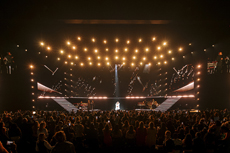
CHAUVET Professional, Ryan Healey Team Up for Mary J. Blige's Vegas ResidencyFor Mary J. Blige's My Life, My Story residency at Dolby Live at Park MGM, lighting designer Ryan Healey, of 22 Degrees, and set designer Shaun Motley are providing a richly textured setting for the singer as she takes fans on a 42-song, nearly two-hour journey through her career. Working on a roughly 70'-wide section (not counting stage left and stage right IMAG screens) of a 120'-wide stage, the designers created a vista that reflected the many facets of their client's music and persona. "We knew the show had to shift between big spectacle and very intimate moments," Healey says. "Because of this, it was important that we could turn different parts of the set on and off. That approach helped create a cohesive picture. We used pixel tape on the stage left and right staircases, and edge lighting along the entire balcony and band risers to create this sense of cohesion. Vanish screens and blow through fixtures upstage created added depth. "This gave us the flexibility to build looks that were fully lighting-driven, fully content-driven, or a mix of both," he continues. "The scale of the stage was a real challenge in terms of filling the space within budget, but I'm happy with how we used the fixtures to make it feel as large as possible." Chief among those fixtures are 110 COLORado PXL Bar 16 motorized battens, 54 Color STRIKE M motorized strobe-washes, and 59 Rogue R2X Wash IP units. Making up most of the residency's lighting, the 223 CHAUVET Professional fixtures were supplied by Volt Lites, a "huge supporter" of many of Healey's projects. Describing the role of the COLORado PXL Bar 16, the "real workhorse in the rig," Healey says, "They are spread throughout the set to help ground it. On the deck level, they sit on the downstage side of the staircases left and right, in front of the band risers, and all the way upstage at the base of the video wall. On the second level, they are mounted along the back of the scenic balconies on both sides, and across the bridge in front of the video screen. They are also located on the lighting ladders, acting as caps to the stage left and stage right sides of each video screen. They give us soft, washy looks with a lot of pixel control, but they can also zoom in and create a very crisp beam. That lets us use full groups as light curtains for certain numbers." In keeping with the vision of creating a varied, continuously fresh lighting narrative, Healey does not activate the COLORado PXL Bar 16 units on the vertical tower until the show's second act. "We wanted to introduce a new lighting language for that part of the show. It is great being able to play between the bars as vertical elements and as horizontal elements across the set. They also create some great moments for the dancers, especially on the bridge, where we can silhouette them or have them cut through big beam looks and throw shadows out into the house." Healey also varies how the Color STRIKE Ms in the rig are deployed, bringing them to the forefront for the more hip-hop driven songs. "We don't use them at all in the first number, and then when the beat drops in the second number, we open everything up," he says. "Much of that impact comes from the Strike Ms. We could run them as one large system to define structure and geometry, or use them more sparingly for accents and small, twinkling moments." The Color STRIKE M units on the uppermost part of the rig are arranged in an irregular pattern that contrasts with the straight form of the linear fixtures below them. Laid out with a vanishing point that moves toward the audience, the overhead units spread out as they approach upstage and offstage, aligning them with the Color STRIKE Ms on the lighting ladders between the screens, so when they all play together, it reads as one large angular arch. "It was also important to fill the overhead left and right of the side screens at an angle that matches the set," Healey says. "This helped complete the picture. When all the strobes are on, you really see the shape and angularity of the rig. When we lean into the profiles, the overhead becomes more ambiguous and can shift with the look. In the end, we were able to get the show in the door quickly and still have an overhead rig that supports the overall look in a strong way." The Rogue fixtures are also deployed strategically, not coming on until the third act. "It was tough holding that back, going through two full acts without any blow-through, but it makes the payoff at the end of the show much stronger," says Healey, who thanks Jeff O'Brien of Volt Lites, Harrison Lippman, Matt Shimamoto, Scot Roper II, and LD Gina Manago. Healey notes that programmer Joe Holdman has been an invaluable collaborator. "Without Joe, this show would not look the way it does," he said. "Joe has an incredible ear for music and is the perfect person to do this type of show with. Not only is he musically inclined, but he also has a great eye. He can hear me key on to give a note, and by the time I start speaking, he's already done it. He was my right hand through this entire process." Also coming in for praise is the show's director, Mark Swanhart. "Shaun and I worked closely with Mark, who is a great visionary, to build interludes that could feel intimate and silhouetted, or hit hard straight into the next number with a big bass drop and a full look snapping on," Healey says. "I'm especially happy with how we move between songs, particularly in the medleys, which range from four songs up to sixteen. "A lot of Mary's material is very lyrical and pulls you in, so in those moments it made sense to pull things back, let the set disappear, or lean into a light curtain effect upstage of her," Healey adds. "On the other side, she has huge records that really open the door for strobes and pixel work. We rarely do the same thing twice." 
|