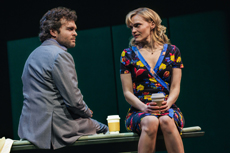
Theatre in Review: Becky Shaw (Second Stager/The Hayes Theater)Gina Gionfriddo's glittering black diamond of a comedy, a bright light of the 2008-09 theatre season, returns, still brimming with scathingly unsentimental observations about class, dysfunctional families, and the advisability (or not) of honesty in personal relationships. Seizing on the classic high-comedy format of another era, the playwright retools it for the age of snark, populating the stage with tart-tongued worldlings and entangling them with the title character, who wields her vulnerability like a weapon. Becky Shaw is every bit as alarming (and amusing) as its title figure. Even before Becky makes her belated Act I entrance, the other characters are caught up in personal dramas, mostly of their own making. Richard, a once-successful businessman, has died, leaving his wife, Susan, and daughter Suzanna in a precarious financial position. (Apparently, Richard's accountant, Yoshi, was also his lover and, therefore, too indulgent of his spendthrift ways. This can't be verified because Yoshi is on a lengthy crying jag.) Susan and Suzanna are a classically neurotic my-mother-myself pairing: Susan has acquired a younger lover; Suzanna, appalled at her mother's Gertrude-like approach to widowhood and horrified at her father's secret life, prefers to stay in bed. Susan will have none of it. "Some women -- Marilyn Monroe, Princess Diana -- are sensual in grief. You are not," she coolly informs her. Trying to wrangle this fractious duo and their ailing financial portfolio is Max Garrett, their money manager and all-around fixer; he's also an honorary member of the family, having been handed over to them as a child by his father, a white-collar criminal. "Between my father's stealing and your father's squandering, it's amazing that I have any time or any money for myself," Max exasperatedly tells Suzanna. Determined to end Suzanna's mourning, he sleeps with her, breaking their long-time semi-sibling taboo, then sends her off on a skiing weekend, where she meets and hastily marries Andrew, an aspiring fiction writer of such sensitivity that pornography makes him cry. It goes without saying that Max disapproves of Suzanna's marriage; to dispel the lingering feelings between them, Suzanna fixes him up with Becky, a temp at the office where Andrew unhappily serves as manager. Becky, a winsome, attractive trainwreck with a tangled family history, hardly seems prepared for an evening out with Max, who, taking in her dress, says, "You look like a birthday cake." Asking Suzanna for advice on dealing with Max, she is told, "Inasmuch as you can, don't show him any weakness." The rest of the play turns on this spectacularly ill-advised blind date, which ends in a mugging, causing repercussions for everyone. At first glance, Max and Becky are a classic mismatch: He is entirely self-interested, with libertarian leanings, happy to let others worry about pesky things like the war in Iraq. (His scalding assessment of a program, run by Brown University students, that sends books to the troops: "When you live in fear of dirty bombs and torture, you do not want a used, highlighted copy of To the Fucking Lighthouse.") Becky, a heat-seeking missile in search of sympathetic men, nevertheless has startlingly accurate insights into his motivations. Trying to get back into his orbit, she is soon monopolizing Andrew's attentions, leaving Suzanna on the outs in her marriage. Becky's insistence on reconnecting with Max unleashes wave upon wave of awkward questions: Did Suzanna elope with Andrew to escape from Max? Is Max really the love of her life? Is Andrew addicted to wounded-bird types in need of sexual healing? Is Max devoted to his chosen family or, as Susan suspects, is he a manipulator and power-monger? It's not until Susan's reliance on her young lover, an "alternative redneck" and aspiring documentary filmmaker, begins to entail costly legal liabilities that everyone is forced to sit down and sort out their messy lives. Trip Cullman's almost perfect production captures the casually brutal way Susan, Suzanna, and Max talk to each other, often leaving others gasping. For example, Max notes disapprovingly how Richard told the eight-year-old Suzanna that her mother, diagnosed with multiple sclerosis, was an alcoholic. "He never said 'alcoholic'," she protests. "He said, 'Sometimes Mommy drinks too much, and that makes her drop things'." Regarding the endless round of mother-daughter battles, Max tells Suzanna, "You and your mother... It's like the Middle East. Bad situation, not gonna change." Susan advises Becky, a college dropout, to repackage her ugly family history for success: "The story about the Black boyfriends and the racist parents. Write that up and reapply to Brown. You'll get in." Alden Ehrenreich, fresh from the film Weapons, has a fine time as Max, an aging golden boy whose cold practicality proves to be no defense against Becky; his frustration builds amusingly, boiling over in the climactic scene. As Suzanna, Lauren Patten nimbly bounces between the men in her life, her graduate-school therapeutic training offering no insight into her true desires. (One of the script's great strengths is that one has no idea where it is going next.) In a play filled with rattling egos, Patrick Ball, currently in the HBO Max series The Pitt, deftly underplays as Andrew; one of the production's funniest moments comes when, entering Susan's living room, he wearily rests his head against a shelf, anticipating the next round of emotional mayhem. Madeline Brewer makes Becky both a human billboard advertising her emotional needs and a skillful blackmailer when the situation calls for it. Appearing in only two scenes but mopping up each time is Linda Emond as Susan, the least pitiable medical case in modern drama, who urges Becky to drop the martyr act: "It's unattractive. We pity Job; we do not fall in love with him." The only slightly off aspect of the production is David Zinn's set design, which, for much of the running time, features a slanted, black upstage wall with four doors and minimal furniture arrangements. It's a strategy that covers a multitude of locations; it also pays off when everyone congregates at Susan's freezingly chic, all-white home. Overall, however, the design strikes an unnecessarily drab note. The other contributions, including Kaye Voyce's wickedly accurate costumes, Stacey Desrosier's lighting, and M.L. Dogg's sound design (including the all-too-appropriate use of "Run From Me, Darling," by Timber Timbre) are all solid achievements. Our theatre has become so tenderhearted, so calculatedly moral, in recent years that attending often seems disconcertingly like churchgoing. That's why it's positively bracing to hear the Becky Shaw crew offering unvarnished opinions on such topics as amateur porn, attempted suicide, mail fraud, prison, and various other unsavory matters, all rendered disarmingly hilarious. ("Cutting yourself over the age of eighteen is just embarrassing. Everyone at the ER will laugh at you.") The teasing finale leaves one wondering what is next for Becky and Max, although, to be sure, Gionfriddo's people have a way of muddling through. In what may or may not be the play's thesis statement, Susan insists, "When someone with damage -- as we have damage -- courts a lover, we must be like the pedophile with the candy. Lure with candy, no matter how frightful your nature and your intent." That's terrible advice, and yet for this crew, it seems shockingly apt. --David Barbour 
|