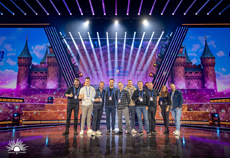
Junior Eurovision 2025 Hits A High Note with Robe The 2025 Junior Eurovision Song Contest featured 18 delegations battling it out to win this coveted competition. The event was staged in the Gymnastic Hall of the Olympic City in Tbilisi, Georgia, organized by the European Broadcasting Union (EBU) and host broadcaster, Georgian Public Broadcaster (GPB). The complete stage, lighting, and video concept and design was created by Raphael Demonthy of Sunrise Studios GmbH in Berlin, who specified nearly 300 Robe moving lights as part of a lighting rig of nearly 800 fixtures. The Robe count included 54 iESPRITE LTL WBs, 39 ESPRITE Profiles, 26 iFORTES, 12 FORTES, 48 Spiiders, 56 MegaPointes, and 36 LEDBeam 1000s. Demonthy's front-of-house team also controlled content for thirteen 4K video outputs spread across multiple surfaces. Lighting equipment, together with LED screens, trussing, and rigging, was supplied by Bulgarian rental company ESC Rental, whose CEO, Natalie Hadad, worked closely with the event's technical production manager and supervisor, Aleksandar Zdravkov, who is also CEO of the company ProCinema Production. This was the third Junior ESC that Sunrise Studios, led by Demonthy and his business partner and LD Chris Moylan, has lit. They collaborated closely with show creative director Basa Potskhishvili, show art director Tamar Potskhishvili, show co-director David Gurgulia, and Oto Tedoradze, who oversaw the stage construction. The centerpiece of the scenic setup was a 12m diameter drum stage based on the famous Doli, a traditional double-headed percussion instrument at the heart of Georgian folk music. This was positioned right at the centre of the 46m-wide stage, with its circumference clad in video panels and lit top and bottom and diagonally with LED tape. Also featured were three large semi-transparent LED walls upstage, and a series of different level decked terraces left and right, adding depth and dynamics to the wide-format production space. The 54 Robe ESPRITE LTL WBs (wash beams) were rigged on ladders behind the main LED surfaces in a matrix formation. "We needed a powerful luminaire and specifically one with a bigger lens so we could really maximise the breakup effects requested by some delegations," Demonthy says. The 39 standard ESPRITES were dotted around the stage on the decks and the perimeter of the drum stage, where they were used for cage-effect beams and other looks. Key lighting was provided by a combination of the 26 Robe FORTE and 12 iFORTE fixtures, which were positioned on the overhead roof trusses. Demonthy says the FORTE's' high CRI and plus/minus green and magenta filters made it possible to definitively fine-tune the output to attain the best levels and shifts for both the live and viewing audiences. A major challenge when working in LED surface-heavy environments like this is to find light levels that simultaneously allow the video to work as it should and function on camera - and with different camera systems! "It's absolutely essential to have all the screens and all the lights working harmoniously with all the cameras," Demonthy says. The 48 Robe Spiider LED wash beams were scattered around the overhead trusses and utilized for the main wash effects, with the 56 MegaPointes deployed along the top of the three main LED screens, serving as beams, specials, and camera flare effects. Above the audience on a series of trusses, 36 LEDBeam 1000 fixtures were positioned. Demonthy worked his front-of-house team: Fabian Schmidt, lighting director for show lighting; assistant lighting designer Marcel Knauf; key lighting operator Tobias Heydhausen, and followspot caller Matthias Hagel. His gaffer was Oliver Klaus, and the remote follow spotting system engineers were Matze Held and Christian "Rocket Chris" Glatthor. The Sunrise Studios team also included the media server crew, comprising server operator Matthias Schöffmann with media server farming managed by Chris van Deenen of Trust Rental GmbH. Head of video planning was Sebastian Huwig, and the projection mapping guru was Martin Karl. Motion graphic designers were Sebastian and Natalie Zittlau, and Natalie was also the overall motion graphic design supervisor. The Junior ESC 2025 was the 23rd edition and was won by France with "Ce Monde" performed by Lou Deleuze. Ukraine's Sofiia Nersesian won the public vote to finish in second place with "Motanka," with Georgia, Armenia, and Spain completing the top five places. 
|