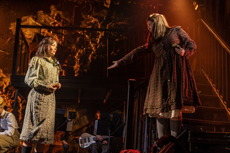
Theatre in Review: Picnic at Hanging Rock (Greenwich House Theater) Of all the properties, literary or cinematic, that one might adapt to the musical stage, Picnic at Hanging Rock is among the strangest. Joan Lindsay's novel, published in 1967, is a classic of Australian literature. Peter Weir's film version was an international arthouse hit, putting the nation's cinema on the world stage. In terms of prestige and tantalizing plot, it must have seemed catnip to its authors, librettist Hilary Bell and composer Greta Gertler Gold. But certain types of material don't thrive onstage, alas, and Picnic at Hanging Rock poses challenges that its authors haven't been able to address. The title event is a pleasure excursion that begins in anticipation and ends in disaster. It is attended by students from Appleyard College, a Victoria-based institution that preps young, well-off women to become poised and accomplished spouses. (Careers are not to be discussed.) At the picnic, held near a famous, real-life geological formation created eons ago by a volcano, four of the girls take an exploratory walk. (They have been strictly warned against this, but they prevail on their sympathetic, if rather too complacent, French teacher.) The day is thrown into chaos when they disappear along with Miss McCraw, a math teacher; one of them, Edith, is found hysterical and unable to recall anything. An extensive search leads to the recovery of another girl, Irma, but her only memory is of Miss McCraw climbing the rock while naked. The most famous and talked-about aspect of Picnic at Hanging Rock, in literature and on the screen, is the lingering mystery at its heart. Instead of revealing the fate of the vanished, the story tracks the disintegration of the survivors. The film, filled with images informed by searing heat in a wilderness indifferent to human concerns, is a kind of slow-motion nervous breakdown: The characters' Victorian worldview, of an orderly, clockwork universe in which everything and everyone has a preordained role, collapses when confronted with a reality that eludes explanation. If the musical preserves its central enigma, in other respects, it explains itself to death. Mrs. Appleyard, the headmistress, lays out the school's philosophy in exactly the terms you would expect: "From this tower flies the Union Jack/A sign to all the world around/One need not fear, for even here/Britannia can be found." The girls, looking balefully to the future, note, "We'll be shiny and new/When we make our debut/And we're put on the market/It's the start of our lives/As respectable wives." Michael, a British gentleman visiting relatives in Australia, who gets drawn into the search, sees a similar fate for himself: "My path will see me marry/And soon produce an heir/My name he'll proudly carry/Our standard he shall bear." So much uprightness quickly becomes tedious, especially since the numbers spell out conventional thoughts that have been well-established by the book scenes. The lyrics largely deal in attitudes and generalizations, an approach that flattens out the characters. This is a pity because Picnic at Hanging Rock is crowded with characters and plot points that cry out for elucidation. These include the friendship between students Miranda and Sara, with apparently erotic overtones; Sara's ill-explained separation from her beloved brother; the tragic backstory, also involving an absent sibling, of Albert, an Indigenous tracker accompanying Michael; and Michael's engagement to Irma, which happens entirely offstage. Gold's melodies have their distinctive moments, but the songs are at odds with the story, which derives its power from the unknown. The score's low point is "Blood and Scandal," which shows journalists (and many others) cashing in on the incident; it's a tired bit of satire derived from other, better musicals like Chicago, Floyd Collins, and Parade. The book employs a scrambled time scheme that often makes the action hard to follow; indeed, the busy second act devolves into a jumble of confusingly rendered incidents. I had to consult the script before I fully understood the respective fates of Sara and Mrs. Appleyard. Some of this is surely the fault of the director, Portia Krieger, who seems to assume that the audience is conversant with the story. (Dealing with a tiny, cluttered stage, the choreographer, Mayte Natalio, is stymied, often having the girls stomp in unladylike fury that recalls the kids in Matilda.) Few members of the cast have a chance to distinguish themselves, although Gillian Han and Sarah Walsh make Miranda and Sara's relationship tingle with deep feeling. Among the others, Bradley Lewis invests Albert's terse dialogues with plenty of unspoken meaning, Kaye Tuckerman is a fascinating presence as Miss McCraw, and Broadway veteran Erin Davie throws herself into the role of Mrs. Appleyard, a Victorian scold who isn't allowed a drop of sympathy. Daniel Zimmerman's set, featuring a precariously leaning balcony, a tiny office for Mrs. Appleyard, and lush verdant growth spreading everywhere, is certainly evocative, although it's often difficult to tell where scenes are taking place. Barbara Samuels' lighting almost palpably suggests the heat of the day, carefully shifting to match the show's darkening moods. Asta Bennie Hostetter's costumes are fairly solid period creations, although the black ensembles featured in "Blood and Scandal" are frankly weird. Nick Kourtides' excellent sound design hints at a malevolent natural environment defined by wind, flapping wings, cicadas, and other, more suggestive effects; he also provides natural and intelligible reinforcement. But nobody involved can make the case for musicalizing Picnic at Hanging Rock. The musical trades the material's haunting lack of resolution for a series of bromides. A successful treatment of this unusual material, if at all possible, would surely call for a more innovative approach; this is fairly standard musical theatre, and as such, it falls short of the mark. --David Barbour 
|