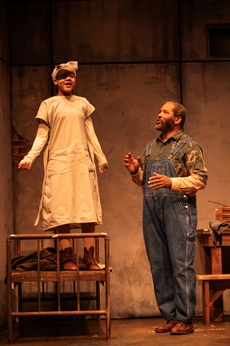
Theatre in Review: The House of the Negro Insane (Negro Ensemble Company)In his new play, Terence Anthony unearths one of the more appalling aspects of life under Jim Crow (and that's saying something): the mental institutions where so-called insane members of the Black community were warehoused under horrifying conditions. Arguably, the most notorious of these was Crownsville, in Maryland. According to a 2025 story in the New York Times, "It was a time when lawmakers and health care officials claimed to see a rise in mental illness among Black Americans, which they blamed on their freedom from slavery." Unsurprisingly, the story adds, "Treatment there was often neglect or outright abuse." That's putting it mildly: According to the National Trust for Historic Preservation, "Patients ranged from the mentally ill to the homeless to children with epilepsy or syphilis whose parents could not deal with the demands of their illness, particularly during the Great Depression. Nearly all of the patients admitted died while still at the hospital, including Henrietta Lacks' eldest daughter Elsie." Lacks, you will recall, was the cancer patient whose cells were used, without her knowledge, to create the first immortalized cell line, still used in cancer research to this day. Meanwhile, Elsie, who suffered from epilepsy and cerebral palsy, was, according to Wikipedia, probably "subjected to the pneumoencephalography procedure, where a hole was drilled into a patient's head to drain fluid from the brain, which was then replaced with oxygen or helium to make it easier to see the patient's brain in X-rays." This procedure features prominently in the plot of The House of the Negro Insane. It's an enormous subject, a canvas of cruelty so detailed it might defeat the efforts of a Hieronymus Bosch, and The House of the Negro Insane isn't big enough to encompass it. Its focus is intimate, centering on Attius, a convicted rapist -- although we will hear more about that -- who, having achieved something like trustee status, is employed in a workshop on the hospital grounds, building coffins. With his sociopathic boss Henry temporarily reassigned to farm work, Attius's newfound peace is disturbed by a pair of runaways: Effie, basically incarcerated for the crime of self-assertion, is so obstreperous that, at one point, Attius feels obliged to knock her unconscious. Madeleine, a young girl afflicted with a missing eye and debilitating tremors, is desperate for a little affection. Attius isn't prepared to handle either of them; neither can he get rid of them. It's a situation built for suspense: Effie wants to escape with Madeleine to Harlem, never mind that she has no money, resources, or, really, a sense of where she is headed. One fears that she won't get far dressed in a hospital johnny; add in a fragile, reflexively honest ten-year-old as her traveling companion and her chances seem beyond desperate. Things look even worse after Effie is subjected to an invasive, utterly unnecessary medical intervention that seriously impairs her ability to function. At the same time, Attius has plenty of reasons to be terrified: If he is caught harboring Effie and Madeleine, the consequences will certainly be devastating. Anthony eventually gets all four characters into a single room, generating high tension and culminating in murder. Attius is an appealing lead character, and, as deftly underplayed by Benjamin C. Rowe, he is a man on a tightrope, trying to do the right thing under impossible circumstances. But The House of the Negro Insane is caught between opposing impulses: For long stretches, it plays as straight-up naturalism, establishing Attius' relationships with Henry, Effie, and Madeleine. It is also packed, awkwardly, with surreal touches: Effie's vision of Harlem streets, images of a Slavic firebird accompanied by music from Stravinsky's ballet of the same name, and a "bottomless coffin" through which the characters sometimes make entrances. Under Daniel Carlton's direction, these touches are applied too crudely; at times the production, switching styles, seems to strip its gears. Based on the evidence at 59E59, The House of the Negro Insane wants a more expansive and theatrical treatment; the script frequently refers to special effects, including in an enflamed finale, that are only hinted at here. Each of the Black characters is, in his or her own way, a visionary, a fact that Carlton's production struggles to accommodate. Also, Anthony could deliver a fuller, more rounded narrative, detailing the characters' backstories and revealing more about the hospital's killing routine. As it stands, the play is a tense melodrama featuring an environment and cast of characters about which one yearns to know more. If Carlton's handling of the characters is also uneven, the script is also partly responsible. Little Sidney Hatcher struggles with the role of Madeleine, one of those preternaturally wise kids who sometimes turn up in plays, but it doesn't help that her medical condition is so ill-defined. Wadiah Waliah gives the action an electric shock each time Effie appears, although it's hard to understand her self-destructive tendencies, especially her mouthing off when staying quiet might keep her safe. Rob Penty is appropriately scary as Henry, laconically sharing confidences one moment and lobbing menacing threats the next. Hang on for the passage when he explains that Attius is really a privileged character; racism doesn't come any more twisted. As with the rest of the production, the design is composed of elements often at odds. Chris Cumberbatch's naturalistic set strikes a tone that is often contradicted by blatantly cued lighting (by Antoinette Tynes) and sound and video (both by Linwood Booker). The preshow lineup of songs by Blind Willie Johnson and Blind Willie McTell sets exactly the right mood, however. The House of the Negro Insane is that most devilish thing, a play that is just good enough to make one wish it was so very much better. Still, it has a terrible story to tell, one that should never be forgotten. A playwright who knows great material when he sees it is halfway to becoming a good playwright. Might this not be the basis of a gripping opera? --David Barbour 
|