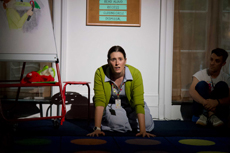
Theatre in Review: Big Feelings (The Cell Theatre's Gallery Space)Was it only last week that I complained there are too many plays about adolescents and their problems? Imagine how I felt at Big Feelings, an immersive production set in a first-grade classroom. Good God, I thought: Will we next have leading characters depicted in utero? Good thing I stayed around; there's quite a surprise lying in wait, coiled and ready to strike. It's fair to say I approached Ryan Drake's play with wariness bordering on hostility. I departed first grade before most of you were born and have never had the slightest interest in a return visit. Still, there's no denying the documentary authenticity of Silin Chen's scenic design, with its posters for the "Mood Meters," "Basic Keywords," and the "Vowel Team." On arrival at The Cell, one is given a name tag and character name. Entering the upstairs space where Big Feelings plays out, one's belongings (backpacks, etc.) are deposited in a cubby, and a designated seat is found at a kid-sized table. An assignment is given out: Draw a picture of a moment when you lost control. All right, I thought. I'll play along. But there better not be any audience participation. (Truth to tell, one of the advantages of carrying a notebook at the theatre is the actors give one a wide berth.) In swept Joy, the teacher, announcing, "We have a big day ahead of us. Let's start with three big ocean breaths." Oh, brother, I murmured under my breath. As it happens, I wasn't at all prepared for what came next. Joy is played with such authenticity by Julia Greer that it's easy to imagine she has a degree in primary education. (Her cheery, cheerleading way -- smoothly rolling out pop-psychology bromides and wielding a guitar in her best Maria von Trapp manner -- immediately brought to mind Miss Barbara, doyenne of the local Romper Room broadcast when I was a boy.) With brisk efficiency, she transfers us to an adjoining room where, sitting on tiny pillows, we take part in exercises related to counting, understanding gerund forms, and writing more vividly. After a few minutes, however, a discordant note creeps in when Joy informs us that this will be her last day on the job. Suddenly, things feel off, subtly at first and by degrees turning more and more alarming. The designated "word of the week" is "semifinalist," surely a strange choice for six-year-olds, and one that comes across as emotionally freighted. Next, Joy uses the word in an enigmatic sentence. ("This summer, I went to the soccer game of a girl I don't actually know. She won the semifinalist round. It hurt my feelings.") And why on earth would the "song of the month" be "Reason to Believe," a recriminatory Carpenters ballad? ("If I listen long enough to you/I'd find the way to believe that it's all true/Knowing that you lied straight faced/While I cried.") As we gradually figure out, Joy knows something about disillusionment, in particular the pain of coming in second with someone she loves deeply. A moment of trauma has left her deeply wounded. And she has decided to do something about it, something that can't be taken back. Think of an Electric Company episode written by the psychological thriller queen Ruth Rendell, and you have some idea of how Big Feelings unfolds: little nuggets of information about word usage and identifying one's feelings doled out by an instructor, who, despite her warm, gentle demeanor, is this close to a rap sheet for violent felony. It's a pretty wild situation, and, on reflection, a highly questionable one. Instead of questioning it, however, one watches in horrified fascination, avid to see how far Drake will push his premise. Big Feelings might be much less effective but for the controlled tension of Greer's performance, which, under Sammy Zeisel's seamless, utterly natural direction, is packed with red flags: A strange outburst against an unseen student (to whom Joy seemingly has a strange attachment); a time out that finds her briefly lying on the floor in a fugue state; and her increasingly confidential manner about matters that no child needs to know. (In some ways, Big Feelings plays like an homage to Roberto Athayde's Miss Margarida's Way, another exercise in deranged pedagogy, which provided Estelle Parsons with a signature vehicle.) Chen's thoughtful, utterly convincing work is supported by Joyce Ciesil's sound design, which combines Muzak melodies with disconcerting sounds of children at play, and Finn Bamber's naturalistic lighting. All are names to remember, and that goes double for Drake, Greer, and Zeisel. We are perfectly set up for a visit to an environment that is both banal and deeply unsettling. Finally coming clean about her actions, Joy adds, "In the moment, I smiled. Because I thought I won. I've finally won. Is that okay?" Her students will have years to decide exactly how to take those words. --David Barbour 
|