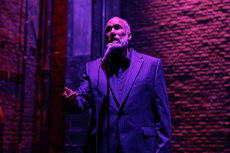
Theatre in Review: In Honor of Jean-Michel Basquiat (New York Theatre Workshop)Is Roger Guenveur Smith an actor or a medium? I'm not so sure. His previous pieces, about Huey Newton and Rodney King, were virtual seances, featuring performances that felt more like spirit possession than standard acting technique. He's after something different in his new effort, about the gifted, tragic painter, dead of a heroin overdose at twenty-eight. Rather than call up an individual soul, he conjures multitudes, a virtual army of spirits. It's an original and riveting spectacle. Watching Smith commune with the dead, one dare not look away. In Honor of Jean-Michel Basquiat is ostensibly Smith's poetic memoir of his friendship with the painter. They met in the early eighties, in California, when Smith performed under the stage persona "Hollywatts." He provides many amusing and/or telling moments about Basquiat: the two of them crawling across a movie theatre balcony, Basquiat's extensive dreads getting in the way of the projector and blocking Robert De Niro on the screen; Basquiat, at a club, getting touchy with another patron whose jacket sports a Confederate flag; Smith's discovery, in the artist's studio, of an "uncontrolled white substance." As Smith recalls, "He stares at me/I stare back/I should quit huh." Most of the time, however, Basquiat remains elusive, appearing only to vanish like smoke. Rather than focus on him as a person, Smith's tribute enshrines his friend in a cultural tradition of artists and writers of color beginning with Marcus Garvey and ending with Spike Lee. Many, if not most, of them, he sadly notes, were bedeviled by poverty, addiction, and illness, gone before their time: "Charlie Parker/Certified genius/They put him in an insane asylum/Charles Mingus/Brilliant pianist/Bud Powell/He had to scrawl eighty-eight keys/On his nuthouse wall." They are hardly the only examples. Indeed, the intensely observant Smith makes connections that one might otherwise not notice, for example, the fact that Basquiat and his mentor/rival Andy Warhol were both injured -- Basquiat in a car accident, Warhol shot by the deranged Valerie Solanas -- leaving them both "spleenless." A memory of the 1955 Brooklyn Dodgers, led by the Black players Jackie Robinson, Down Newcombe, and Roy Campanella, Jr., leads to the observation, "And the baseballs were hand-stitched in Haiti/For slave wages/Maybe that's why/The Haitians rejected the Great American Pastime/And the vicious American occupation." Smith draws a line from Basquiat to his friend, the artist Fab 5 Freddy, and the latter's godfather, the bebop drummer Max Roach. Lurking in the background is the ghostly presence of Michael Stewart, a victim of police brutality in 1983. Every line of Smith's text is rich with history and poetic expression. In a way, Basquiat, despite his personal connection to the star, serves here as an avatar of a multi-generational tradition, a lineup of brilliance without which American culture would be a much poorer thing. So erudite is Smith's writing that I'm guessing its densely packed allusions may leave some occasionally scratching their heads. In one passage, he slips from Basquiat, "dipping his brush in blood," to the artist's multilingual mother, to the jazz musician Eric Dolphy, Bob Marley, drummer Carlton Barrett, artist Ana Mendieta (who fell or was pushed from her apartment window), and the political philosopher Frantz Fanon. This rush of identities makes Smith's hold over the audience all the more remarkable. The piece also skirts sentimentality at certain moments; its consideration of young lives lost needs no special emphasis to affect us. But Smith is an incantatory presence, conjuring up worlds of musicians, artists, and thinkers, all of them brilliant, many of them broken yet determined to leave a mark on a society that is all too frequently indifferent or hostile to them. He is aided to no small degree by Marc Anthony Thompson, whose live onstage sound design is a steady stream of musical cues and sound effects that match Smith's cataract flow of words. Arlo Sanders' moody lighting design isolates the men in pools of saturated color, occasionally switching to full-stage ballyhoos or stark white washes. It's hard to think of another prominent theatre artist whose work is similar to Smith's blend of music, memory, and poetry. Interestingly, In Honor of Jean-Michel Basquiat is bookended with personal reminiscences: His father urging him to forgo art for a paying trade ("I'm a Black man/I've never denied it/And now that I've been a Black man/Why don't you go ahead and try it?") and his appearance in the film Do the Right Thing, as Smiley, who helps to torch a pizza parlor because its wall of fame features no Black celebrities. "The pizza parlor/is now a mausoleum/And a colored museum," he says, recalling the film's memorable denouement. Never mind; in this brief, stunning piece, he creates his own wall of fame, and it is well worth a visit. --David Barbour 
|