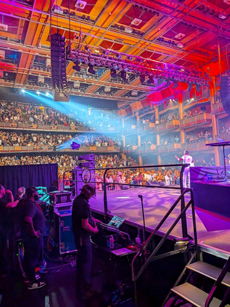
Cerritos Center for the Performing Arts Masters Continuous Reconfiguration with a d&b audiotechnik XSL SystemThe Cerritos Center for the Performing Arts (CCPA), renowned for its unique ability to physically transform into multiple configurations, has completed the installation of a d&b audiotechnik XSL-Series loudspeaker system, solving critical challenges related to acoustic control and logistical flexibility, while simultaneously making the venue rider friendly for the numerous touring acts who choose the Cerritos Center to reach the Los Angeles community. "The venue is an amazing place. At the time it opened in 1993 with Frank Sinatra, it was one of two venues worldwide that could reconfigure to different stage setups," shares Jon Bullock, head audio specialist for the City of Cerritos. "The sheer engineering required to transform the space is astonishing." The theatre can shift between five different configurations, for example, going from the Lyric Configuration, which is a typical proscenium theater with raked seating, to the Arena Configuration, which features a flat bare floor. To accomplish these transitions the venue's walls, 100,000 to 300,000-pound towers, actually move with the assistance of compressed air casters, as do the seating "wagons." Flooring and seating raises and lowers, and ceiling panels fly in and out. Continuous transformation demands a flexible sound solution. "The main challenge was designing a system that could easily break down and reassemble effectively. When we reconfigure the building, the PA, cables, and lighting come down completely, says Bullock. "In one configuration, the actual venue space may be wider or the seating distance different, and the distance from the downstage edge to the front of house position changes completely." Other objectives for the system focused on improved coverage, voice intelligibility, and overall tonality. "We needed a system that offered a far superior audio experience for our patrons and guests. Critically, we needed a system that could meet tour rider requirements, which our prior system was unable to do, shares Bullock. "We ultimately went with the d&b XSL system, which met all our objectives and we found to be the perfect size for the venue without giving up sonic quality or horsepower." A core component of the d&b audiotechnik solution that made such dramatic transformations possible were the use of ArrayCalc software for system design and then ArrayProcessing during deployment. "I relied heavily on ArrayCalc to determine the tuning and coverage patterns for each configuration which are then realized through ArrayProcessing which makes the transitions so much easier," Bullock reveals. "I am developing specific presets tailored to the various venue setups as they come up in our schedule which we can then recall when we return to any given configuration." For a venue constantly tearing down and resetting the audio system, rigging efficiency was also essential. "With the new d&b system our rigging is so easy," Bullock reported. "I literally can fly the whole PA by myself. I have new crew members, some very green, and they quickly comprehended and mastered the process. For instance, by their third time, they were connecting boxes and setting angles while I just watched for safety." The ease of use, speed, and efficiency of this system also translated into cost savings, requiring less crew time, reduced power consumption and eliminating the need for the excessive cabling and amplifiers required by the prior system. Bullock also reports a far superior audio experience for patrons and crew. "Clarity is a constantly reoccurring theme; people notice the detail and tell me they can now hear everything," Bullock affirms and the sonic improvements extend from the back to the front of the stage. "The rear rejection behind the PA is mind-blowing," Bullock highlights. "They (crew members) can walk directly behind the PA and have a normal conversation without shouting. Stage monitor levels have come way down as well. Broadband directivity control is a huge benefit in front of the PA as well, because the movable ceiling panels above the audience create a 40' void and can cause weird reflections. By keeping the sound focused, we mitigate unwanted reflections." Since the installation, CCPA has hosted performances including Dionne Warwick, Trace Adkins, Boyz II Men, Matteo Bocelli, and Kansas, in the Arena Configuration, and Robert Cray, The Filharmonic (a cappella group), and Broadway Theater shows, Stomp, Clue, and Hadestown, in the Lyric Configuration. The results have been universally praised. "I am not exaggerating when I say that touring engineers have been ecstatic when they arrive." exclaims Bullock. "They come in expecting the prior system, and when they see the d&b rig, they're immediately happy." "Our relationship with the d&b team has been fantastic. We're a medium size venue, but they always treat me like a top-of-the-line touring guy, their support is unwavering." concludes Bullock. "Looking to the future, we're discussing a possible Soundscape installation in our multi-purpose room. The relationships and the quality of their product are the biggest reasons we are happy to be a d&b audiotechnik house." The d&b audiotechnik installation at CCPA utilizes d&b ArrayProcessing and consists of the following key setups: In the arena configuration, the flown PA consists of 14 boxes of XSL per side (six XSL8 over 8 x XSL12). Ground stacks include 2 x XSL-SUB per side stacked house left and house right with single XSL-12 on top, and four SL-GSUB arrayed across the front, along with six 44s Frontfills. Coverage is supplemented by two V-Series V12 per side for upper balcony delays for presence in the last four rows. In the lyric configuration, this setup also utilizes the same XSL flown boxes, 14 boxes of XSL flown per side (six XSL8 over eight XSL12), but the angles and bumper points change dramatically. Six 44s Frontfills are also utilized. No Ground stack XSL12s. The subwoofer setup changes, using two XSL-SUB per side stacked house left and house right, only two SL-GSUB, and two V12 per side for upper balcony delays. In the recital configuration, this configuration features six XSL8 flown per side and two V12 per side for upper balcony delays. In the cabaret configuration, this smaller arrangement uses 2 x XSL12 on top of two XSL Subs stacked per side, supported by 4 x E-Series E8 front fill speakers. In the concert configuration, this setup includes nine A-Series AL90 augmented array loudspeakers in a 180-degree center cluster array, and eight E8 front fill speakers. 
|