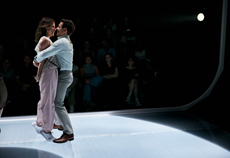
Theatre in Review: Disruption (Pershing Square Signature Center)As if we don't have enough problems -- what with OpenAI and Claude running amok, and half of the country's English majors turning to Copilot to find out how Middlemarch turns out -- here comes John David Washington with an algorithm designed to run our lives for us. In Disruption, Washington is Nick, one of those blandly self-assured Silicon Valley nerds who, as the play begins, is already worth a cool $300 million. Hosting a dinner party for his three college besties and their wives, he shows up with his business partner Raven, who looks and acts more like a Bond Girl than a digital genius, but never mind: Nick makes the couples an offer: For a mere $500,000, they can get in on the ground floor of his latest invention, which, he insists, is more than a game changer: If it hits the market, humanity will never be the same. Nick and Raven have designed an algorithm that makes all of one's decisions for one. "When you're at a fork in the road, wondering which way to go, we'll tell you," Raven says. Thinking about buying a brownstone? It'll tell whether to do it, naming a building or a location. Worried that your marriage is going south? Consult the algorithm about whether to call a lawyer or have an affair. Unsure about having a kid? You know where to turn. "Think Waze, but for your life," Nick says, but really, that's too modest. It's like having the Delphic Oracle in your pocket. Although he'll be happy to take everyone's money should they pony up, Nick is really using his pals as guinea pigs, amassing every available detail about them (which, as it happens, is plenty) and then advising them, via the algorithm, on their life choices. Never mind that a test group of six would yield nothing in the way of useful data. The playwright Andrew Stein seems certain that this trio of case histories will reveal all. But it's never clear that anything truly disruptive really happens. Unlike Matthew Libby's unnerving thriller Data, Disruption, has trouble making what should be a very easy case. For one thing, two of the couples are so sketchily drawn that one struggles to understand whatever brought them together. First, there's Paul, art director of a print magazine, and Jill, toiling unhappily as a corporate lawyer, who live beyond their means in Connecticut, conniving to get their young children into Fieldston. (It doesn't help that the excellent Elizabeth Stanley, as Jill, is forced to carry on like a frump and a jealous shrew until an eleventh-hour transformation that only Helen Gurley Brown could dream up.) But there's also Ben, an academic, and Suze, a psychoanalyst, whose relationship, marked by her remarkable detachment -- she seems fed up with everybody and everything -- and his divided sexual loyalties, needs far more explanation than it gets here. In another, more dramatic iteration, everyone's lives might be ruined by Nick's scheme, leading to recrimination and revenge. As it happens, the results are strangely mixed: Some characters end up happier, others less so, and one of them is killed, but only indirectly because of outside meddling. The outcomes are surprisingly banal even when the algorithm takes on a life of its own, acting without human input. Yana Biryukova, the projection designer, creates a series of rippling circles on the deck to indicate when someone is being manipulated, but so much is going on visually in Hersh Ellis' production that this effect is easy to miss. Indeed, much of the time, Disruption is a fairly standard comedy-drama about relationships among members of professional classes whose careers have failed to generate sufficient money and/or satisfaction. If the action often seems to ramble, at least Ellis has rounded up a bunch of first-rate pros to advance Stein's shaky thesis. Leading the way are Jason Ralph and Irene Sofia Lucio as Barry, a surgeon, and Mia, a photographer; she suffers from real estate envy while he frets about finances and yearns for his days in Doctors Without Borders. They are funny, affectionate, and thoroughly human, the most convincing characters onstage. Stein has a good time with their tangled backstory: "You think it's weird that my wife slept with two out of three of my best friends?" Barry wonders, getting the biggest laugh of the evening. If Paul and Jill can be hard to take -- one wants to rush them into divorce court, posthaste -- Joe Tippett and Stanley work heroically at making their problems seem to matter. (Paul's entire character can be summed up by his anxiety about print being dead.) Jill and Mia are semi-estranged sisters, setting up a rueful and amusing reunion that Stanley and Lucio make into a standout sequence. Conrad Ricamora and Shaunette Renee Wilson are stuck with the severely underwritten Ben and Suze; her massive change of heart about having children is the play's least credible aspect. Among the plot's puppeteers, Emma Kikue comes on strong as Raven, but her about-face, switching from predatory techno-predator to doom-saying prophet, is so abrupt that one doesn't know what to think. Washington is luxury casting defined as Nick, who is little more than a plot catalyst. Aside from that bit of confusion with the projections, the rest of the production is pretty slick. Zoe Hurwitz's set, a reflective black void with the audience on two sides, has the right look, and it accommodates the script's many rapid scene changes. (Her costumes are solid, even if Jill's makeover is a bit over the top.) It is livened up with Reza Behjat's lighting, which creates various strongly articulated beam effects, including a nightclub look complete with saturated ballyhoos. The projections include torrents of ones and zeros, what look like pulsing neurons, and information about the time frames of certain scenes. Caroline Eng's sound design includes bits of EDM, a thunderstorm, a voice on FaceTime, and a crying baby. The play ends with Nick, in triumph, getting a papal audience. Since Catholic theology is strongly rooted in the assumption of free will, Nick is probably the last person the Pope would want to see. But that's Disruption for you: It wants to rattle your nerves, but it sometimes has trouble getting to the point. --David Barbour 
|