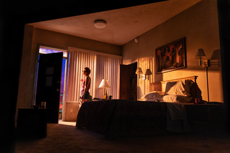
Theatre in Review: Bug (Manhattan Theatre Club/Samuel J. Friedman Theatre) When I first saw Bug about twenty years ago, I found it a creepily effective but distasteful exploitation thriller, the stage equivalent of a Blumhouse horror film -- the kind released in early January for a quick buck. I now withdraw that comment. Sometimes it takes a while for us to catch up with a playwright. Truth is, Tracy Letts -- who, in the last two decades, has established himself as our leading dramatic poet of American decadence -- saw, before anyone else, the creeping spread of conspiracy theories that have infected our collective consciousness, driving those "doing their own research" -- another term for credulous, Internet-surfing fools -- to embrace the most outlandish ideas. In 2025, in the aftermath of QAnon, Pizzagate, and that benign tourist expedition on January 6, Bug, has acquired a skin-crawling acuity. Bug begins as a low-key thriller before it explodes into a paranoic fever dream: Divorced, tragedy-struck cocktail waitress Agnes is holed up in an Oklahoma motel, hiding out from Jerry, her abusive ex-husband, who got sprung from jail earlier than expected. Jerry is trouble on wheels, forever involved in something shady, the kind of brute who will deck a woman before reminding her of his love. Despite her blunt, brusque manner, Agnes is basically a prisoner -- "Hermitized" is how her caustic, yet loyal, friend RC puts it -- killing time rather than planning her next move. Protection of a sort arrives in the form of Peter, a gentle stranger who, with his notable lack of physical or sexual aggression, appears the opposite of Jerry. He stays over with Agnes, partying with booze and weed, at first sleeping on the floor, later joining her in bed. Could he be her ticket to a better life? Actually, a trap door is opening beneath Agnes, with hellfire raging beneath. Peter, who was homeschooled by his father, a preacher without a congregation, is a walking catalog of fears. First, he calls out the toxic elements in the room's smoke detector. His worldview boils down to the notion that it's all a plot: "You're never really safe. One time, maybe, a long time ago, people were safe, but that's all over. Not anymore, not on this planet. We'll never really be safe again. We can't be, not with all the technology, and the chemicals, and the information." (He never gets around to fluoride in the water, which, in a way, is surprising.) Adopting a confiding tone, he informs her that he is the victim of sinister government experiments from his time in the Army, apparently during Operation Iraqi Freedom. By then, Peter has identified a bedbug "infestation" in the room. Agnes starts to see them, too; at least, she thinks she does, peering nervously in his microscope. Soon, he is spinning ever-wild fantasies, drawing on some admittedly unsettling details: Who keeps calling on the phone, refusing to speak? Who is Dr. Sweet, who claims to be familiar with Peter's medical history? What really happened to Agnes' son, who disappeared from a store years earlier and was never found? As Agnes and Peter isolate themselves, accumulating fly strips, spray cans, and bug lamps, the action reaches its obsessional peak in a pair of Act II arias: Peter, threading Jim Jones, Timothy McVeigh, and Ted Kaczynski into his own tortured history, imagines a vast mind-control scheme with him at the center; next comes Agnes' even more unhinged account of her son's loss, which, she now understands, is all part of an evil grand design. By then, the room has been converted into a bunker, its walls covered in tinfoil, and Peter has committed an act of self-mutilation that sends shockwaves through the audience. Rest assured, the worst is yet to come. David Cromer is not a director to overhype a dramatic situation, and, in its latter stages, Bug hardly needs juicing up. Nevertheless, his handling of the first act is a bit slack, a problem partly due to casting: Michael Shannon, who played Peter Off Broadway in 2004, brought a tense, faintly menacing quality to the role from the get-go; even before he tipped his hand, we understood that something was terribly off. At the Friedman, Namir Smallwood initially underplays the character a little too expertly; even Peter's first-act closing speech, the first real suggestion of his profoundly cracked worldview, doesn't quite land. To be sure, he ignites fully in the second act, especially during an onstage meltdown that should scare the bejesus out of anyone, effectively pulling Agnes into his existential rabbit hole. Carrie Coon's Agnes --- taut, whippet-thin, getting by a diet of vodka and Coke plus the odd puff -- is on point throughout, talking tough but taking it on the chin from Jerry, gradually revealing the loneliness that makes her the perfect unwitting prey for Peter's theories. Her wild-eyed recitation of the "facts" that explain her unhappy life is delivered with the exaltation of one who has seen the unbelievable truth. ("It's better. Knowing," Peter says. Never mind that the whole thing makes no sense.) The animal howl of pain seemingly torn from her gut testifies to the unappeased agony caused by the loss of her son. After a slowish start, she and Smallwood come together for a folie a deux that has fatal consequences; Letts wrote Bug, in 1996, but Agnes and Peter are true creatures of today. The rest of the cast is expert: Steve Key as Jerry, his cheerful country-boy manner turning surly when crossed; Jennifer Engstrom as RC, who introduces Peter to Agnes and lives to regret it; and Randall Arney, as Dr. Sweet, whose bedside manner is enough to make anyone feel crazy. The same goes for the design team: Takeshi Kata's set is an effective rendering of a last chance motel, converting in the later scenes into a housekeeper's worst nightmare. Heather Gilbert's lighting employs highly directional time-of-day looks and practical units to create a film-noir-in-color atmosphere. Sarah Laux's costumes consist of suitably grungy everyday wear; J.Jared Janas' makeup designs make clear how badly Peter has damaged himself. Josh Schmidt's subtle, yet chilling, sound design combines all sorts of quotidian noises -- crickets, passing traffic, a coffee maker, the clunk of an air-conditioner cycling on to eerie effect. Letts, who often thinks the worst of his characters and is rarely wrong, offers an alarmingly mordant comment on the current paranoid style of American life. He grasps our all-too-human insistence on assembling facts in a logical, yet utterly distorted, way that reduces the confusing facts of life to simple, if deeply misleading, good-versus-evil narratives. Nearly thirty years ago, he foresaw our age of mis- and disinformation. Today, Bug has never seemed more relevant. Alas. --David Barbour 
|