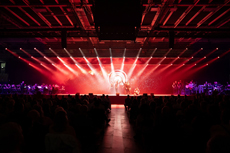
GLP WildBar 16 and impression X5 Compact Light the Stage for the HERILO Rock Musical in KaufbeurenFor the five performances of the rock musical HERILO: Das Rad dreht sich weiter, staged at the Energie Schwaben Arena in Kaufbeuren, Germany this summer, lighting designer Leo Herrmann of Lumenlabor created a stage space 105 feet wide. Using a symmetrical lighting architecture built from 128 GLP WildBar 16 and 64 GLP impression X5 Compact fixtures, he concentrated the light on an exceptionally broad playing area. "I didn't want simply to light the arena. I wanted to redefine the stage space," Hermann says. HERILO was developed specifically for Kaufbeuren, connecting the town's history, present, and future. It centers on Herilo, a legendary figure bound up in local tradition. Medieval scenes meet contemporary settings, set to a specially composed score. For the performances, the Energie Schwaben Arena was converted into a temporary musical theater complete with a live band, orchestra, large-format LED video and the wide stage. Lighting and rigging equipment for the production was supplied by Kaiser Showtechnik, of Augsburg, Germany. "For me, good lighting design always begins with the room, not with the fixtures," Herrmann says. "I didn't want to inherit an existing concept. I wanted to start by analyzing what the arena actually makes possible." On his first site visit, he recognized that the stage layout did not fully use the hall's spatial potential, so he opted for a fundamental change. The entire production was rotated 90° and reoriented along the long side of the arena. The arrangement improved sightlines and audience capacity. It also let Herrmann work with the full width and depth of the playing area. He developed a fully symmetrical lighting architecture across four identically built trusses. Rather than programming the individual positions as separate units, he treated the entire structure as a single coherent instrument. This allowed light to be precisely directed across the full width of the stage while still being conceived spatially. Performers, stage architecture, music and video were all treated as components of one shared overall picture. "The rotation was ultimately the foundation for the entire lighting concept," he says. "It created new perspectives, improved the sightlines and gave us considerably more creative freedom." For the symmetrical lighting architecture, the designer deployed 128 GLP WildBar 16 and 64 impression X5 Compact fixtures. Both fixtures handled scenic lighting and dynamic effect cues. He used the linear form of the WildBar 16 to emphasize the width of the stage, to create clear graphic structures and to make the spatial depth of each scene visible. "The WildBar 16 was the perfect tool for me to render architecture and depth on the stage," he says. "The clean lines guide the audience's eye and support the impact of a playing area some 32 meters across." The impression X5 Compact fixtures extended that graphic structure with flexible light for a range of scenes and moods. Herrmann had originally specified the larger impression X5, but their weight ruled them out within the planned structure. The X5 Compact offered a more compact alternative without requiring him to compromise on color matching within the GLP portfolio. "It was important to me that the fixtures came from the same manufacturer, above all because of the colors," he says. "It meant the WildBar 16 and the X5 Compact combined very well with one another. We had musical scenes with beautiful, theatrical light, over which I ran rock-and-roll cues. For that, I could use both the X5 Compact and the WildBar 16 equally, for illumination and as effect lighting." The relationship between lighting and video was shaped by a decision Herrmann made early on. The previous year's staging had placed a large-format LED wall behind the orchestra, an approach he chose not to repeat. "I deliberately decided against that solution for this year's production," he says. "It mattered to me not to create silhouettes of instruments, backline or the musicians themselves in front of the video surface. Instead, the whole of the visual attention should be concentrated on the central playing area. "For me, light and video belong inseparably together," he adds, "The light should extend the content of the LED wall into the stage space. If the audience takes in the overall picture and doesn't stop to think about where light ends and video begins, then I've achieved my aim." 
|