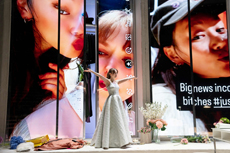
Theatre in Review: The Maids (Donmar Warehouse at St. Ann's Warehouse)Kip Williams and Jean Genet are a match made in hell. And I mean that in the nicest way. These days, the theatre is loaded with directors who apply certain ideas to each of their projects with an almost maniacal single-mindedness. (The term "one-trick pony" comes to mind, but I'm not out to pick a fight; let's say they tend to be just a little bit theory-ridden.) If this sometimes leads to dissatisfaction and critical quibbling, in the tradition of stopped clocks, certain productions pay off gratifyingly. If Ivo van Hove's disregard for traditional mise en scene and his love for video cameras can seem affected, they worked brilliantly when adapting Luchino Visconti's film The Damned. Similarly, if some of Jamie Lloyd's scenery-free stagings irritate, this approach resulted in a blistering revival of Harold Pinter's Betrayal. The trick, as you no doubt already know, is finding the right material. The bizarre excesses and bloated running time of The Damned all but cried out for van Hove's stripped-back approach. (Although I didn't love it, his staging of Network was similarly canny in its use of video.) Lloyd's austere direction was the ideal analog to Pinter's terse, subtext-filled dialogue; he met the playwright where he lived. Williams earned plenty of praise (but not from me) for his video-heavy take on The Picture of Dorian Gray, seen on Broadway last year. A similar approach to Dracula, recently closed in the West End, drew a rather more mixed verdict. But if you want someone to evoke the lushly appointed, climate-controlled, no-exit inferno of The Maids, Williams is your man. To be sure, he has given Genet's text a top-to-bottom rewrite, bringing it into the contemporary world of social media, influencers, fashion galas, and the twenty-four/seven scandal cycle. But, with one or two exceptions, nothing he does feels affected; instead, he transforms Genet's murderous triangle, a meditation on identity, power, and domination, into a stunningly mordant comment on a society so obsessed with shiny surfaces it is oblivious to the rot underneath. The basic situation is unchanged. Claire and Solange, sisters, keep house for and attend to Madame, a chic airhead whose self-absorption, as Tom Stoppard once wrote, would glaze over the eyes of Narcissus. When Madame isn't around, the maids amuse themselves by acting out abusive scenarios, with each in turn taking the role of Madame. These bizarre exercises seem to provide the only form of emotional release available to them. As Solange bitterly notes, "We can't even begin to love each other. Filth doesn't love filth." Then again, these strange, secret ceremonies may be a way of toughening themselves up for carrying out the unthinkable. Solange and Claire may have tipped off the police about Madame's boyfriend, a practiced embezzler who has been robbing Madame's billionaire father. "She deserves better. "We deserve better!" snarls Claire, a comment that comes even as she is brewing a pot of phenobarbital-laced tea guaranteed to launch Madame into the next world. "Why is it so hard to get good help these days?" Madame wonders, striking a suffering pose. Honey, you don't know that half of it. If Genet's ideas about appearances and power games retain their ugly ring of truth, Williams' adaptation and the work of his design team bring The Maids alarmingly up to date. Rosanna Vize's deluxe boudoir set is dominated by three upstage floor-to-ceiling mirrors that also act as video screens, coming into play as Claie and Solange record the antics for posterity's sake; when Madame arrives, she also puts her smartphone to use. Note how all three make use of face-altering apps; it's just another aspect of a world where reality is infinitely malleable. Zakk Hein's video design fits seamlessly into the set, turning this posh boudoir into a nightmarish hall of mirrors. Lydia Wilson (Claire) and Phia Saban (Solange) achieve such intimacy that one easily takes them for siblings, both in the casual way they prompt each other, and in the weird thrill they take in their sadomasochistic scenarios. (They make the most of exchanges like this: "She gave you her latest Maison Margiela to wear." "Because she'd already worn it three months earlier!" "And she took you to the afterparty, and you met Bad Bunny." "It was once, it was one time!) Saban also mines the full bitterness in her description of life with Madame: "You have fed us, and housed us, and paid us a minimum wage, you have taken us to fancy parties where no one looked at us, and you have dressed us in your discarded clothes like we were hand me down dolls, and sometimes, sometimes, you've even gotten our names mixed up." That's one hell of a job description. For all of this, the play really goes into high gear with the appearance of Yerin Ha's Madame, a borderline personality draped in fashion-victim couture, shifting in head-snapping fashion between accusations, abject despair, and groveling demands for affection. "I have literally done nothing wrong to anyone my whole life, and like, like I'm even nice to people who I don't need anything from," says, as if this confers her with high moral distinction. Returning from her boyfriend's arraignment, she denounces the courtroom's chilly atmosphere as "a hate crime against my serotonin levels!" And then there's her version of the fate worse than death: "I'm going to lose my audience over this, you know that? Like, my audience that I have spent years growing, they're all going to evaporate." Williams orchestrates this psycho-circus with real verve, causing the audience to murmur nervously the more closely the fatal cup of tea comes near Madame's lips. When the murder plot blows up, he sends Claire and Solange down a sinister, surreal online rabbit hole before arriving at the deadly denouement of Genet's script. This updated Maids unfolds in a world where emojis are the lingua franca, sex and fashion are the currency, and omnipresence online is the only achievement worth considering. Going Andy Warhol one better: Everyone is famous for being famous for fifteen minutes. It's a bleak, bracing, and often shockingly funny vision. The production has its eccentricities and distractions. The first quarter or so unfolds behind a diaphanous curtain, for no good reason that I can divine. (Oddly, a 2012 staging at Red Bull Theatre featured an onstage house, with the audience peering at the action through a horizontal opening; did Genet want to make seeing his play this difficult?) Dan Balfour's sound design, which mixes Edvard Grieg with the Swedish pop star Tove Lo, is solid, but DJ Walde's incidental music becomes increasingly irritatingly bombastic; the action doesn't need this sort of underlining. On the plus side, lighting designer Jon Clark works a warm white/cool white binary with his usual skill. Marg Horwell's costumes constitute an amusing display of couture run wild; half of the outfits on display could be slipped into Cats: The Jellicle Ball, with no one the wiser. Indeed, The Maids practically demands a high-concept staging, but none of the revivals I've seen were as blood-curdlingly of the moment as this one. Here, Williams successfully appropriates the original text to make points of his own while leaving Genet's point of view intact. It's quite an achievement. --David Barbour 
|