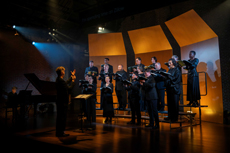
Theatre in Review: I Became We (Atlantic Theater Company) A sixteen-person chorus comes onstage and, accompanied by a piano, sings, "I saw a segment on Jimmy Kimmel Live, called 'What Do You Know About the Female Body?" Well, that's something you haven't seen before, is it? A bigger surprise: This thoroughly disarming opening is the doorway to enchantment. The playwright Mona Pirnot specializes in highly personal theatre pieces from which she is notably absent, finding unusual ways to preserve her voice in performance. In I Love You So Much I Could Die, she sat facing upstage as her monologue, an extremely vague account of a family tragedy, was delivered in the calm, unemotional voice of a computer-driven text-to-speech tool. I Became We, a meditation on family, children, house hunting, and other domestic matters, might make an amusing solo piece, the sort of thing one might see at Greenwich House Theater or Soho Playhouse. Here, it is transformed -- elevated, really -- by Jack D. Coen's lovely, lilting choral score. It's a song cycle about the cycles of life, how the decisions one makes at, say, 25, look starkly different at ten years later. That Jimmy Kimmel opening, including a riotous sequence in which men reveal they can't tell a cervix from a uterus, leads to a passage about the nerve-jangling qualities of friends' children. Meanwhile, Pirnot (for surely the chorus is voicing her thoughts), having had a couple of well-received Off-Broadway shows, is relentlessly courted by entertainment executives desperate to know what's next. (A friend notes, "You have finally begun to see the fruits of your hard labor...and the wisdom of your pain.") But, shaky from all the coffee consumed, uptown and downtown, at meetings, and feeling panicky about not getting her work done, she begins dreaming of a home outside the city. This cues a fugue about Zillow.com that, in its descending melody, is one of the score's most charming passages. Next, she and her husband arrive in Beacon, New York, where Ashley, a relentlessly upbeat actress-turned-broker, takes them on a tour of available housing. Visiting a "fixer-upper," her husband wonders, "Well, if that's what this one is, what was the last one?" He means a "wonderful house" (Ashley's term) filled with aged appliances, a problematic septic system, and a menacing tree hovering over the neighbors' property. The house-hunt ends successfully but, combined with her mother's retirement and decamping to Italy, it stirs up longings Pirnot never imagined. These musings are captured in deft, witty lyrics (co-written by Pirnot and Coen) riding on waves of music that instantly identifies Coen as a distinctive composing talent. Conducted by Coen, with lovely piano work, including solos, by Blair McMillen, the score races with Pirnot's train of thought, totting up her husband's many nervous triggers ("overcrowding, unpredictable movements, changes in routine") and trying to explain the work of her mother, a mathematician whose work "led to the technology/for facial recognition/and I hardly understand it/so I could be getting all this wrong." Underneath, however, a plangent tone emerges, cueing the realization that the clock never stops ticking and even the longest life isn't enough for all that one wants to do or be. Sarah Benson's light-touch staging features a production design that appears to be simplicity itself, beginning with Mimi Lien's arrangement of concert risers and acoustic panels, which transforms the Atlantic into a mini-concert hall. But it's the result of meticulous detail work: The costumes, by Louisa Thompson and Gylanni Carrington, deliver many subtle variations on the theme of black evening wear. I couldn't tell if the choir was amplified; if so, Palmer Hefferan has done an outstanding job, so much so that projection designer Nicholas Hussong's surtitles are hardly necessary. Tuce Yasak's extraordinary lighting demonstrates the astonishing variety of looks possible via shifting angles and warm-cold contrasts. She also picks out each singer's face with pinpoint precision. And the voices are glorious; the soloists are not identified, but the quartet that delivers many key passages is especially ravishing. Even in an unusually rich season for original musical theatre, I Became We stands out for its fresh approach, its powerful evocation of time's passage, and its sheer lyricism. It's an authentic offering of grace, a gift that fills the autumn season with gorgeous emotional colors. --David Barbour 
|