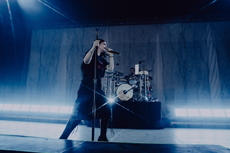
GLP JDC2 IP Debuts Firmware 2.0 on Spiritbox's North American Tour Most touring lighting designs are built from a palette of fixture types. The 2026 North American tour starring the Canadian heavy metal band Spiritbox had just one. Lighting designer and programmer PJ Carruth carried 20 GLP JDC2 IP fixtures and nothing else, running firmware 2.0 in what is believed to be the first touring deployment of the 2.0 release. Carruth is a Los Angeles-based designer and programmer who came to lighting through mathematics and science, first learning moving lighting programming from his high school math teacher and continuing the trade through his applied physics degree. "I'm typically hired for timecoded productions that seek a high level of syncopation," he says. "Most of my clients admire my engineering mindset and my applied physics background. It makes me a good fit for unique applications." Spiritbox presented a particularly unique design element to Carruth. The band moves between crushing rhythms and long atmospheric sections, often within the same track. The lighting had to articulate that structure rather than simply keeping pace with it. Carruth's programming leans into the percussion, treating light as a form of annotation for the music. "Spiritbox wants staccato in their visual production, so my programming leans heavily into the percussion elements of their songs," the designer says. "It's important for the lighting to set each moment's unique mood, acting as visual subtitles throughout the set." Volt supplied the touring package. The units are arranged as a single row across the upstage floor. Committing to doing the entire show with a single fixture type placed considerable weight on the range of the JDC2 IP. "We knew that for this tour, we needed a Swiss Army Knife for a fixture," Carruth says. "The greater JDC family has always been the greatest engineered set of strobes on the planet, especially with how the control modes don't belittle the intelligence of the programmer. We knew we were only going to bring one fixture type out, so we needed something versatile, and there's nothing more versatile than the JDC2 IP. A full-length set can have a completely different look for each song." The Spiritbox set is fully timecoded, and for Carruth, a fixture's suitability for that workflow comes down to how faithfully it responds to DMX rather than what its feature list claims. "The JDC2 is a responsive, reliable fixture that doesn't seem to have any measurable input latency, making it ideal for timecoding to a grid," he says. "As someone with a background in digital communication theory, I don't believe that LED fixtures should necessarily need a shutter channel. A lot of my programming relies on Nyquist effects rather than sync shutter looks, and random generators rather than random shutter looks, so I very much judge a fixture's response to DMX signals." The JDC2 IP pairs a 12-segment beam line of 84 LEDs with a 1,728-LED color plate offering individual pixel control. It generates digital content through GLP's DigiFX, directly controllable from the lighting console. These are real-time algorithms running on the fixture's onboard dual-core processor with no media server in the signal path. It can also display NDI video streams on its LED plates. "We love the DigiFX system. It is truly brilliant how it all comes together to produce a constant pattern across all JDC2s with DMX-configured canvasing," Carruth says. "I initially programmed the entire set with no external video and all DigiFX. Once we got to rehearsals, I added some NDI cues, but with how MA3 handles recipe tagging, I was able to keep all the DigiFX programming as emergency video-failure looks at the single click of a macro. I was never stressed if our media server failed." Firmware 2.0 introduces a canvas-based positioning workflow with relative, absolute, and segmented modes, allowing fixtures to be placed within a defined coordinate space so that content maps accurately across a group rather than repeating identically on each unit. For a row of 20 fixtures acting as a single surface, this is the difference between 20 strobes and one continuous canvas. "Canvasing was way more user-friendly than I could have imagined," Carruth says. "It did not take me long to make DMX presets for the various canvases I wanted to use and then apply them to either the DigiFX or the video stream." The JDC2 IP accepts up to four external NDI streams directly over its 2Gb EtherCon ports, without a dedicated interface or external video processing. Having built the show initially only on DigiFX, later on, Carruth additionally layered NDI content during rehearsals after the production's VJ presented looks that suited particular cues. The performance of that path proved better than the rest of the video system around it. "The initial programming was all DigiFX, but during rehearsals, our VJ demoed looks that we added to various cues," Carruth says. "We found the latency to be near zero, even to the point where the video walls and the projector lagged behind the JDC2s." That capability produced the moment Carruth singles out from the set. During a spoken poem interlude, the same content ran simultaneously across the IMAG screens, the projector and the row of JDC2 IPs, with the strobes carrying legible text as part of the composition. At the tour's outdoor shows, where projection and screens lose contrast to ambient light, the fixtures' contribution became disproportionately important. "During the interlude, the IMAG, projector and the JDC2s were all showing the content. For those outdoor shows, the feed on the JDC2s made a world of difference," Carruth says. The practical demands of the run were as significant as the creative ones. Changeover windows and console time were both short, leaving little margin for a rig that needed coaxing into position each day. "Our changeover time and console time were very short on this run, but the setup and the programming of these lights were so streamlined that we weren't stressed about getting everything working quickly," Carruth says. "I'm very excited to incorporate these fixtures into future productions." 
|