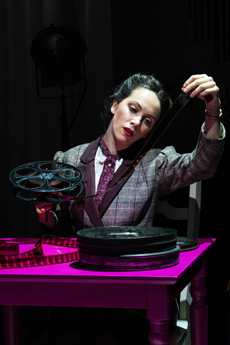
Theatre in Review: Beauty Freak (the cell) There's a telling moment not too far into Beauty Freak that crystallizes everything one needs to know about its central character, the notorious filmmaker Leni Riefenstahl. She is riding high, having landed the commission from none other than Adolf Hitler to make a documentary about the 1936 Berlin Olympics. Feeling ebullient, she celebrates the birthday of Ernst Jaeger -- her confidante, ghostwriter, press agent, and all-around factotum -- with the gift of an expensive watch. He is stunned, yet grateful for her largesse. Perhaps unconsciously referring to Ernst's Jewish wife, which leaves him in an alarmingly shaky position under the Third Reich, she adds, "And you can always sell it if the work dries up." This sort-of-but-not-really joke reveals the Riefenstahl captured so thoroughly in James Clements' play: A live-for-today gal, yet always with a Plan B in mind, just in case the bottom drops out. Not that she imagines ending up in a jam like Ernst, whose days of freedom are surely numbered. In Leni's view, she is an artist, rising above politics but with all the right connections, and the future is limitless. Regarding her Nazi-adjacent career, she is a moral gymnast whose self-exculpating exertions are more strenuous than anything caught on film in Olympia. Such was her cross to bear for the next seven decades. Living at the corner of blind ambition and impregnable narcissism, Riefenstahl directed two cinematic masterpieces that also happened to be horrendous examples of Nazi propaganda, then spent the next several decades swearing that she wasn't Hitler's gun moll, insisting she was always in another room when the Final Solution was being discussed. Few, if any, bought her denials, although she managed to reinvent herself as a photographer and author, living to the ripe old age of 101. (For the whole unbelievable truth, check out the superb 1993 documentary The Wonderful, Horrible Life of Leni Riefenstahl.) Beauty Freak covers a decisive turning point in Riefenstahl's fortunes, following her as she films Olympia, basks in its success, and makes a disastrous tour of the US hoping to launch a Hollywood career. (By all accounts, Marlene Dietrich's stardom ate at her like a slow-acting poison.) Clements' script is uneven, to be sure, but the spectacle of Leni carefully walking her moral high wire, looking on as friends and colleagues take terrible falls, cannot be denied. Her skirmishes with propaganda minister Joseph Goebbels have plenty of crackle, their hostile exchanges sheathed in good manners. (He has little use for "lady directors" making big-budget demands; she wields her closeness to Hitler like a cudgel.) Her second greatest gift is for evasion. When a gay colleague disappears, she angrily blames "a segment of his followers who have, clearly, corrupted his message," then quietly tears up the letter she has been bullied into writing on his behalf. Hearing about the suicide of an acting colleague, who ran afoul of the Nazis, she pleads ignorance, adding snappishly. "I've been working so much these past three years. And like I said, when I work, I have four walls up around me. I don't pay any attention to the outside world. That is not my department." But it is the 1930s, Europe is in turmoil, and politics cannot be ignored. Arriving in the US even as Kristallnacht unfolds back home, she is drowned in oceans of bad press coverage. In the play's most gripping scene, Leni, at dinner with Hans-Heinrich Dieckhoff, the German ambassador to the US, has her face rubbed in the Nazi hatred she for so long has deftly skirted. Dieckhoff defends the Nuremberg Laws, which functioned as a kind of coming-attractions trailer for the Holocaust. "These people are non-compatible with Western Civilization," he says, adding that "they took advantage of the Republic to peddle filth and revolutionary dissent." (He also notes that Americans should talk, given their treatment of the country's Black population.) As his conversation reaches its ugly climax, she excuses herself to the restroom, quietly screams, then returns to the table, steering the conversation in a more pleasant direction. It's putting it mildly to say that Leni is a tricky character for any actress, but Baize Buzan has a solid grip of her contradictions: Making insanely elaborate plans to film Olympia, she marshals her creative troops with the skill and magnetism of a seasoned general. (Her plans include restaging certain sports events to capture them in detail and using the camera to give Hitler a godlike mien.) She skillfully defends herself as an apolitical purveyor of beauty, furiously using feminism as a last defense. ("You don't think a weak little lady director is up to the challenge?') Saving her pity for herself, not those whose lives are destroyed, she is a wounded narcissist at bay, lashing out at her perceived enemies and slipping by degrees into Nazi true-believer status. "Has it ever crossed your mind that I have flourished because I am excellent?", she asks Ernst, offended at having her intentions questioned. The script has its limitations and weaknesses, especially Leni's confrontation with Walt Disney, which doesn't come off dramatically. Riefenstahl really did meet with Disney, and he did refuse to let her screen Olympia for him, but here the writing feels forced and artificial; why does he agree to see her if she is persona non grata? It doesn't help that Clements, who plays him, appears clutching a gold statue of Mickey Mouse, as if he had just been awarded a special Oscar. (Interestingly, Hedda Hopper loved Olympia and thought it should be released here as a tribute to American athletes. It's just what you'd expect from a red-baiter who once dismissed M-G-M as "Moscow-Goldwyn-Mayer.") Overall, a certain Teutonic quality is missing; the dialogue is flecked with too many modern-day neologisms like "married to the job," "pass in a flash," "cut to the chase," and "shoot me now." Danilo Gambini's production also has its questionable aspects; the play cries out for a projection design that would evoke Riefenstahl's aesthetic. As read, the final scene, in which Leni confronts a wounding personal betrayal, is devastating; as staged, it doesn't quite come off. Still, the playwright has done his research, he writes plenty of live-wire dialogue, and he gets at Riefenstahl's maddening, magical, shockingly self-aggrandizing nature. (Without him saying so, the parallels with today's MAGA acolytes are made scaldingly clear.) Providing Buzan with effective opposition are Peter Coleman's Goebbels, purring his lines like the cultured Nazi swine in a 1940s Hollywood film; Slate Holmgren as Dieckhoff, whose defense of a disrespected, brutalized Germany feels scarily contemporary; and Keith Rubin as Ernst, who, without raising his voice, delivers Leni's most damning indictment: "You don't have autonomy, you have access. You agreed to make films for Hitler in exchange for influence and money and fame. But it didn't give you autonomy. You scrubbed the Jewish names from your film credits just like everyone else." The production has been carefully designed to fit on Suzu Sakai's tiny circular stage, with the all-male supporting cast on the sidelines, attending to Leni as needed. Yung-Hung Sung's lighting creates a series of useful looks playing warm and cold white tones against each other; he also deploys a spinning effect on the stage look, which, combined with a clicking sound from Liam Bellam-Sharpe's solid sound design, suggests a film projector in use. (A quartet of studio lighting units could be better used, however; you may find yourself with light in your eyes more than you would like.) Stephanie Bahniuk's costume design combines well-tailored period men's suits with Leni's all-business wardrobe. Beauty Freak stands as a companion piece to Mark Rosenblatt's Giant, now on Broadway, in wondering how such a gifted artist could be such an appalling human being. It's a question that never goes away, alas, and it's to Clements' credit that he tackles it with such vigor. By exploring his protagonist in all her terrible complexity, he can truly be said to give the devil her due. --David Barbour 
|