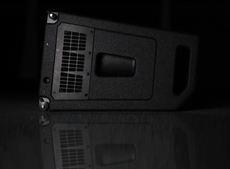
dB Technologies Debuts VIO L1606 Loudspeaker at NAMM dB Technologies debuted its VIO L1606 loudspeaker at the NAMM 2026 Show, January 21 to 24, at Anaheim Convention Center. When its engineering team began developing the newest member of the VIO Series, the goal was not simply to build another compact line array. The ambition was to create a true three-way system the size of a traditional two-way dual-8" enclosure, one capable of delivering dramatic output, clarity, and the flexibility required in today's touring and installation environments. VIO L1608 advances the company's R&D into precision-scaled acoustic architecture -- in other words, bringing three-way performance to an enclosure the size of a traditional two-way dual-8" array. Although its footprint mirrors that of a standard two-way compact array, the L1608 is unmistakably a three-way design. Inside the enclosure, dual 8" neodymium LF drivers work alongside a coaxial MF-HF assembly powered by a 1,600W RMS Class-D amplifier. An optimized waveguide on the coax assembly and a low crossover point around 600Hz extend part of the midrange into the horn, producing a stable horizontal response and an open, natural midrange character that translates consistently across listening positions. Supporting all of this is dBTechnologies' Side-firing Bassreflex Port geometry, which manages airflow through lateral acoustic paths to reduce turbulence, stabilize internal pressure and increase low-frequency efficiency. This design contributes to the system's output performance relative to its reduced physical volume, the company says, offering the ability to transport, deploy and fly -- if necessary -- by a single technician, without sacrificing performance. That aspiration led to the development of VIO L1608, a deceptively compact module shaped by the same engineering philosophy that guided the evolution from the VIO L210 to the acclaimed three-way VIO L1610. Where the L1610 redefined what a dual-10" enclosure could achieve, the L1608 brings that mindset into the dual-8" category, extending its reach into performance spaces and applications traditionally reserved for larger systems. In keeping with that lineage, the L1608 exhibits several design principles that shaped the success of the L1610, adapted for scale and optimized for this platform. These include hybrid midrange propagation through both waveguide and horn for improved pattern precision, an enhanced three-point rigging system that accelerates deployment and increases safety, and improved environmental protections such as sealed electronics, upgraded moisture treatments for transducers and a fibrous protective layer behind the grille that helps reduce water ingress. L1608 also incorporates current-generation VIO technologies, including inclinometer integration, opto-isolated preamps to minimize unwanted noise, NFC-assisted positioning and a bright front ID LED designed for visibility during setup and system verification. For the first time in a VIO module, the award-winning A2Net protocol is included as a standard feature, enabling high-resolution digital audio distribution and complete Aurora Net control. Optional Dante interface remains available for networked environments requiring advanced routing and integration. As part of the VIO ecosystem, the L1608 fully benefits from the unified platform established with firmware 2.0. All VIO modules running this firmware share matching phase response, latency and input sensitivity, allowing engineers to deploy different models together with complete consistency. This uniformity lets the L1608 operate as a standalone main PA, as a compact touring system, as a down-or side-fill for larger arrays such as the VIO L1610 or L212, or as a flexible utility element in complex touring configurations. For rental houses, this consistent behavior across formats reinforces VIO's user-centric philosophy: every box in the VIO platform functions as part of the same sonic and operational language. The introduction of the DRK-28 flybar further contributes to this unified workflow. Supporting both flown and stacked configurations, is mountable directly onto the dolly, the DRK-28 reduces accessory demands, accelerates load-in and simplifies logistics across compact VIO systems. Its compatibility ensures that deployment practices remain predictable. 
|