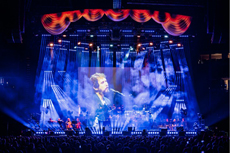
Bringing the Cinema to the Arena for Josh Groban's Tour For Josh Groban's recent Cinematic Tour, production/lighting designer AJ Pen used projection, layered scenic reveals, and carefully timed moments that echoed the visual language of classic cinema. Curtains parted to reveal new environments, an 18-piece orchestra became part of the composition, and every reveal arrived in service of the music rather than the technology." Helping bring Pen's vision to life was a production team anchored by production manager James Pettinato, tour manager Dani Gore, and PRG's touring crew led by lighting crew chief Terry Mueller and video director Matthew Howe. PRG account executive Burton Tenenbein worked alongside the production during prep, continuing a collaborative relationship with Pettinato that spans multiple tours. After a powerhouse opening set by the EGOT-winning special guest Jennifer Hudson, the main show opened with Groban appearing on the B stage as imagery was projected onto a sharktooth scrim. It was a fittingly cinematic choice. Pen assembled the show's projection content from contributions by longtime creative collaborators 272 and So Midwest, a blend of newly created visuals, reimagined archival assets, and adapted lyric-video artwork. The layered composition was built from blackout drapes, a bi-parting traveler, a swagged proscenium header, and a dedicated projection screen. Even floor-mounted film-style Fresnels contributed to the aesthetic. As the performance progressed, the blackout drape disappeared to reveal the concealed lighting rig. Later, the scrim itself flew out before a bi-parting traveler opened to unveil a 32'-by-18' projection screen. Rather than presenting every visual element at once, the production revealed itself in carefully timed layers, allowing the stage to grow alongside the emotional arc of the music. Each tour stop incorporated a locally hired 15-person choir and 17-piece orchestra, requiring more than two hours of rehearsal every afternoon before the performance. Instead of treating the orchestra as a backdrop, Pen designed the stage around it. Strings were positioned downstage alongside Josh's performance area, brass players were brought forward rather than hidden upstage, and the choir rose behind the orchestra on tiered platforms. The arrangement created depth while ensuring every performer remained visible, turning the orchestra into an architectural element rather than scenery hidden in the shadows. As Pen describes it, "I paint the orchestra." That daily rhythm extended beyond the musicians. Every show day began with one of Pettinato's now-famous "Today's News" updates, a single-page bulletin blending logistical information with weather, venue notes, bits of trivia and often a healthy dose of humor. Crew members reference it throughout the day, and it has become something of a tradition on tours Pettinato oversees -- a small but telling example of the communication and culture that keeps the production running smoothly. "Jimmy runs a classic tour," says Tenenbein. "It's organized, collaborative, and built on trust. Everyone knows their job, communication is constant, and that allows the crew to focus on making the show better every day." PRG supplied the arena-scale lighting package, which gave Pen a broad palette. The rig included 62 ACME Tornados, 58 Vari-Lite VL3600s, 56 Martin MAC Quantum Washes, ten additional VL3600 fixtures used for followspot coverage, eight Elation KL Fresnel 8 FCs, four film-style Fresnels with barn doors and five Hazebase Base Hazer Pros. Controlled from a grandMA3 full-size console, the package balanced subtle, cinematic texture with arena impact, from the warm glow of the Fresnels to the sweeping aerial looks and automated followspot movement. One of the most striking aspects of the production is how selectively it deployed its technology. The design rarely felt driven by fixture count or movement for its own sake. Instead, lighting cues were carefully reserved for moments of musical significance. Numbers like "Sondheim Melody" and "Bridge Over Troubled Water" remained visually restrained, allowing Groban's baritone to command the room. One of the moments where the production intentionally expanded was "Alla Luce," where PRG's GroundControl Multi system controlled 18 automated followspot fixtures that moved in unison with Groban. "When he moves and all of a sudden you feel the whole lighting rig move with him, it's quite a cool moment," Pen says. "That's one where I have a lot of movement that goes through the audience, and some drama." Rather than relying on rapid cuts, Howe favored slow dissolves and layered compositions that allowed the imagery to breathe alongside the music. "There's a lot of slow dissolve," he explains. "I don't do a lot of cutting. It's really nice to be able to get into a creative flow every night." Working with an eight-camera package supplied by PRG, Howe treated the horizontal projection surfaces as an extension of the design, often blending two images to create a softer presentation. To maintain continuity as Groban walked through the crowd toward the main stage, Howe added a dedicated PTZ camera overlooking the Bstage alongside repositioned handheld and long-lens cameras. The camera package preserved intimate sightlines while allowing the production's theatrical pacing to remain uninterrupted. A pianist and composer himself, Howe says his background shaped the rhythm of his camera direction as much as the songs themselves, allowing the pacing to rise and fall with Groban's performance each night. 
|