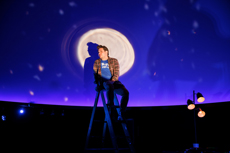
Theatre in Review: 73 Seconds (En Garde Arts)Just in time for Mother's Day, we're getting a matched set of shows in which middle-aged playwrights brace themselves for the loss of their beloved mothers. Trouble is, they seem more worried about themselves than the ladies in question. In Rheology, reviewed a couple of weeks ago, Shayok Misha Chowdhury works himself into a positive lather over the impending passing of his mother, Bulbul Chakraborty, never mind that, by all accounts, she is hale, hearty, and ready to give a physics lecture on cue. Jared Mezzocchi has a sadder, more complicated story to tell, filled with the sort of piquant details that might make it an ideal Personal History feature in The New Yorker. In its current form, however, despite some lovely theatrical touches, it is a curiously one-sided affair, which warrants further investigation to achieve the powerful dual portrait it wants to be. In 73 Seconds, Mezzocchi touches on three key moments in life with his mother, Rosemary, a high school algebra teacher and award-winning coach of the MathCounts team. (As he amusingly grumbles, "After trying out for it two years in a row, she reluctantly gave me the role of the alternate in case one of the MathLetes got sick." That's a tough customer.) Each of these episodes ends in a discovery that leaves Mezzocchi feeling strangely on the outs of what he always assumed was an extraordinarily close relationship. Who is Rosemary, and why does she sometimes keep him at arm's length? Warning: Spoilers ahead, but it's the only way to get at what makes 73 Seconds so interesting yet oddly unsatisfying. The first shocker comes when, during a celebration of Mezzocchi's high school graduation, he learns his mother once worked for NASA. He is even more stunned to learn that she was a potential candidate for the Challenger mission, only dropping out when she became pregnant with him. The second, more upsetting, incident involves his father's shock death from a brain aneurysm; racing from his college in Connecticut to the hospital in New Hampshire, he repeatedly calls Rosemary, who, instead of telling him the truth, cryptically repeats the phrase, "He's in the same condition." It's not until he arrives in person that her hand is forced. The third, and most devastating, moment comes when, on a visit home to introduce his new girlfriend, the adult Mezzocchi sees Rosemary melt down horrendously over a simple game of cards; as his panicked, overwhelmed stepfather finally admits, Rosemary is struggling with Alzheimer's and is in denial about it. Taken together, these events make a strong case that Rosemary is, and maybe always was, withholding things about herself, making her unknowable in a way that Mezzocchi cannot accept. Of course, the last part is the most wrenching, since his mother is still with us. "What am I doing, memorializing someone who's still alive?" he wonders, sadly, questioning his motives in creating the piece we are seeing. Then again, her loss of self is arguably the true reason for the existence 73 Seconds. "Why did you keep this from me?" he asks about the news of his father's death; now, of course, he can never get an answer from her about this and many other questions. Still, for all that is intriguing and well-told about 73 Seconds, much remains unspoken. One can easily imagine that Rosemary -- who was apparently happily married and a first-rate teacher -- chose to tuck away her NASA career in a mental filing cabinet; she might not have been keen to relive when she and the entire student body of her school, assembled in front of a television, saw the Challenger go up in flames. Mezzocchi reports feeling guilty about having derailed his mother's space career. Then again, you can argue that he is the reason why she is alive today. Similarly, Rosemary's inability to share the news of her husband's death with Mezzocchi may well be the product of a woman in a profound state of shock over a medical event nobody saw coming. And it is far from unusual for married couples struck by Alzheimer's to soldier on for a time, ignoring the obvious decline until reality catches up with them. In each case, the playwright can't help framing himself as the victim of Rosemary's choices, when the truth is surely messier, the result of multiple (and conflicting) motives. The difficult truth might be that, in each case, she wasn't thinking of him at all. Aya Ogawa, who co-developed and directed 73 Seconds, might want to work with Mezzocchi, a multimedia designer turned writer and performer, on relaxing and letting his text work for him; at times, he pushes for big emotions when restraint would get the job done more efficiently. Ogawa might also ask him some tough questions about his maternal portrait; as the author of the powerful theatre piece The Nosebleed, Ogawa has something to say about complex parent-child relationships. Still, Ogawa's design team surrounds the star with an evocative environment. This is a production of En Garde Arts, which specializes in site-specific works, in this case, the Lower East Side Girls Club Planetarium. The visual component ranges from cosmic vistas on the room's curved ceiling to images delivered via a good, old-fashioned overhead projector; both media allude to different aspects of Rosemary's professional life. (One of the most poignant images features Rosemary as Mezzocchi's date at the Obie Awards in happier times.) The design credits are rather hard to parse in a way that suggests everyone had a hand in everyone else's business: Calvin Anderson is listed as production designer, scenography lead, and production manager; Jeanette Oi-Suk Yew is production designer: light lead and video consultant; and Vinny Mraz is production designer: technology lead. In any case, sound designer Ryan Gamblin creates effective spatialized soundscapes of Rosemary's voice, as heard in conversations recreated by Mezzocchi. Despite everything, 73 Seconds is an honest grappling with a revelation that, sooner or later, comes to us all, that our parents (even the most loving among them) remain as mysterious as some distant unexplored galaxy. It's the nature of the relationship: What we do know of them is the merest iceberg tip; a deeper grasp of the facts might painfully conflict with the persons we need them to be. It's an impossible situation, and the only balms are love and understanding, applied to the best of our abilities. Mezzocchi's script points the way to this profound truth, but it hasn't gotten there yet. --David Barbour 
|