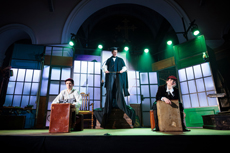
Theatre in Review: David Copperfield (Guildford Shakespeare Company/59E59)Abigail Pickard Price seems to have a novel turn of mind, having previously been associated with stage adaptations of Pride and Prejudice, The Hound of the Baskervilles, The Prince and the Pauper, and Graham Greene's Our Man in Havana. She turns up here in David Copperfield as the adaptor and director of the Charles Dickens classic, given the once-over-lightly, Classics Illustrated treatment courtesy of a trio of energetic actors. It's a fast-paced, giddy trip through the David Copperfield Museum, with the cast members as our docents, pointing out the highlights. Condensing the sprawling novel to a little over two hours, cuts have been made. Mr. Barkis is no longer willing, because he is missing in action. Mr. Murdstone still casts a sinister shadow across the story's early passages, but his sister has vanished from the scene. If you blink, you'll miss young David's nightmarish employment in a bottle factory, one of Dickens' indictments of the Industrial Revolution's grim excesses. Even when characters are given stage time, they don't always register strongly: The tragic Emily, seduced by David's false friend Steerforth, then sinking into prostitution, comes and goes so quickly that the situation carries little emotional impact. For that matter, David's friendship with Steerforth, which runs the gamut of (platonic) infatuation to profound disillusionment, is little more than a minor plot point here. You do get the main thrust of the plot, which, in true Dickensian fashion, is cunning enough, proof that no greater storyteller ever walked the earth. What you don't get is the true point of David Copperfield, which is how the title character's varied, tumultuous experiences over two decades shape his character. The novel is the biography of a soul; here, it is often played as sketch comedy, with the actors swapping out roles at a frantic pace. They are, to be sure, quite gifted: David, who remains essentially passive in a whirling universe of eccentric, grasping, selfish, predatory, and occasionally saintly characters, is a tough challenge, but Eddy Payne is such a stalwart presence that he effectively serves as an anchor to the intrigue-filled action. Louise Beresford capably takes on a multitude of female roles, scoring especially as the dotty, donkey-phobic Aunt Betsey Trotwood, who abandons David as an infant for the sin of not being a girl, only to ultimately become his benefactress and, later, be rescued by him from financial ruin. Beresford is also the principal victim of the production's jokey approach: Dickens makes it patently clear that Dora Spenlow, the "child wife," is an unsuitable mate for David; here, she is made into such a ninny that one prays for the Grim Reaper to arrive at the earliest possible moment. The production could also give more stage time to Agnes, David's true love, who vanishes from the story for much too long. (Beresford is, however, an ideally slimy Uriah Heep, slithering about the stage dispensing false compliments while plotting nefarious deeds.) Partly because he is given the best opportunities, the production's standout is Luke Barton, creating an astonishing gallery of characters: in drag as the servant Peggotty; sneering with grim authenticity as Mr. Murdstone; descending into alcoholism as Mr. Spenlow, Agnes' father; and padding about, spouting bizarre theories, as Mr. Dick, Aunt Betsey's oddball companion, and, I suspect, one of the first on-the-spectrum characters in English literature. Especially rich is his Mr. Micawber, cheerfully perched on the edge of ruin, triumphantly announcing, "I am an insolvent debtor!" The weakness of this Reader's Digest Condensed Books-meets-SNL approach is its attempts at kidding Dickens undermine what makes him so great. Especially in the first act, we are never allowed to forget that we are watching actors at work, aided by various tricks involving puppets, designed to keep the stage fully populated. Something happens in the second half, however: Dickens can't help asserting himself and, as the action reaches its frantic climax, involving sudden deaths, emigrations, and the uncovering of financial chicanery, one can't help getting caught up in it all; even the most skeptical may find themselves very much moved. But it takes a long time to reach this emotionally satisfying place. The production design is appropriate and accomplished, with Neil Irish's set, featuring a series of storefronts, given a gorgeous, colorful patina by lighting designer Mark Dymock. Irish's costumes, co-designed with Anett Black, are both stylishly in period and cunningly engineered for ultra-fast changes. Matt Eaton's sound design is solid, including the preshow compositions by the Northern Ireland composer Alexander Faris, which strike the right mood. This production is solid enough that anyone looking for a literate light entertainment may have a good time, if they don't mind getting the most superficial version of a great novel. I am one of the hardy few who still recall the disastrous 1981 Broadway musical Copperfield -- I'm still not over Uriah Heep cakewalking to a brassy number titled "Umble" -- and I can confidently say this version towers above that. But, at the intermission -- an audience member seated near me turned to her friend and, gushing, said, "It's so cute!" That, I'm sorry to say, is a just verdict.--David Barbour 
|