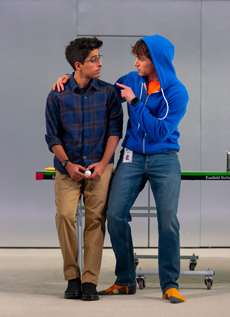
Theatre in Review: Data (Lucille Lortel Theatre) "Data is the language of our time. And like all languages, its narratives will be written by the victors." This statement, meant to reassure, is one of the most chilling in this new thriller, and that's saying something. It is delivered by Alex, a super-slick software mogul, to Maneesh, a new hire, who, reluctantly, may hold the key to his company's future success. It also speaks to the heart of Data, which grapples with the technological juggernauts that are rewiring our lives daily. The debuting playwright Matthew Libby invents an all-too-plausible scenario in which the future of American democracy hangs on an algorithm's performance, putting the outcome in the hands of a callow, troubled recent college graduate. Scary enough for you? Maneesh isn't altogether happy to be in Alex's office; he prefers to keep a low profile, writing code in the relatively mundane user-experience department of Athena, a Silicon Valley colossus. But he is something of a genius, who, in college, developed a "predictive algorithm" for "rare events." Designed to forecast baseball players' performances, Maneesh's invention is ripe for exploitation by unscrupulous users -- investment groups and lobbyists come sniffing around -- so he has hidden it away. But Alex gets wind of it, and he wants it. Badly. Indeed, Alex is under severe pressure, racing to fulfill a make-or-break government contract. The brief: a software that "can analyze applications for immigration benefits to the United States, and then, utilizing government, federal, and local databases, as well as databases acquired from third-party brokers, make a determination whether said applicant will be positive and productive addition to America and its values." As a colleague notes, the task is to "find data that's more in line with people's hearts." The possible misuses of this technology are too obvious to spell out, but Alex, whose affable facade fronts an ocean of flop sweat, keeps upping his Faustian offers to Maneesh. At his wiliest, he relies on their mutual outsider status -- Maneesh is the son of Sikh immigrants, Alex is a Singaporean native with a considerable history of visa troubles -- insinuating, "It's about people like us having a seat at the table." But Libby springs a double trap: Maneesh was brought to Alex's attention by Riley, a former school acquaintance, who is already attached to the project, and, horrified by its implications, hungers for a comrade to help bring it down. Maneesh is simultaneously tempted by money and prestige, and burdened with an urgent, unwanted moral dilemma. The complications hardly stop there. Maneesh's past includes substance abuse, attempted suicide, and a family tragedy guaranteed to haunt him permanently. He is also gay and possibly closeted. And he has an especially awkward connection with Riley, who has seen him at his worst. Lurking on the sidelines is Jonah, Maneesh's supervisor, a mediocrity by his own admission, who will do anything to hang on to his job. It's quite a tangle, informed by Libby's knack at suggesting complex emotional states in two or three lines; aided by Tyne Rafaeli's direction, he also works up a supremely paranoid atmosphere informed by NDAs, clandestine scheming, and a culture of surveillance. Data is that rare thing, a moral thriller, its suspense rooted in the characters' decisions and identities. Keep an eye on Karan Brar (a former Disney TV star in his theatrical debut) as cagey, wounded Maneesh, deftly using his poker face in pressing confrontations. (Among other things, he fears that his algorithm would bar people like his parents from entering the country.) Sophia Lillis lends conviction to tense, panicky Riley, who, improbably, thinks she and Maneesh can leak bombshell revelations to the New York Times without losing their jobs. Justin H. Min is candid, affable, and utterly untrustworthy as Alex, pressuring his subordinates with a sympathetic smile. As Jonah, Brandon Flynn's tech-bro geniality contrasts starkly with his clumsily calculating nature. The scene in which he tries to cut a deal with a cold-eyed Alex is equally riveting and cringeworthy. Libby is good on Athena's adolescent workplace culture, which keeps employees happy with endless ping-pong sessions and Taco Tuesdays. And his alarming ideas about digital technology and immigration control offer plenty of ripped-from-the-headlines shudders. Rafaeli keeps the action exquisitely taut, and her designers create an immaculate, yet sinister environment. Marsha Ginsberg's sparsely furnished set, featuring walls that resemble airbrushed aluminum, is burnished by Amith Chandrashaker's lighting, which leans toward deep blue, acid green, and clinical white color washes; during scene changes, he provides LED chases embedded in the proscenium, paced by sound designer Daniel Kluger's use of EDM. Enver Chakartash's costumes smartly note each character's response to a workplace where every day is casual Friday. Not a gimcrack piece of crime fiction, Data doesn't pretend that the march of new technology can be stopped. Instead, he interrogates his characters, asking them what they intend to do about it. Can they save the world? Probably not. Can they save themselves? That is the question. --David Barbour 
|