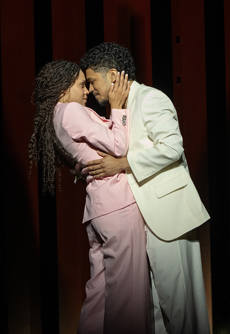
Theatre in Review: Romeo and Juliet (New York Shakespeare Festival/Delacorte Theatre)This new Romeo and Juliet is a good example of the strengths of Shakespeare in the Park productions and the weaknesses of some Public Theater offerings. The good news: Saheem Ali's staging is clean and swiftly paced. Everyone onstage moves with purpose, determined to drive the action of William Shakespeare's tragedy to its dark conclusion. Even as one scene ends, another is already starting up; dead air will not be tolerated. This extends to the finale: As Juliet recovers from her drug-induced sleep, she sees the expiring Romeo, mistakenly thinking he has come to her rescue. It's a split-second misunderstanding, delight instantly turned into dread, that adds to one's sense of young lives destroyed amid the pointless conflict swirling around them. The production is also well-cast. Daniel Bravo Hernandez, recently of the Drama Desk Award-winning ensemble of Spread at INTAR Theatre, is an earnest, upright Romeo, a good fellow maddened with passion for the first time and nearly undone by it. He has a solid classical technique, so, with luck, we'll see him take on more such roles soon. Ra'Mya Latiah Aikens, a recent NYU graduate, is a real find as Juliet: bright, coltish, and bursting with good humor before being overtaken by events beyond her control. Note how she dispatches a kiss from Paris, her would-be lover, or, giggling and overcome with thoughts of Romeo, she mischievously makes out with her pillow, like every adolescent girl since the invention of bedclothes. More than any other Romeo and Juliet in my memory -- including Kit Connor and Rachel Zegler on Broadway a couple of seasons ago - Aikens and Hernandez really come across as lovestruck adolescents, made reckless by feelings they never imagined having. Ali stages a lovely first meeting for them that makes clear the force of their attraction, and the balcony scene is suffused with the pure joy of their mutual discovery. The key supporting roles benefit from equally assured performances. Caleb Joshua Eberhardt's Mercutio has such authority that it's little wonder that Romeo looks up to him. Glenn Fleshler's Lord Capulet is both dignified and, ultimately, more than a little villainous; you'll feel the chill when, turning on Juliet and dismissing her objections to Paris, he announces, "An you be mine, I'll give you to my friend/And you be not, hang, rot, beg, starve, die in the streets." Lady Capulet is, to my mind, one of the most difficult roles in Shakespeare's canon. (One minute, she is deep in mourning for the slain Tybalt; the next, she's frantically planning a wedding like a mother of the bridezilla; what's with her?) But LaChanze demonstrates a strong bond with Aikens' Juliet, which helps to explain her often-misguided attempts at securing her daughter's future. In Francis Jue's portrayal, Friar Laurence is a dominant figure, presiding over the action like a priest conducting a requiem Mass. The always delightful Deirdre O'Connell makes an achy, cranky, caustic delight of the Nurse, sharply telling Juliet, "Do you not see that I am out of breath?" before lighting up a cigarette, and applying an earthy cackle to her charge's follies. Delacorte productions, designed for vast audiences and presented on an enormous stage, tend to be rendered in broad strokes, and there's nothing wrong with that, especially when the text is rendered clearly and with passion, as it is here. But perhaps because this is a Public Theater production, Ali seems bent on making a political statement. Fair enough: The Verona of Romeo and Juliet is being ripped apart by dueling factions, a mirror image of life in America today. There's probably a way into the play that makes it into a comment on our own torn social fabric. Instead, Ali goes all-out on the hot-button issue of immigration for reasons that never become clear. Maruti Evans' set is dominated by an enormous chevron-shaped wall located upstage, backed by two enormous statues, one a Madonna figure and the other a looming death's head. It is, apparently, meant to echo the construction along our Southern border. Early on, actors appear with a sign, saying, "Defund the Wall." Later, a black-and-white US flag, often used to honor first responders, is affixed to the wall, only to be pulled down by Mercutio. Still later, another sign will announce "El Muro Mata," Spanish for "The Wall Kills," and the stage is briefly occupied by demonstrators in camouflage outfits. At some point, somebody paints "Abolish ICE" on the wall. But Romeo and Juliet has nothing to say about such matters, and Ali's attempts to affix his theme to Shakespeare's text are awkward in the extreme. There are fascist hints in Oana Botez's costume for the Capulets, which favor tailored black outfits with a military tone. (Tybalt, given a notably sinister cast by Ariyan Kassam, calls to mind one of 1930s-era blackshirts.) But if immigration, indeed any government policy, is the issue dividing the Montagues and Capulets, you have to guess it. I found myself grabbing at straws: Romeo is exiled from Verona; does that make him an alien? Further muddying matters, the characters all drop into Spanish from time to time; if we're inside an all-Latino society, then who are the outsiders? The defund-the-wall theme keeps intruding on the action, adding nothing, and sometimes distracting from the production's best moments. The production is also marked by many little touches that depart from the original text for little or no reason. These range from changing Friar Laurence's name to "Lawrence" to Juliet killing herself not with a self-inflicted stab wound but by kissing the expired Romeo's poison-stained lips. (We go from "Oh, happy dagger!" to no happy dagger.) If there were some discernible pattern to these fussings, they might yield some insight. Instead, one has a sense of a director eager, even desperate, to put his stamp on the drama without having anything coherent to impart. The production also piles on intimations of death a little too heavily: funereal crosses cluttering the stage, a silent chorus robed in black with goat-faced masks roaming like so many Grim Reapers, and an opening tableau, featuring the lovers in a gilded embrace, suitable for a mausoleum. Every single person at the Delacorte knows where the story is headed; there's no need to keep adumbrating it. Still, Christopher Akerlind's lighting, which ranges from floods of color for the Capulets' party to stark white looks suitable for the Verona morgue, is thoroughly assured, as is Mike Tracey's sound, which, even by the high standards of the Delacorte, is notable for its nuance and clarity. (It is entirely the Public's credit that the Delacorte has benefited all these years from such excellent sound design.) When Ali's direction sticks to the script's basic dynamics, Romeo and Juliet is a solid revival that, given its charismatic stars, would make a fine way of introducing young people to Shakespeare. But every time it tries to editorialize, it turns incoherent. It's a pity: The history plays -- including Henry VI, which we are about to see downtown at the Public -- demonstrate an insider's understanding of power politics that is thoroughly contemporary. (There's a reason we've been seeing Coriolanus so frequently in recent years; it nails our populist grievances with unnerving accuracy.) Alas, Romeo and Juliet is an imperfect vessel for such thoughts, and the strain shows. In a way, Ali's production recalls the Julius Caesar staged in the park in 2017, which made the title character into a Trumpian figure. It was a wildly wrongheaded choice; Caesar is nothing like the current occupant of the White House; trying to link them only confused matters and provided red meat for outraged conservatives. There's nothing wrong with using Shakespeare to make larger points about today's world, but you've got to think it through. Otherwise, you end up with something like the sometimes beguiling, sometimes baffling exercise currently on display at the Delacorte. --David Barbour 
|