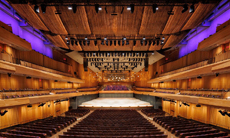
Meyer Sound Becomes Official Sound Partner of David Geffen HallMeyer Sound has installed a TIGRA line array system in David Geffen Hall and now serves as the venue's official sound partner. David Geffen Hall is the first concert hall in the world to order TIGRA. David Geffen Hall is owned and operated by Lincoln Center for the Performing Arts in partnership with the New York Philharmonic. The oldest symphony orchestra in the US, the Philharmonic is resident in the hall and one of 11 arts organizations on Lincoln Center's 16-acre campus. The venue serves as a cultural hub for music, film, dance, opera, and theater from around the world, accommodating orchestral repertoire, choral performances, recitals, semi-staged opera, dance, film premieres, and amplified pop and rock concerts. Among the busiest stages in New York City, it can convert from one presentation to the next in the same day. Renovated in 2022 to serve the New York community and its resident orchestra, David Geffen Hall set out to bring the same standard to its amplified sound. "We had real challenges in reaching a rich amplified audio experience to every seat in the hall," says Darren Robertson, executive vice president and chief operating officer at Lincoln Center for the Performing Arts. New York Philharmonic president and CEO Matias Tarnopolsky and Robertson opened conversations with John and Helen Meyer, and a Lincoln Center delegation traveled to Berkeley, California. The team was already familiar with Meyer Sound, with systems in place at Jazz at Lincoln Center, and the visit began with a demonstration of the LEOPARD line array. Under a black sheet was something the visitors did not know existed: an early prototype cabinet for a line array still in development. TIGRA entered the conversation from that point. "It was about making an upgrade with state of the art technology and showcasing the artistry of these phenomenal musicians for every seat in the hall," says Robertson. Live orchestral performance to film is a major component of the hall's programming, with a large retractable screen influencing sound system design. Arrays have to clear the screen completely, which pushes them high and well off stage. Stacked seating tiers wrap all the way around the room, and the farther out an array hangs, the more each tier blocks the one below it. TIGRA answered several requirements at once. Its output allowed the design team to cover the hall with fewer loudspeakers than the LEOPARD proof of concept had required. The system's resolution at low levels suits an orchestra's dynamic range, where a pianissimo has to carry as clearly as a fortissimo. And its narrow horizontal profile allowed the arrays to move closer to the stage, reaching seats the earlier position could not. Successive test hangs before the permanent installation reduced arrays from 13 loudspeakers per side to 12 and identified seats where lighting fixtures blocked coverage, prompting the addition of ULTRA-X40 loudspeakers to serve those seats. "I literally sat in every seat with a Sharpie and marked every single seat for sight line and for sound line," says Bob McCarthy, director of system design optimization, Meyer Sound. New York integrator Sound Associates installed the system, drawing on three decades of work with the New York Philharmonic and other Lincoln Center organizations. The team designed a custom rigging solution that carries the arrays, tier-fill loudspeakers, and low-frequency control elements. A concert hall is built to let an orchestra be heard at its quietest and its fullest, which is why noise floor sits alongside reverberation time among the benchmarks that define the room. Great halls are distinguished by how they handle that dynamic range, and a sound reinforcement system has to work within it without flattening it. While the New York Philharmonic performs acoustically and without amplification, certain performances and events in David Geffen Hall require sound reinforcement, including spoken-word presentations, film screenings, amplified contemporary works, and pop, rock, and other non-orchestral programming. The new Meyer Sound system provides high-quality sound reinforcement for these and other amplified events presented in the hall. "The one thing that I found with TIGRA is that when you're at extremely low levels and you do have to reinforce something, it'll maintain that sound," says Sound Associates executive vice president Domonic Sack, who has deployed many sound systems at Lincoln Center in the past 30 years. That capability matters for where the repertoire is going. "The new young composers are writing for orchestra and electronics and sounds we haven't heard yet," Sack says. "Now the hall can keep up with them." The Meyer Sound system centers around 24 TIGRA line array loudspeakers in left/right arrays, supported by six 2100-LFC low-frequency control elements along with ULTRA-X40, ULTRA-X22, and ULTRA-X42 point source loudspeakers serving fill and delay positions throughout the tiers and gallery and UP-4slim front fills that sit on the deck and are repositioned as the stage extends. TIGRA is the first Meyer Sound line array to incorporate GEN-1, which moves Galileo GALAXY processing into the loudspeakers themselves. The remaining loudspeakers are processed through Galileo GALAXY Network Platforms. Control and monitoring run through the Nebra software platform. For David Geffen Hall, success is measured row by row. "The goal is to provide an excellent experience and a uniform experience in every seat," says Robertson. "It doesn't matter if you're in the second row of the orchestra or you're in the third row of the third tier; you are deserving of the same experience." "We have supported the arts for as long as we have made loudspeakers, because the institutions that sustain live performance are worth standing behind," says Helen Meyer, executive vice president, Meyer Sound. "This is the kind of work Meyer Sound exists to do, and Lincoln Center and the New York Philharmonic are the kind of partners who make it possible." "Meyer Sound represents the gold standard in sound amplification," says Tarnopolsky. "It is thrilling for us to begin a new era of amplified sound quality in David Geffen Hall with a custom-built new system using the latest technology from Meyer Sound. We look forward to years of beautiful-sounding amplified performances in our hall." 
|