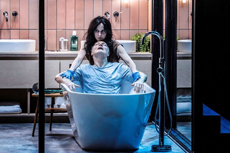
TiMax SoundHub Keeps Pace with The Oresteia's Revolving Glass HouseAlongside the death count and bloodied bodies, the revolving two-storey glass house that formed the set was a prominent feature of the press reviews for Simon Stone's The Oresteia at London's Bridge Theatre. That house was effectively soundproof, and it turned throughout the evening. To keep the actors' voices anchored as their relationship to the auditorium changed, sound designer Peter Rice specified TiMax SoundHub and TiMax TrackerD4. Rice identified the requirement before rehearsals began. "With the rotation of the two-storey house, I knew there'd be a need for some sense of location and vertical imaging, so my first choice to achieve that was TiMax as it allows you to have Z-axis as part of the algorithm." Unusually, the design tagged the rooms rather than the performers. Rice wanted the vocal image to sit still while an actor moved about within a room to allow the audience to more easily register arrival and departure rather than continuous motion. TiMax TrackerD4 tags were fitted to the house structure itself and performers were assigned to room groups, so a voice travelled when the room travelled and held still when the actor walked across it. TiMax SoundHub took its inputs from the console before sending feeds to 121 amplifier channels and around 150 loudspeakers. An LCR configuration of overhead drops was supported by a traditional LR system of four d&b V10 and pair of upstage d&b V10, 15 front fills built into the stage fascia, and foldback in the ceiling of every room, deployed to create a cinematic vocal to achieve the "auditory voyeurism" desired. Originally, Rice planned for the main LCR speakers to sit on the proscenium line, in line with the front fills and the LR system to make time alignment as simple as possible. However, due to the height and position of the house the front corner of each room swept down over the most downstage center point. For this reason, the main LCR PA was pushed forwards and out of line with the rest of the rig and as Rice explained, he was free to place the speakers where the production needed them, "The timing is all automatically managed via TiMax, which took that worry out of the way." SoundHub calculated delay and attenuation across the entire frame from the image definition positions. Rice built five image definitions for the lower house, downstage left, center and right with an upstage pair, then repeated them for the upper house with Z detail added. A third set handled content. Rice and head of sound Ryan Anstey programmed the show with commissioning support from TiMax, including two sessions with TiMax product director, Robin Whittaker and a visit from Whittaker and product and software manager Dan Higgott. "I always knew I wanted to keep it as simple as possible to achieve what we needed for this show," Rice confirms, "Once we set TiMax up, it just worked. We didn't then have to spend any time really adjusting it." The Oresteia's closing sequence saw TiMax make light work of the overlapping dialogue during roughly fifteen minutes of unbroken rotation that carried performers in and out of rooms across both levels. "That was the point TiMax really earned its keep," Rice says. "People are appearing and disappearing in rooms constantly, with overlapping dialogue. Being able to have people and rooms and people in rooms tracked really helped give the audience the information of where the next piece of the story was coming from, when it was happening at pace." Summing up, Rice says, "What TiMax brought was simplicity. It never overcomplicated what we were trying to achieve, and the support we had behind it was wonderful." 
|