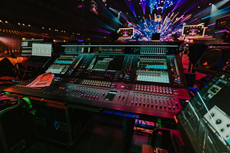
DiGiCO at MIA, Golden K AwardsBelgium's biggest and most important awards ceremonies were held in the ING Arena, a 15,000-capacity venue in Brussels over two consecutive weekends in January 2026. A star-studded line up graced the stage for both shows and one of those artists insisted on a DiGiCo Quantum 852 at front-of-house, thanks to its processing power. Audio for the presenters was covered by a second front of house console, a Quantum 338 and monitoring for the performers was controlled on a Quantum 7. The MIA's are Belgium's largest music awards, while the Golden K Awards are held to recognize the top Belgian Children's entertainment, voted for by children. Peter Philips and Pieter "Pita" Tanghe, were front-of-house engineers for both the MIA's and the Golden K Awards, with seasoned monitor engineer Marcel Cortleven completing the mixing team at the monitor position. The engineers were supplied by MONO, with equipment and project management provided by SPLENDIT, overseen by head of production, Tom Logghe. "The Quantum powered combination was really down to artist insistence. They absolutely wanted it because of the processing," Logghe recalls. "Previous editions of this show were done with the SD Range, but due to the extensive matrices and extra processing, the Quantum 852 and Quantum 338 won the day." Both the MIA's and the Golden K awards present significant challenges, with multiple guest artists in quick succession, all being broadcast to millions via Belgium's national broadcaster VRT, plus multiple online outlets. With presenters speaking from multiple locations on-stage, in the wings and in the audience, guaranteeing intelligibility without unwanted spill was very important. "All DiGiCo systems were connected via an Optocore loop, sharing SD-Racks, including the necessary MADI splits for the broadcast and multitrack recording trucks," Logghe continues. "This was a live production with more than 150 inputs and 142 outputs." Quantum onboard processing was essential to deliver not only the sound expected by stadium filling artists, like Axelle Red, who was awarded the lifetime achievement award and Pommelien Thijs, who won several awards, but also the clean audio feeds required for broadcast. With its low-latency sonic clarity, the Quantum 852 console was more than capable of handling the feeds, plus the speedy change-overs and reliability expected for this high-pressure evening. The presentation mixes were all handled with the Quantum 338 and, as Logghe expands, this was the reason for two separate consoles and engineers. "It really is the only way to do it properly," Logghe says. "Shows like these have lots going on all at once, live in front of the audience but also, in front of millions of people at home either online or watching on TV. At front-of-house, everything was multitracked for virtual soundcheck or post-production control, so timecode and Snapshot integration was a big part of getting everything seamless. The Quantum 852 is a big console with many faders on the surface and with the programming options, it gives you the flexibility you need." "DiGiCo consoles excel in automation through powerful Snapshots and advanced Macros, allowing precise and efficient control during complex productions," Logghe finishes. "Because the video for both shows was driven by CUE Pilot, reliable timecode integration was critical. DiGiCo's robust timecode support ensures perfectly synchronized audio changes with video, lighting, and other show elements. The MIA's is one of the biggest television shows in Belgium so there is no room for error, and that's why we chose DiGiCo." 
|